Is Phoenix Safe?

[ Updated Sept 2018; this year’s Allsate 2018 America’s Best Drivers Report lists Phx rather low (less “safe” than average); not sure if anything has changed in methodology(?). ]

Sept 2015 Update: Each year we’re treated to this recurring tidbit of stupidity via Allstate Insurance press release which always gets picked up and published in the media: Arizona’s urban drivers score well for safety. ‘Well’ for safety?  Unfortunately Arizona remains significantly less-safe (i.e. more dead bodies) than average in US, and far worse than the best state.  Like as much as hundreds of percent worse, depending on which metric is chosen (VMT vs. per capita)
NHTSA state-by-state stats.


Phoenix was reputed to be America’s 7th safest city, according to this survey which looked at three factors relating to insurance. Clearly the stuff of newspaper-filler stories. Intrigued, I see that the survey involves ranking cities in three categories 1) Crime, 2) Natural disasters, and 3) Traffic safety; though it wasn’t clear how they were weighted. For example, traffic fatalities claim far more lives than murder, and the number of deaths in the U.S. due to natural disaster is miniscule.
That being as it may, their source for traffic safety rankings is the “Allstate America’s Best Drivers Report” (tm!), which Allstate claims “Reveals Safest Driving Cities”.

What it actually measures is the statistical likihood of having an auto insurance claim. Which Allstate claims, and I think sounds reasonable, as a proxy for the number of MV collisions. The next leap, which is demonstrably false, is that fewer collisions translates into “safety”. One glaring data point is enough to disprove this: cities of similar size are frequently and for good reasons ranked against one another; it just so happens that Phoenix and Philadelphia have virtually the same population, and are currently the 5th and 6th largest city in the U.S. Actual fatality data reveal that Phoenix is significantly more dangerous than Philadelphia, yet Allstate’s proxy data says just the opposite:

NHTSA Fatality Data Allstate data
City Killed population killed per 100K time between collisions rank (higher=worse)
Philadelphia 95 1547297 6.14 60.2% worse 6.2 years 187
Seattle, WA 30 616,627 4.87 25% worse 8.0 years 147
Phoenix AZ 159 1593659 9.98 1.1% better 10.1 years 74

Source: NHTSA Traffic Safety Facts 2009 (latest year available), Table 124 811402.pdf, and Allstate (follow link above; current year result they refer to as 2011, is similar to 2005-2010 ). Notes: overall U.S. fatals/population/ratePer100K = 33,808/307,007,000/11.01

So, Allstate’s data merely shows that Phoenicians suffer from fewer fender-benders than Philadelphians; but say nothing about safety.

Why is Phoenix so dangerous? The main reason is probably because it’s “Dangerous by design”, with a higher priority on moving more cars, at higher speeds; and a lower priority on getting everyone to their destinations without being killed. More driving could explain some but not all of the gap; this, in itself, a symptom of poor land-use choices.

I threw Seattle into the table simply because of this recent op-ed that aggravated me: why-seattle-is-safer-than-phoenix. Phoenix and Seattle are quite dissimilar in population, but here again the Allstate data claims Seattle is significantly more dangerous than Phoenix when just the opposite that’s true.

2014 Update

Here’s the figures based on Allstate released in Sept 2014. Phoenix is the “best” large city at 9.2 years; and coincidentally Philadelphia is the “worst” large city at 6.2 years.

Auto Insurance Center Fatality Statistics

An outfit called the Auto Insurance Center put out a statistical roundup that looked only at fatal crashes (covering data years 2005-2015) and then normalized each stat to each state by population, and then ranked the states. It’s a FARS data-mining exercise that comes up with sometimes curious stats of dubious value but interesting nonetheless, e.g. “Fatal car crashes caused by road rage were the most prevalent in Indiana (almost 13 fatalities per 100,000 residents)”. Variations like that tend to come from wide variations in reporting, not that there’s a lot more road rage in one state versus another.


By the way

I always have trouble finding this page at www-nrd.nhtsa.dot.gov (which can be found by searching for FARS, then clicking on “publications”) where it lists publications like Traffic Safety Facts; e.g. 2009 Traffic Safety Facts Data Summary Booklet ; and 2009 Traffic Safety Facts FARS/GES Annual Report, they list back to about earlier 1990’s.

NTSB calls for complete cell ban: LaHood backpedals

The NTSB has called for a complete ban on personal electronic communications device usage by drivers on the grounds that any non-emergency usage is unacceptable risky. Here is Deborah A. P. Hersman, NTSB chairman writing in USA Today on 12/15/2011:

Distraction, whether it’s hands-free or handheld, whether it’s texting or talking, is deadly. The National Highway Transportation Safety Administration (NHTSA) said distraction-affected crashes killed 3,092 people last year

Handheld-only bans, such as that proposed in the city of Tucson, are at best not likely to improve safety much; and in fact may have perverse effects. If handsfree become explictly permitted, it may well change behavior of those who formerly chose to abstain entirely, thus increasing risky behavior rather than reducing it.

Fast forward a couple of weeks, in late December “U.S. Transportation Secretary Ray LaHood said he won’t back a proposal to prohibit drivers from talking on cellphones, even hands-free devices, giving a boost to car makers and mobile-phone companies that stand to lose if regulators impose a ban” [wsj]. So there you have it, distracted-driver warrior LaHood won’t back a ban; along with an explanation of presumed pressure from business interests.

At this point, you might be wondering and confused about who-is-who in this Federal alphabet soup: What is the NTSB? This is a both interesting and intricate. One might think that NTSB resides under the DOT, however it turns out that is incorrect: “In 1974, Congress reestablished the NTSB as a completely separate entity, outside the DOT”.  The NTSB is run by a five member board; each nominated by the president for five year terms. Read that as far less politically sensitive, as compared to the Secretary of Transportation.

So Ray LaHood is Obama’s Secretary of Transportation; who runs the U.S. DOT, the United State’s Department of Transportation. And the NHTSA (National Highway Traffic Safety Administration) is the group, under DOT, tasked with highway safety.

…

There is an enjoyably-cycnical view of the subject at LaHood says hands free calls are A-okay; throws NTSB under the bus.

…

Recent DOT blog  fastlane.dot.gov touts enddd.org.

…

Listening to Phoenix’s Bicycle Collision Summary

[Updated Jan 2015: There are more recent summaries posted at  phoenix.gov/streets/safety-topicss; direct links (unfortunately, many of these links now are 404 or link to the wrong report): bike (2010) ; ped(2012) ; all traffic(2012); bike (2013) (see section below for 2013 numbers) also an interesting MV collision rate study spanning 2006-2010.  I did a quick glance at the bike and numbers are very similar to the 2007 which is detailed below… including the tendency of Phoenix PD to mis-characterize collisions at driveways and crosswalks as the fault of the bicyclist ]
[Update 2023: I see a bicycle summary for year 2020 , see below, which was released in 2022; ]

Phoenix, and many other entities issue a report, usually called something like a Bicyclist Collision Summary. For some background, complaints, and links to others, see Understanding Collision Summaries.

At hand, I have the most recent, 2007, report from the City of Phoenix, which can be still be found here ( Local copy in case that link breaks) Continue reading “Listening to Phoenix’s Bicycle Collision Summary”

Mesa traffic cameras to stay 2 more years

Story from AZ republic (via Tucson Citizen site; i don’t see it online otherwise. Also it ran in condensed form as an east valley brief 2/14/2012) Mesa traffic cameras to stay 2 more years.

Story mentions the Sean Casey fatality from 2005 where a junior high school student was killed while walking his bike through a crosswalk with a green light when he got whacked by a motorist who ran a red light. This whole story seems to have been a huge miscarriage of justice. A judge dismissed neg hom charges against the driver. And to add insult to injury, according to news reports the driver did not even pay her fine, or attend traffic school as ordered.

In any event the gist of the story is camera enforcement (among other factors) is credited with reducing crashes, according to Mesa Police commander Bill Peters: “Crashes at intersections now monitored by cameras dropped from 694 in 2005 to 370 in 2010, Peters said.”

Bill would ban cell phone use by novice teen drivers

(this article relates to bills introduced in the 50th Second Regular Session of the Arizona Legislature, spring of 2012)

Here’s a news item that has a pretty good rundown on SB1056, introduced by John McComish (R-20, which happens to be my district).

As I mentioned a few weeks ago, the NTSB has called for a total ban on use of portable electronic communications by drivers — thats text, talk, handsfree or not — the whole shootin’ match.

This bill is a total ban; but targets only permitees and new drivers under 18 (but only for six months); which seems like a pretty logical place to start. The youngest drivers don’t have the experience and also tend not to understand the consequences of their actions that only comes with maturity and experience. When questioned about difficulty of enforcement, McComish pointed out that it is a secondary offense, like seat-belt laws, and that it will give parents a useful tool.

In case you’re wondering how this affects bicycle riders; it doesn’t. The licensing statutes are in Chapter 8, and bicyclists are only bound to follow Chapter 3, 4, and 5, see 28-812.

The hearing in front of the senate Public Safety and Human Services committee 1/18/2012 (direct link, does that work?) was very good; it’s near the end, and is about 10 minutes. This bill is something of a follow-on to some graduated driver’s license restrictions (the Teen Driver Safety Act, enacted in 2007.  Bill number?). Stuart Goodman spoke in favor on behalf of AAA; i would like to quote him, and i might be in the minutes(?) but in sortof paraphrase he said that according to CDC the number one cause of death for teens is traffic collisions; that the graduated license restrictions were good/helpful and there is evidence that as from 198?-2007 as alcohol-involved teen deaths have decreased,  the overall rate of teen fatalities has remained largely unchanged… and that is largely attributed to an increase in distracted driving as becoming the primary culprit. He then rattled off a bunch of age-related stats that seemd to indicate teen deaths are way down (due presumably to graduated license restrictions, like nighttime driving, and limiting the number of passengers for novice drivers). It passed unanimously out of committee. Also of note, Representative Vic Williams (R-26) , chair of House Transportation Committee, is a co-sponsor indicating if the bill makes it to the House, it would probably have an easy time getting through committee.

Here are the new sections, as introduced:

28-3154

C. A PERMITTEE SHALL NOT DRIVE A MOTOR VEHICLE WHILE USING A WIRELESS COMMUNICATION DEVICE FOR ANY REASON EXCEPT DURING AN EMERGENCY IN WHICH STOPPING THE MOTOR VEHICLE IS IMPOSSIBLE OR WILL CREATE AN ADDITIONAL EMERGENCY OR SAFETY HAZARD. A PEACE OFFICER SHALL NOT STOP OR ISSUE A CITATION TO A PERSON OPERATING A MOTOR VEHICLE ON A HIGHWAY IN THIS STATE FOR A VIOLATION OF THIS SUBSECTION UNLESS THE PEACE OFFICER HAS REASONABLE CAUSE TO BELIEVE THERE IS ANOTHER ALLEGED VIOLATION OF A MOTOR VEHICLE LAW OF THIS STATE.

28-3174

F. EXCEPT AS PROVIDED IN SUBSECTION K OF THIS SECTION, FOR THE FIRST SIX MONTHS THAT A CLASS G LICENSEE HOLDS THE LICENSE, THE LICENSEE SHALL NOT DRIVE A MOTOR VEHICLE WHILE USING A WIRELESS COMMUNICATION DEVICE FOR ANY REASON EXCEPT DURING AN EMERGENCY IN WHICH STOPPING THE MOTOR VEHICLE IS IMPOSSIBLE OR WILL CREATE AN ADDITIONAL EMERGENCY OR SAFETY HAZARD.

…

There’s also a recurring generic texting ban bill that has once again been introduced by Steve Farley (D-28), HB2321 texting while driving; prohibition. I’m not sure if it is significant or not, but it’s worth mentioning that this go-round, Vic Williams (R-26) , chair of House Transportation Committee, is a co-sponsor.

Why Seattle is safer than Phoenix

An op-ed written by one of the wsj editorial board staffers illustrates a certain strain of belief in have-your-cake-and-eat-too-sism. Kaminski, in decrying how the mayor Mike McGinn (whom he gleefully points out is referred to as mayor McSchwinn by his political foes. Get it? it rhymes with McGinn) of Seattle worked to block the building of some car-based project; later claims that “Seattleites say they want to save the planet from global warming, but in their personal lives they want safe streets…”.

The disconnect Kaminski, and others of his ideological ilk, is this; that somehow streets can be made safer by ever-expanding the number and speed of privately operated motor vehicles. But this is simply not possible. Faster and more always equals more dead; mostly more motorists, but also more dead peds, and more dead bicyclists. The numbers are stark; comparing e.g. Phoenix with Seattle (metro areas), the Dangerous by Design survey estimates Phoenix to be FOUR TIMES more deadly to pedestrians than Seattle. The number spills over not just in pedestrian deaths, but also cyclists deaths, and also to MOTORISTS deaths; see e.g. Beyond Safety in Numbers: why bike friendly cities are safer (for everybody).

Thus Kaminski rejects car-user-fees as hair-brained; yet motorists are the source of enormous externalities — economic impacts that aren’t paid for by their users — from air pollution (never mind ‘global warming’), to mayhem, to free parking.

By the way, McGinn has only been mayor for the past two years; I’m not suggesting that McGinn has made it safer. It was already safe, relatively speaking — due in no small part to its general overall “anti-car” culture.

Addendum

Seattle DOT (SDOT) puts out a fancy traffic safety report (every year, i imagine), e.g. here is  2011. Note the “speed studies”, p 7-7… their major streets are posted speed limits of mostly 35, with a few at 30, and one at 45. The 85th percentile speeds were running in the high 30’s.


Three Foot Passing Laws

[Updating this is cumbersome and I am probably missing some… This page at ncsl.org says it’s updated to the end of 2015]

As of the 2015 legislative season, by my count, 22 US states have added three-or-more-foot passing provisions (not counting NY, Missouri or SC, which both relatively recently added “safe passing” laws without specifying a distance):

YEAR
ENACTED
STATE
2018 Michigan news item. amends section 257.636
2015 South Dakota HB 1030 minimum 3/6 foot.
2013 California AB 1371
2012 Pennsylvania HB 170 3303(3) FOUR foot passing
2011? Delaware see below
2011 Kansas HB2192 K.S.A. 8-1516
2011 Georgia
2011 Nevada SB248 NRS 484B.270; 3-feet AND must change lanes on multi-lane
2010 New York* A10697 S 1122-A (right section, wrong bill?)
2010 Mississippi info
2010 Maryland SB51. code 21-1209. has bad features
2009 Louisiana
2009 Colorado  info
2008 South Carolina *
2008 Connecticut
2008 New Hampshire
2007 Tennessee info
2007 Maine info
2007 Illinois info
2007 Arkansas info
2006 Florida
2006 Oklahoma
2005 Utah
2005 Missouri *
2004 Minnesota
2000 Arizona HB2625 44th/1st Regular. ARS 28-735
1973 Wisconsin

*NY, SC and MO: requires “safe operating” — not specific distance. I also need to look up NC; i seem to remember they have a 2-foot specification for passing. Continue reading “Three Foot Passing Laws”

FARS and PBcat

Commencing with the recently-released 2010 data FARS (The USDOT’s Fatality Analysis and Reporting System) will have far more specialized detail on Pedestrian and Bicyclists crashes.

“Motorist Failure to Yield — signed intersection” One of several dozen crash types defined by PBCAT

618 cyclists (person type 6 bicyclist, and 7 other pedalcyclist) were killed in 2010 in traffic collisions — and as noted at the link above, only collisions with motor vehicles in-transport are tracked by FARS. So for example, a bicyclist who lost control and died as a result of crashing into a tree would not be tracked here, nor would a bicyclist who strikes a parked motor vehicle. Continue reading “FARS and PBcat”

48th Street; Piedmont to Guadalupe gets SLMs (sharrows)

I have a lot of thoughts about this stretch of roadway in Phoenix: 48th Street (turns into Guadalupe Rd), north of Piedmont. [google maps]
It involves the odd geographic position of the Ahwatukee area of Phoenix; and the the almost complete lack of connectivity for Ahwatukee residents to anywhere else, (Tempe, Chandler, and indeed the main portion of Phoenix) except by car-choked umteen lane roads.

Ahwatukee is called — sometimes derisively, sometimes happily — the world’s largest cul-de-sac. Setting aside 48th street for a moment; Ahwatukee’s ONLY ingress/egress is Pecos Rd (which is loop 202, a limited-access highway), Chandler Blvd (10 lanes?), Ray Road (10 lanes), Warner Road (only 6 lanes?), Elliot Road (10 lanes?). So these are all either a limited-access freeway, or humongous monstrosities that have interchanges with I-10.

In short, these are all car-choked, car-sewers. They are not particularly bad for cyclists; two (Ray, and Chandler) have wide-curb lanes; Warner has nice narrow lanes;  I find Elliot road to be most annoying as it is “critical width“; that is to say not wide yet not narrow enough to be perceived as too narrow to share by many motorists. Yet many cyclists, understandably, don’t want to do it. It is a thoroughly obnoxious experience for pedestrians, too. Continue reading “48th Street; Piedmont to Guadalupe gets SLMs (sharrows)”

Bicyclist stop sign law changes re-introduced

50th 2nd regular session (2012) HB2221. This is (i think) an exact copy of the bill from last year; which was a tweak to the original try in 2009.

HEARING SCHEDULED 1/26/2012 at 9AM by the House Transportation committee. All video is archived, in case you miss it live, you can also view the 3/4/2009 hearing at the archive — it’s kind of interesting.

BILL PASSES out of the Transportation Committee 1/26/2012, on an 8-2 vote. It was passed “DP” (do pass. i.e. passed without any amendment). If you didn’t see it live, you can catch it on archived, but it looks like there is a day or two delay… (bill ultimately dies). Continue reading “Bicyclist stop sign law changes re-introduced”

Bad Drivers and friendsofcalholman.com

Looking North
Looking North

(motorist) Cal Holman was killed in a horrific traffic collision in 2007 involving very high speeds and alleged street racing. Going on 5 years later a lot has and continues to happen, the two other drivers, Van Brakel and Aronica, have eventually plead guilty to certain crimes, Van Brakel going to prison for manslaughter. Aronica received probation, and subsequently  requested it be reduced, but that apparently was denied.

The site friendsofcalholman.com is doing, and has done an excellent job of making court documents available; such as the plea agreements. Van Brakel’s 5 year sentence was reduced to below 3 years actual  both by the 1 day for every 7 served (that’s normal; it where the “85%” figure comes from); but also apparently because of  “over 2 years credit because he was out on bail while the criminal hearings were going on“. How does that work? Being out on bail somehow counts as the same as being incarcerated? [see suggestion in comment below that this may have been erroneously calculated] This is criminal case CR2008-031157  (minutes) (which i could only find by searching Maricopa County Superior directly) — and here is Van Brakel’s (who is Party 001) 9/16/2011 sentencing minute “5 year(s) from 09/16/2011; Presentence Incarceration Credit: 487 day(s); Presumptive”. Note that this is “non-dangerous” manslaughter — sick joke. p.s. the way sentencing math works apparently is: 85% (assuming he got the most time off) of 5 years is 1551 days minus the 487 leaves 1064 (just under 3 years).

Van Brakel’s pre-sentence credit of 487 days was due to him being incarcerated immediately (i guess) after his initial sentencing in 2010.

Here is Aronica’s 5/18/2010 sentencing minute of probation; pleading guilty to two counts of endangerment which is, like Van Brakel’s manslaughter, designated as a “non-dangerous” crime.

On a larger scope, they have exposed these two men’s driving history; again something we rarely get to see. According to friendsofcalholman the two,

Van Brakel was driving an AMG Mercedes, after hitting Cal Holman his car continued 75 feet past the intersection. Van Brakel hit first on the passenger side. He did not sustain any injuries in the crash…  Since 2004 there have been 7 tickets for various moving violations. Driving 55 in a 35 zone, 67 in a 40 zone, and failing to yield in a cross walk are a sample of his driving record… Van Brakel has several previous driving violations. One ticket in 2004, was for doing 120 miles per hour in a 75 miles per hour zone. [link]

and the other:

Aronica’s Mustang flipped on impact and landed in the ditch on the side of Scottsdale … Aronica was injured with a broken arm and his passenger had minor cuts…. Since 2002 Aronica has had 13 citations. On December 3rd, less than four weeks prior to the accident where he hit and killed Cal Holman, he was cited for doing 88 miles per hour in a 60 miles per hour zone. This was in Texas while he was traveling to Arizona… Other citations include speeding. In Virginia speeding 84 in a 65 zone, in Florida traveling 20-29 miles per hour over the posted speed, again in Virginia speeding 79 in a 65 zone, in Maryland he had four speeding violations, and in Michigan he has 3 violations for speeding including a careless driving and a 78 in a 55 zone. [link]

This really makes me wonder how such repeated dangerous driving behavior can be tolerated — why weren’t their licenses suspended or revoked before they killed somebody? Traffic collisions, even after a marked decline, continue to be a leading cause of death for Americans. Who’s minding the store?

Do drivers stop at stop signs?

I thought this was completely non-controversial. We all know that a full stop is required (for bicyclists, too, by the way) by law, always,  and that there is no wiggle room. Do drivers slow down? Yes, often. Do they make a full stop? Rarely.

Or rather, it completely depends on traffic — if there is conflicting traffic they do (usually) stop; otherwise RARELY. Here is a brief clip where 1 driver stopped (well, almost, but I’ll give it to him) to yield to cross-traffic, and then the next SIX rolled through without stopping:

If that’s too short for you, here is a longer clip that I didn’t even bother to count — the story is exactly the same; DRIVERS RARELY STOP AT STOP SIGNS. Continue reading “Do drivers stop at stop signs?”

Camelback Road Diet and Buffered Bike Lane

Here are some city documents:

The Diet

The diet part of the plan seems like a slam dunk… Normally any road diet is opposed becasue of fears that the lane removal will increase automobile congestion. In this particular case, that isn’t possible because of the unusual circumatance that this 1-mile stretch of 3 through lanes in each direction, is bounded on both ends by 2 through lanes. I.e. both north of Bethany Home Road, and south of Camelback Road is already only two lanes.

The Buffered Bike Lane

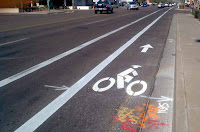
The “problem” then became what to do with “extra” space? A generously wide bike lane, including gutter is only 6′ wide, and the diet meant that 12′ of space had to be filled (in both directions). The answer came in the form of placing a 6′ buffer between the bike lane and the rightmost traffic lane. A.k.a a Buffered Bike Lane, see e.g. nacto.org.

I am somewhat skeptical of placing space between cyclists and overtaking vehicles. While this is presented as an un-alloyed good thing by many facilities advocates, it clearly has safety drawbacks which usually go unmentioned. here is a more balanced view, as presented in the Feb 2010 (the latest) Draft AASHTO Guide, p.78 (my emphasis):

Striped buffers may be used to provide increased separation between a bike lane and another adjacent lane that may present conflicts, such as a parking lane with high‐turnover or a higher speed travel lane. The benefits of additional lateral separation should be weighed against the disadvantages; a buffer between the bike lane and the adjacent motor vehicle travel lanes places cyclists further from the normal sight lines of motorists, who are primarily looking for vehicles in the normal travel lanes, and buffers between the travel lane and bike lane reduce the natural “sweeping” effect of passing motor vehicles, potentially requiring more frequent maintenance.

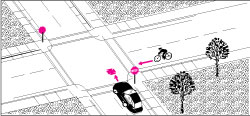
 That all being said, I objected to the original design which called for the outer buffer stripe to gradually arc into the intersection. This seemed to me to be a recipe for extra right-hooks. City staff readily agreed to my and Gene’s suggestion to end the buffer ahead of each intersection, and then a bit of dashed line; which is incidentally, as shown in the NACTO guide as recommended. (so thanks to Kerry Wilcoxon, and Joe Perez).

This should make the buffer “not bad” at intersections, yet doesn’t do anything for the many driveways. In other words, it should be no worse than a standard bike lane at intersections, but I fear it will raise risks at driveways relative to bike lane. So anyway, I’m reserving my judgement on the whole buffered bike lane thing. The hope is that it will encourage/entice cyclists off the sidewalks, where most collisions occur. However that doesn’t help those of us who are already legally using the roadway, and in fact may well be putting us in more danger.

The re-striping

The striping project apparently happened on schedule 4AM Saturday morning 1/7/2012, there are some pics on P4’s Facebook page (f.b. login required to view). TBAG has listed a ride to visit the new work on 1/8/2010.