The deluge of new rules continues… Now it’s Maricopa County. To step back for a moment, keep in mind there are NINETY TWO cities and towns in Arizona, in addition to THIRTEEN counties; each and every one of these jurisdictions has the authority to further regulate e-bikes (and bicycles, too!). Most recently we covered what was done in Queen Creek, which did have some bad stuff in it.
So the latest is Maricopa County: specifically only areas that are unincorporated, but excluding federal jurisdiction, and also excluding Maricopa County Parks (see park rules in the comment below; thx Reed!). Both of which have THEIR OWN set of rules.
The Bad
Overall the new Ordinance is very reasonable and minimally restrictive. I do want to mention one bad feature that is getting copied (e.g. it is in Tempe’s ebike code, and was also in earlier proposed statewide legislation)…
A person shall not operate an electric bicycle, electric miniature scooter, or electric standup scooter at a speed greater than 5 miles per hour when passing a pedestrian or horse.
It’s unclear the way the clause is written where it applies, presumably it refers only to sidewalks or share use paths, but it’s still sloppy drafting. Anyway, the problem is, and I’ll repeat here from previous articles on the subject:
… many joggers/runners move at 5 to 10mph. It would be legally impossible to pass such people, a law-abiding bicyclist would need to just follow behind them indefinitely.
It’s also quite difficult to ride that slowly; it’s easy to lose balance and fall.
And I’ll admit I haven’t thought-through how horses fit in.
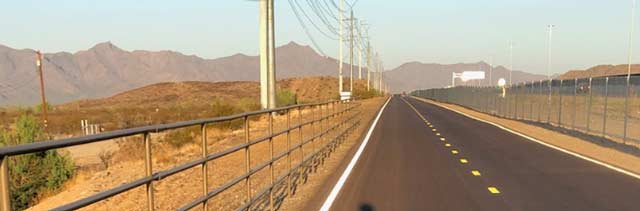
I also think the 15mph limit on paths is a bad one-size-fits-all rule, some paths are quite wide and 15mph limit is unreasonably restrictive and unnecessary for safety. For example, the South Mountain Shared Use Path is twenty feet wide. The width of a two-lane road!
The Good
It’s almost all good:
-
-
- It regulates only e-bikes (and e-scooters); bicyclists are not involved.
- It does not alter the rules-of-the-road in any way.[1] In the roadway, e-bicyclists (and e-scooterists) are the same as bicyclists, they are the “driver of a vehicle”, and there’s already a full set of laws in that regard.
-
The reasonable:
-
-
- e-scooter rules work like class 1/2 e-bike.
- No age limit for class 1/2
- Min age 16 for class 3
- Class 3 under 18 requires helmet
- Class 3 banned from sidewalk (but not shared paths)
- sidewalk speed limit of 15mph
(as mentioned above, I think the limit for paths shouldn’t also be 15, depending on conditions). - no wheelies 🙂
-
As mentioned above, County Parks aren’t covered — if anybody has a handy link to those rules please leave it in the comments.
Are there any County shared use paths?… and that aren’t in Parks? (I don’t know of any but I rarely go outside of incorporated areas)
Some info about e-bikes on Federal use is here (with reference to SRP canal paths)
Bonus: City of Buckeye
I don’t have the energy to actually look up the ordinances, but according to the graphic it seems ok:
New e-bike, e-scooter regulation goes into effect this weekend in Buckeye
City’s webpage.
Footnotes
[1] This clause worried me a little, my emphasis on the word ‘may’ added: “If there is no bike lane or sidewalk, the operator of an electric bicycle, electric miniature scooter, and electric standup scooter MAY ride adjacent to the roadway at a speed no greater than the posted speed limit for vehicles”. I guess this is okay, it doesn’t say ‘shall’ or ‘must’. It’s not a back-door get-out-of-the-road law.
References
Press release, Maricopa County Approves E-Bike Ordinance Governing Unincorporated Areas.
Maricopa County Ordinance P-38.
You may be interested in language the Ohio Bicycle Federation succeeded in adding to the Ohio Revised Code in 2006. (I was heavily involved, working with a cycling lawyer who was also an OBF board member.)
https://codes.ohio.gov/ohio-revised-code/section-4511.07
4511.07. Local traffic regulations.
(A) Sections 4511.01 to 4511.78, 4511.99, and 4513.01 to 4513.37 of the Revised
Code do not prevent local authorities from carrying out the following activities
with respect to streets and highways under their jurisdiction and within the
reasonable exercise of the police power:
…
(8) Regulating the operation of bicycles; provided that no such regulation
shall be fundamentally inconsistent with the uniform rules of the road
prescribed by this chapter and that no such regulation shall prohibit the use of
bicycles on any public street or highway except as provided in section 4511.051
[4511.05.1] of the Revised Code;
[Note: 4511.051 prohibits operation of bicycles on freeways. We failed to convince the legislature to drop or limit this provision.]
“Sloppy Drafting” is an understatement.
Typical
I think the distinction between different types of electric vehicles is especially important when creating local regulations. E-bikes and electric scooters can serve very different purposes, and their speed, design, and intended riding environments should all be considered. I also agree that speed limits should take actual trail conditions into account, including path width, visibility, and pedestrian traffic. A balanced approach that prioritizes safety without unnecessarily restricting responsible riders is the best way forward.
Here are the e-bike rules in Maricopa County regional parks.
Q: Can I ride an e-bike in a Maricopa County regional park?
A:
E-Bike Policy (Effective January 1, 2019)
The Maricopa County Parks and Recreation Department follows Arizona Revised Statute (ARS) 28-819 regarding electric bicycles (e-bikes). General Provisions
E-bike operators have the same rights and responsibilities as traditional bicyclists
E-bikes are not subject to registration, licensing, or insurance requirements
Manufacturers must include a permanent label indicating classification, top assisted speed, and motor wattage
Trail Use
Class 1 and Class 2 e-bikes are allowed on bicycle and multi-use trails, unless otherwise restricted by park management
Definitions:
Class 1: Pedal-assist only; assistance stops at 20 mph
Class 2: Motor-powered (no pedaling required); assistance stops at 20 mph
Roadway & Restricted Use
Class 3 e-bikes are not allowed on multi-use or bike paths unless the path is adjacent to a roadway or specifically permitted by park management
Definition: Class 3: Pedal-assist only; assistance stops at 28 mph