Cycle Tracks are NINE TIMES safer than roads?

There was a glowing article in theatlanticcities.com with the tantalyzying headline Dedicated Bike Lanes Can Cut Cycling Injuries in Half,  referring to this study, published in a peer-reviewed, albeit public health and not a transportation, journal:

Route Infrastructure and the Risk of Injuries to Bicyclists: A Case-Crossover Study Kay Teschke, PhD et al.  Am J Public Health. 2012;102:2336–2343. doi:10.2105/AJPH.2012.300762  [pdf]

The design of the study is intriguing: it’s based on randomly choosing a “control site” along the participant’s (i.e. the crash victim) route.

Cycle Tracks are NINE TIMES safer?

Undoubtedly, the incredibly safety differential of “cycle tracks” will be the main take-away. The study found them to be NINE TIMES safer compared to their reference street (essentially a “worst case”: a mulitlaned arterial with on-street parking and no bicycle facilities whatsoever). The actual result is OR 0.11 (0.02, 0.54) — that is to say Odds Ratio of about 9 times safer, compared to the reference road.

Ok, so I don’t understand a lot about statistics, but the wide range between the lower and upper confidence interval (27X) is a clue. In short there is not very much/many cycle tracks in the study, mentioned only as “despite their (cycle track’s) low prevalence in Toronto and Vancouver”. There were two reported collisions, and 10 control sites on cycle tracks (out of N=648). In the critique of the study by John Forester he found during the study period there was apparently only one cycle track, the Burrard Street bridge, in both cities — my that is a “low prevalence” — here is his take-away:

In the much more impressive cycle-track issue, the authors proclaimed enormous crash reduction without informing the readers of the two relevant facts. First, that their data came from only one installation. Second, that that installation was not along a typical city street but in the only situation in which a plain cycle track could possibly be safe, a place without crossing or turning movements by motorists, cyclists, or pedestrians…

And even regarding the Burrard Street Bridge cycle-track, the timeline seems to conflict/overlap somewhat with the study dates. According to a surprisingly detailed account on wiki a test of what sounds to be the cycle-track was “to begin in June 2009. The proposed trial began on July 13. It saw the southbound motor-vehicle curb lane and the northbound-side sidewalk allocated to bicycles, with the southbound-side sidewalk allocated to pedestrians. The reassigned lane was separated from motor vehicles by a physical barrier” The timeline of the study was for bicyclist injuries presenting to the ERs “between May 18, 2008 and November 30, 2009″.

But wait? According to this (from mid-2011, i think, the date is unclear), Tesche said there are other cycle tracks:  “However, we were able to examine separated bike lanes elsewhere in the city, including Burrard Bridge, Carrall Street, and other locations that met our definition: that is, a paved path alongside city streets that’s separated from traffic by a physical barrier,” Teschke told councillors.

Some Other Things i Noticed

The highest median observed motor vehicle speed along major roads was 44kph (27mph)! This is comically low compared to what I am used to here in Phoenix. Interesting trivia answer: 27.79mph —  the fastest time on record for a person running.

One-third of the incidents involved collisions with MVs. The balance were various types of falls or collisions with objects. The one-third number is pretty close to the 26% reported by another ER-based survey of bicyclist injuries (  Injuries to Pedestrians and Bicyclists: An Analysis Based on Hospital Emergency Department Data.  linked here ); though this isn’t directly comparable, e.g. in the former case, mountain biking was not eligible for the the study, whereas in the latter it was any sort of injury incurred on a bike.

There was a bunch of interesting data collected in the survey (which the author’s are nice enough to give a link to) that are not in the final study. I’m not sure why. I would have been interested to see various spins on lightness/darkness vs. cyclist’s light usage.

The Injury Prevention Article

and here’s another similar article, or perhaps pretty much the same(?):

Comparing the effects of infrastructure on bicycling injury at intersections and non-intersections using a case–crossover design Inj Prev doi:10.1136/ip.2010.028696 M Anne Harris, Conor C O Reynolds, Meghan Winters, Peter A Cripton, Hui Shen, Mary L Chipman, Michael D Cusimano. Shelina Babul, Jeffrey R Brubacher, Steven M Friedman, Garth Hunte, Melody Monro, Lee Vernich, Kay Teschke


NYC Protected Bike Lanes on 8th and 9th Avenue in Manhatten

According to a report (it’s really a brochure) by NYC DOT cited by  americabikes.org; these are the “First protected bicycle lane in the US: 8th and 9th Avenues (Manhattan)”…”35% decrease in injuries to all street users (8th Ave) 58% decrease in injuries to all street users (9th Ave) Up to 49% increase in retail sales (Locally-based businesses on 9th Ave from 23rd to 31st Sts., compared to 3% borough-wide)”. I don’t know if or what the data are to back up these claims. I also don’t know much about how these are structured, what was done with signals, how long these are,  or how long they have been in place… here is a google street view at 9th/23rd. (these segments show up in Lusk’s May 2013 AJPH article, discussed below)

Study of Montreal Cycle Tracks

Likewise, Harvard researcher Anne Lusk, et. al (includes Peter Furth, Walter Willett among others) has claims of safety increases  Risk of injury for bicycling on cycle tracks versus in the street, brief report Injury Prevention. Streetsblog.org is expectedly uncritical, but a through rebuttal by mathemetician M Kary can be found hosted on John Allen’s site(older, 2012), and more recently (Jan2014) including links to Kary’s two original unedited letters, as well as the published commentary in Inj Prev. , which includes a rebuttal from the authors. There is some other rebuttal from Ian Cooper, in a comment below.

Methodology aside, though the study claims an increase in safety, it found only a modest increase: “RR [relative risk] of injury on cycle tracks was 0.72 (95% CI 0.60 to 0.85) compared with bicycling in reference streets”. I.e. a 28% reduction in crashes.

They had an interesting reference to Wachtel and Lewiston 1994, a much-cited sidewalk study.

More Lusk, July 2013 Article in AJPH

Oh, it’s like it never ends:

Bicycle Guidelines and Crash Rates on Cycle Tracks in the United States
Anne C. Lusk, PhD, Patrick Morency, MD, PhD, Luis F. Miranda-Moreno, PhD, Walter C. Willett, MD,  DrPH, and Jack T. Dennerlein, PhD Published online ahead of print May 16, 2013; it was in the July printed edition of American Journal of Public Health. “For the 19 US cycle tracks we examined, the overall crash rate was 2.3 … per 1 million bicycle kilometers… Our results show that the risk of bicycle–vehicle crashes is lower on US cycle tracks than published crashes rates on roadways”. What are published rates? Later they say “published crash rates per million bicycle kilometers range
from 3.75 to 54 in the United States”. The first number is footnoted to Pucher/Irresistible (which is discussed and linked here), and the second to, if you can believe it, a study of Boston bicycle messengers (Dennerlein, 2002. I haven’t bothered to look that one up). In Pucher, it’s in Fig 10  where they quote US injuries at 37.5 per 10 million km for the period 2004-2005, sourced to US Department of Transportation (2007), which is/are Traffic Safety Fact Sheets according to the footnotes. Pucher does, um, mention that injury rates comparisons across countries are particularly suspect; Figure 10 would lead on to believe the UK and US have similar fatality rates, whereas US injury rates are quoted as SEVEN TIMES higher. (Pucher’s claim/point is that NL and DK are very safe, while US and UK are very dangerous). In any event TSF does not list injury rates per unit of travel, only number of injuries, e.g. TSF 2005 quotes 45,000 injuries (these are presumably some sort of statistical estimate?).  To get the rate estimates, he uses one of the surveys (household trans survey?).

Paul Schimek gathered data on the 19 cycletracks listed in table 3; he added another column “intersections per km” and sorted them into two groups, 1) Urban Side Paths and 2) Side Paths with Minimal Crossflow. And as would be predicted by traffic engineering principles, the former had very high (7.02) versus the latter which had very low (0.57) crashes per 1 Million bicycle kilometers. The published letter-the-editor of AJPH is available in full on pubmed (or draft version on google docs) which is well worth reading. He, by the way, provides an estimate for whole US bike crashes at 3.5 per 1M bike km’s; which fits rather nicely between the high/low cycletrack numbers. The bottom line is that the AASHTO guidelines (which prohibit the on-street barriers; but permit bicycle paths adjacent to the roadway where there is “minimal cross flow by motor vehicles”) , contrary to Lusk’s assertions, are well-founded. This blog post at  bicycledriving.org also discusses the same AJPH article, with links to both Schimek’s published letter, and Lusk’s published response. This is wrapped up in an article the Paul wrote A Review of the Evidence on Cycle Track Safety, Paul was kind enough to send me draft copy dated October 10, 2014.

Oh, and here is John Forester’s review of Lusk’s May AJPH article. In summary, Forester says “This review does not evaluate Lusk’s method of calculating car-bike collision rates. However, the cycle tracks with high collision rates are all in high-traffic areas with high volumes of crossing and turning traffic, while the cycle tracks with low collision rates are all in areas with low volumes of turning and crossing traffic. That is what should be expected, but it says nothing about any reduction in collisions that might have been caused by the introduction of cycle tracks. The data of this study provide no evidence that cycle tracks reduce car bike collisions”.

What about Davis, CA?

Late-1960s parking-protected cycletrack, Davis, California
Sycamore Lane Experiment:1967 parking-protected cycletrack, Davis, California (Photo: Bob Sommer)

The article/thesis paper Fifty Years of Bicycle Policy in Davis, CA 2007
Theodore J. Buehler has a deep history. Davis, home of course to UC Davis, installed and compared designs including what we would now call a cycle track in the late 1960’s as “experimental” designs, (emphasis added):


Lane location relative to motorized traffic
The early experiments included three different types of bike facilities (see examples at the top of this section):

  1. bike lanes between car lanes and the parking lane (Third St.),
  2.  bike lanes between the parking lane and the curb (Sycamore Lane), [what we now call a cycle track, or protected bike lane] and
  3. bike paths adjacent to the street, between the curb and the sidewalk (Villanova Ave.).

… The on-road lanes worked best, the behind-parking lanes were the worst, and the adjacent paths were found to work in certain circumstances.

Perhaps telling, perhaps not, I have archived the .pdf referenced above as I can no longer find it on the bikedavis.us website. There is a similar version of Buehler’s paper that was published through TRB with the same title (but with a co-author, Susan Handy); its conclusions are worded somewhat differently; instead of best and worst, they just say “Eventually all lanes were converted to the now familiar configuration of the bike
lane between the moving cars and parked cars” without saying why.

Notations from the City of Davis website says (retrieved 1/19/2017. Emphasis added):

Sycamore Lane Experiment: This 1967 bike lane used concrete bumpers to separate parked cars from the bike only lane. The parked cars screened the visibility of bicyclists coming into intersections and cars would unknowingly drive into the bike lane. This bike lane design was eventually abandoned.
The 1967 separated bike lanes on Sycamore Lane didn’t prevent conflicts with turning vehicles. Today at this intersection there are special bike-only traffic signals that provide cyclists their own crossing phase. These innovative bicycle signals were the first of their kind to be installed in the United States.

Other Critiques

Ian Brett Cooper offers this critiques of a number of papers involving  segregated infrastructure, e.g.:

2012 Teschke: Route Infrastructure and the Risk of Injuries to Bicyclists: A Case-Crossover Study
Selection bias: uses comparison streets instead of a before-after situation; study claims greatly increased safety on cycle tracks, but the cycle tracks chosen for the study were not representative of a typical cycle track, in that all were on roads with limited or nonexistent road intersections. It is not surprising that bicycle facilities that have little or no possibility of interaction with motor vehicles are safer than those that have many such possibilities, and if all bicycle tracks were completely separated from turning and crossing traffic, they would indeed be safer than cycling on the road. The problem is, cycle tracks with few road intersections are very rare indeed.

2011 Lusk: Risk of Injury for Bicycling on Cycle Tracks Versus in the Street (Montreal, Canada)
The infamous Lusk study. Selection bias: study claims increased safety on bicycle specific infrastructure, but its street comparisons are flawed – the streets compared were in no way similar other than their general geographic location. Busy downtown streets with multiple distractions per block were twinned with bicycle tracks on quieter roads with fewer intersections and fewer distractions..


.

IIHS (2019) (#IIHS)

Some protected bike lanes leave cyclists vulnerable to injury

and the study page, more fully titled;

Not all protected bike lanes are the same: infrastructure and risk of cyclist collisions and falls leading to emergency department visits in three U.S. cities

Since Washington D.C. was a primary study site, and the home of a significant amount of separated bikelanes/cycletracks, The WashPo ran a news item on the study under the title D.C.’s oldest and most popular protected bike lane has ‘highest injury risk,’ study says, two-way cycletracks being unsurprisingly the most problematic.

As you might imagine, it’s generated quite a stir on certain discussion groups;, some thoughtful comments here:
 Highlights (part 1):
* Same “case-crossover” method as Teschke et al. Bicycling in Cities Study, which is the only reliable one yet used with N. American data.
* Unlike that study, there were actually PBLs installed in the cities where data was collected.
* They found NO safety benefit for one-way PBLs and a significant indication of higher risk with two-way PBLs.
* They reproduced the Teschke finding of higher risk for going downhill and VERY high risk due to streetcar tracks (all in Portland, OR).
Highlights, part 2:
* Only 40% of bicyclist injuries were due to moving motor vehicles (data are from emergency department visits).
* 12% of injuries were due to non-moving motor vehicles. These include dooring, but it is not presented separately. The figure rises to 20% of injuries on “major-roads.” They do not separate roads with and without on-street parking.
* Ordinary bike lanes appear to reduce risk BUT the presence or lack of on-street parking may be a confounding factor. The risk reduction is only AWAY from intersections. At intersections there was a 4-fold increase in risk (but not enough data to be statistically significant).
* Further, there was no evidence that bike lanes reduce the risk of collision with moving motor vehicles (see Table 6).
* There were only 18 injuries on one-way PBLs, which was not enough to determine how they affect risk EXCEPT that there was enough to say that they increase the risk of bike-ped injuries.
* Even with only 21 injuries on two-way PBLs, there was enough evidence to show that they increase risk by an order of magnitude, specifically collisions with bicyclists and pedestrians (Table 6).
The study is yet more evidence that looking at motor vehicle crash statistics (which ignore incidents not involving mvs) will not give a true picture of the safety effects of bike facilities.

.

Why cities with high bicycling rates are safer for all road users

Another Marshall and Ferenchak study Why cities with high bicycling rates are safer for all road users; was commented on in this letter by Paul Schimek. In the study, F&M claim safety-in-numbers was not shown, but that “Better safety outcomes are instead associated with a greater prevalence of bike facilities – particularly protected and separated bike facilities”. Schimek observse that they mixed “trails” (off-street paths removed from roadways) with true protected and separated bike facilities. He also points out “Third, a significant p-value does not imply a causal relationship. With 112,918 observations, it is not difficult to find coefficients that pass conventional significance tests”. (is that “p-hacking“?). As well as some other observations.


An earlier F&M paper originally titled The Relative (In)Effectiveness of Bicycle Sharrows on Ridership and Safety Outcomes seems to have used the same dense statistical techniques they say establishes their premise; it involves census tract block groups.

Time marches on… #FHWA2023

This is a fhwa report style white-paper(not peer reviewed, I assume?)

FHWA-HRT-23-078
Developing Crash Modification Factors for Separated Bicycle Lanes
September 2023
Karen Dixon, et al.

FULL report .pdf (122 pages!)
Tech Brief (8 pages)
ODOT summary sent like a newsletter

The headline number, “up to 53 percent” reduction presumably comes from  Table 66. p.104 CMFs for converting to an SBL; Before condition: Traditional or flush buffered bicycle lane / After condition: SBL with flexible posts CMF 0.468 (i.e. a reduction of 52.8%) along with some statistical significance factors.

The “53% reduction” touted by the FHWA is flawed and/or misleading… the report specifically excludes intersection crashes entirely, and only looks at segments between… this rather remarkable fact isn’t well-publicized — notably it’s not mentioned in the abstract, which is the only thing most people read(!) — here is what the report states

… The second challenge is the inconsistent nature of SBL applications, particularly at approaches to intersections. Initially, the research team hoped to develop CMFs for segments and intersections, but their attempts to model intersections and/or entire corridors were unsuccessful.
Consequently, the team focused on developing robust CMFs for segments. Future work may be to conduct research that estimates the safety effect of the various types of SBL-to-intersection transitions. 
— p.104 “Future Research” in the full report

This was confirmed by email with one of the authors, who stated:

We did a quick check on the intersection-related crashes to develop CMFs for intersections as well. But since it was out of the scope of the project and because of the funding restrictions, we could not extensively explore intersection-related crashes. Depending on the availability of resources, we might analyze intersection crashes as well in the future.

The report doesn’t seem to have any data with regard to bicyclist crashes/falls with or caused by the vertical element (whether it be a bollard, flexpost, parked car or whatever); these crashes are known to happen but are not reportable as traffic crashes, and as such are a known unknown that we really need the answers to before putting up barriers everywhere (on urban streets).


Keri Caffrey of cyclingsavvy has a longer critique, which is, as usual, loaded with excellent graphics depicting common crash scenarios; here’s the crux of it:

The FHWA document states that 1/3 of Killed/Serious Injury (KSI) crashes are caused by overtaking motorists. In the data from the Orlando Metro area, overtaking crashes accounted for 10% of KSIs and overtaking in bike lanes was 2.1% of KSIs (14 crashes in 7 years). The percentages for overtaking KSIs will certainly be higher when adding rural roads to the dataset. Overtaking crashes are worse on rural roads. But that’s not where they’re wanting to put separated lanes.

Which is to say, real-world metropolitan crash data varies dramatically from overall averages; the places where the SBL projects are being proposed are mostly or virtually all distinctly metro/urban settings. An SBL, at best, reduces the mid-block crashes where a driver drifts into a (an UN separated) BL and KSIs a bicyclist. And worse yet, is the junctions (both intersections and driveways) can introduce new crashes — and remember, the referenced study EXCLUDED intersection crashes

Some discussion here (this may be a private group?)  https://www.facebook.com/groups/SupportersOfFullLaneRightsForBicyclists/posts/7605228416231380/?comment_id=7605372829550272

Related and by the way, I had a lot of trouble finding the “Green Lane Project” spreadsheet, lots of dead links, which is referenced in the FHWA report:


Arizona road-safety focus switches to pedestrians

… or so says the headline. Arizona road-safety focus switches to pedestrians, by Jim Walsh, The Arizona Republic Oct 11, 2012.

The article looks at the uncomfortable truth in Arizona traffic crash stats — that ped rates appear to have gotten worse even as MV rates have fallen (see ‘Disturbing Trend?’ here). The article neglects to mention that Arizona trends worse than average in overall (overall US; and overall counting motorist, pedestrian and bicyclist) traffic fatalities.

Why is Phoenix Dangerous by Design? As I pointed out when the 2010 Arizona statistics came out: “there were more bicyclists killed within the City of Phoenix (9) than were killed in the entire state of Massachusetts(6)”; it appears that Arizona/Phoenix values building out more ultra-wide (lots of lanes), ultra-fast (speeds 40mph AND UP). These car sewers are not conducive to human life; and that goes for not only pedestrians but for bicyclists and motorists as well. This is also the gist of the paper/article Beyond Safety in Numbers: Why Bike Friendly Cities are Safer.

To complete the factoid: Nearly as many pedestrians were killed in the city of Phoenix (45) than in the entire state of Massachusetts (56) in 2010. (sources: City of Phoenix 2010 Traffic Collision summary; NHTSA State Traffic Safety Information for the year 2010).

We’re doing something horribly wrong here in Arizona.

To Continue The Theme…

A more recent article then appeared a couple of weeks later  Pedestrian vs. vehicle fatalities alarm police, By Cecilia Chan, The Arizona Republic,  Nov 12, 2012.

There’s a bit of undertone from certain parties that this is largely a pedestrian problem, e.g. Phoenix police spokesman James Holmes said. “Lots of accidents are midblock”. There are a couple of problems with this attitude — one is that with long blocks (the norm on Phoenix’s arterial streets), traffic both speeds up, and there is simply more mid-block (that is to say, it becomes increasingly unreasonable for a pedestrian to walk out of their way to a crosswalk).

Setting all that aside, reading on we find that (only)” Thirty percent of the fatal pedestrian collisions in 2010 were the result of the pedestrian not using a crosswalk”, and “In 49 percent of the fatal collisions, the driver was not at fault”. Which is to say: 70 percent of peds in collisions were using a crosswalk, and right around half the time the ped is at fault (even under the laws, that clearly fault peds over motorists, particularly at mid-block), and the other half the time the motorist was at fault.


Who’s Behind the Wheel? Nobody.

The WSJ did a “special section” on innovations in transportation; and the largest piece was about autonomously driven vehicles and how that might play out in the (not so distant) future. I was sort of surprised at the slant/tone of the lead article, written by Dan Neil, the Journal’s “car guy”:

Who’s Behind the Wheel? Nobody / The driverless car is coming. And we all should be glad it is , excerpts (all emphasis mine; and any additions are in [square brackets]):

The cost of automobile accidents in the U.S. (measured in death, disability, health care and property loss) totals $300 billion annually, according to AAA estimates. The cost of traffic congestion (lost productivity, wasted petroleum, among other factors) AAA reckons at about $100 billion. Taken together, the costs of automotive death and delay equal 2.6% of GDP [plus many more negative externalities of automobile use; pollution, enforcement, etc, etc]. Our new robot chauffeurs can help… Continue reading “Who’s Behind the Wheel? Nobody.”

More AZ photo enforcement politics

Much to the chagrin of the small group of individuals who run the Arizona legislature; it’s been discovered that ADOT (yes, the ARIZONA dept of trans) has routinely been allowing cities to install and use photo enforcement along state highways that run through their jurisdictions. ADOT appears to be following a common sense approach to allowing them: “ADOT has generally given cities and towns permission to install photo-enforcement cameras on state rights of way where the municipality takes the lead on enforcing traffic laws and responding to emergencies”. We can look forward to polictical pressure on ADOT to deny all requests.

In 2010, the (Arizona State) DPS (Dept of Public Safety — i.e. the state police) in what was presumably a politically-motivated decision by Brewer’s appointee, ended all use of cameras along state freeways.

We can look forward to this group of legislators, once again (click here for a roundup of last session’s half-dozen bills), spending an inordnate amount of legislative energy into preventing cities and towns from enforcing traffic laws. Their claim is they actually support enforcement; they just prefer it be done live and in person. This is, of course, disengenous — they know that the costs involved in putting additional sworn officers out on the street is horrendously high, and oh by the way, they (the legislature) don’t have any money to help do so. Continue reading “More AZ photo enforcement politics”

Arizona Road Deaths Increase — 2011 data

ADOT recently released 2011 Crash Facts.

In summary: The overall traffic death toll bounced up after several years of significant declines. The number of fatalities is up 9% year-over-year, despite a 3% decrease in the number of crashes.

Year over year: ped injuries and fatalites were nearly flat; bicyclist injuries were also nearly identical. There were 23 cyclists killed in 2011 (versus 19 in 2010)

Here’s a news piece: azcentral.com/news/articles/20120816arizona-road-deaths-increase It has a graph of fatals per 100million VMT which appears to be drawn wrong; for example line chart shows Arizona’s virtually on top of the overall-US figure for 2009, and 2010 but that’s not correct; although in recent years Arizona has been closing the gap, it remains markedly higher than overall-US:

2009: 1.14 vs. 1.31

2010: 1.11 vs. 1.27

It’s a pretty small graph but it’s clearly not right — the Arizona Line is drawn incorrectly for those two years.


Another driver jumps curb in Phoenx; sends ped to the hospital

Seriously? Seriously how often does this happen? — apparently with alarming regularity. In June a man was killed as he stepped foot outside the front door of a Sun City CVS by an out-of-control driver. Rene Karlin was killed last August while jogging in her Ahwatukee neighborhood when a driver jumped the curb. Drivers routinely mount the curb nearby my neighborhood after losing control and knocking down walls. Randy and Doris Bjerken were both killed walking on a Scottsdale sidewalk  in May of last year as an SUV jumps the curb and wipes them out. In November of 2010, gifted plastic-surgeon and “top-doc” Richard Parvese was killed while walking on the sidewalk near his home in Paradise Valley…. I could go on. This is just a roundup of a handful of egregious incidents from the past year or two, and just the ones i know about; I’m sure there are many more, just around the Phoenix area.

From AZcentral 8/12/2012:

A 32-year-old man was hospitalized Sunday [8/12/2012] morning after being struck by an impaired driver. David Kerhoulas, 25, was booked into the Maricopa County Fourth Avenue Jail for Aggravated Assault and Endangerment, about 10:20 a.m., Sunday. Sgt. Trent Crump, a spokesman for the Phoenix Police Department, said Kerhoulas hit a man after driving over a curb and onto a sidewalk, near the 11000 block of North 7th Street, at about 7 a.m. He also nearly hit another pedestrian, Crump said. It is unknown how the driver was impaired. “The actual drug will be determined by blood or alcohol testing which can take some time,” Crump said. The investigation is ongoing.


Do all Crashes “Count”?

sigh. File this under seriously how often does this happen, and ‘are cars dangerous’?

A man steps out the front door of his local CVS and gets mowed down on the sidewalk. Dead. One of the news reports said police believe the un-named female driver mixed up the gas and brake pedals. oops.

69-year-old man hit, killed by car in Sun City CVS parking lot

by Jane Lednovich – Jun. 27, 2012 10:07 AM The Arizona Republic-12 News Breaking News Team

A 69-year-old man was pronounced dead after he was struck by a car Wednesday morning in Sun City, a Sheriff’s Office official said.
The four-door sedan was making a U-turn in the parking lot of a CVS pharmacy near 107th Avenue and Bell Road about 8 a.m., authorities said.
The car drove onto the curb in front of the store and ran over the man, pinning him under the front wheel of the car, Maricopa County Sheriff’s spokesman Sgt. Brandon Jones said.
The sedan hit a parked car after striking the man, Jones said. Firefighters used airbags to lift the sedan and get the man out, but paramedics were unable to revive him, Jones said.
Witnesses told authorities the man was unresponsive while he was trapped under the car. It is unclear how long he was trapped. The CVS store is closed while officials investigate the scene, Jones said.

yourwestvalley.com has a picture showing the silver car that struck the ped at rest on the sidewalk; along with a red car that was also struck.

SUN CITY, AZ (CBS5) – A man has been killed after he was hit by a car while walking out a CVS pharmacy in Sun City, according to authorities. Sgt. Brandon Jones with the Maricopa County Sheriff’s Office said preliminary reports are that a woman driving a tan vehicle was heading eastbound in the parking lot Wednesday morning when she decided to make a U-Turn and accidentally hit the gas instead of the brakes, causing the car to accelerate. The vehicle ran over a 69-year-old man and hit a red car parked in the lot. Jones said officers found the man trapped under the tan vehicle about 20 feet from the front doors of the CVS. Once the man was pulled from under the vehicle, he was pronounced dead. The driver of the red car was not hurt. Jones said the driver of the tan vehicle has not been charged at this point. Investigators said they do not believe alcohol or drugs were a factor.

Reporting Motor Vehicle crashes

There are a bunch of rules about when traffic crashes must be reported. This bears on how collision and injuries get measured and reported for statistical purposes.

Arizona Statutes

There are statutes that spell out, at a minimum, what all law enforcement agencies in Arizona must report on, reports must be filed with “the Department” (i.e. ADOT). ADOT then collates and tablulates this data — see adot-traffic-collision-database. Somehow or other ADOT forwards this the feds for national statistical purposes, for example, in the case of fatalities see FARS.

ARS §28-667 Written accident report; definition says that any “law enforcement officer or public employee who, in the regular course of duty, investigates a motor vehicle accident resulting in bodily injury, death or damage to the property of any person in excess of one thousand dollars or the issuance of a citation shall complete a written report of the accident” (667A) and that the agency employing the officer  “Shall immediately forward a copy of the report to the department of transportation for its use” (667C5). Continue reading “Do all Crashes “Count”?”

ADOT Traffic Collision Database

ACIS — Arizona Crash Information System; was ASDM?

It turns out (who knew?) that ADOT sells their crash database for a nominal sum. I purchased the 2010 version, the latest full-year available (2011 is supposed to be ready in July). This data is either similar to (or synonymous with) something referred to as the Arizona (or ADOT?) Safety Data Mart — thus the acronym asdm sprinkled throughout. Continue reading “ADOT Traffic Collision Database”

Arizona Agency NCIC Numbers

This info will be only of interest for those working with the ADOT Data Safety Mart database.

There are a couple of places on the ACR form for NCIC numbers. That stands for National Crime Information Center; and the actual number in question apparently is called an Originating Agency Identifier (ORI) and it’s keeper is the FBI. Below I will refer to this number only as the “NCIC number”.

I found it surprisingly difficult to find a list. The only place I found it was in a 12 year old(!) AZ Crash Manual (“Manual of Instructions for use with State of Arizona Traffic Accident Report Forms” published by ADOT dated December 2000), so the info regarding Agency name should be suspect.

It is plain to see that some of it is easily verifyable  and correlates to any of the “big” cities/jurisdictions: Phoenix PD is 0723, DPS is 0799, Tucson PD is 1003, etc. Beyond a couple of dozen, though, things get pretty sketchy.

Of more interest is the meaning of the distinction between data fields ExtendedNcic, and OfficerNcic — the field on the ACR is marked simply NCIC No. (Block 1e), which i imagine maps to ExtendedNcic; however I can’t find a block on the ACR that might correspond to OfficerNcic. They are usually, but by no means always, the same. There’s another thing called Officer ID No., Block 1f, but that maps to OfficerID in table incident.

This info is also in my famous catch-all spreadsheet adsm.xls; and will undoubtedly either turn into enumerations, or probably its own table.


Arizona NCIC Numbers
National Crime Information Center number is a code that uniquely identifies each law enforcement agency. Numbers are assigned by the Federal Bureau of Investigation. (See pages 66 through 68 [of the year 2000 version of AZ Crash Manual] for a complete list of Arizona NCIC Numbers.)
ExtendedNcic, OfficerNcic’s value/count data from ADOT safety data mart year 2010. Agency name list from pages 66 -68 of the year 2000 version of AZ Crash Manual
ExtendedNcic OfficerNcic From 2000 AZ Crash Manual
value count value count agency name value
100 474 100 40 Apache County S.O. 100
101 28 101 28 Eagar 101
103 18 103 18 St. Johns 103
105 12 105 10 Springerville 105
Whitemountain Apache Res. (Apache) 162
189 73 Navajo Reservation (Apache) 189
200 693 200 224 Cochise County S.O. 200
201 89 201 55 Benson 201
203 4 203 1 Bisbee 203
205 41 205 37 Douglas 205
207 7 207 8 Huachuca City 207
209 756 209 763 Sierra Vista 209
211 1 Tombstone 211
213 39 213 32 Willcox 213
300 1539 300 223 Coconino County S.O. 300
301 1909 301 1762 Flagstaff 301
302 1 Hualapai Reservation (Coconino) 302
303 6 Fredonia 303
307 97 307 43 Williams 307
308 21 308 21 Page 308
310 195 310 197 Sedona 310
Hopi Reservation (Coconino) 365
389 34 Navajo Reservation (Coconino) 389
Northern Arizona University 397
400 484 400 134 Gila County S.O. 400
401 172 401 178 Globe 401
403 2 403 1 Hayden 403
405 13 405 13 Miami 405
406 142 406 139 Payson 406
407 1 489 4 Winkelman 407
Whitemountain Apache Res. (Gila) 465
San Carlos Reservation (Gila) 489
500 124 500 38 Graham County S.O. 500
501 3 Pima 501
503 105 503 95 Safford 503
505 45 505 49 Thatcher 505
San Carlos Reservation (Graham) 562
600 60 600 13 Greenlee County S.O. 600
601 6 601 3 Clifton 601
603 4 Duncan 603
700 5242 700 3036 Maricopa County S.O. 700
701 1044 701 890 Avondale 701
703 405 703 256 Buckeye 703
704 56 Cave Creek 704
705 3516 705 3007 Chandler 705
707 321 707 311 El Mirage 707
709 20 Gila Bend 709
711 2378 711 2250 Gilbert 711
713 4822 713 4492 Glendale 713
715 939 715 635 Goodyear 715
Ft. McDowell Reservation 716
717 6130 717 4744 Mesa 717
719 193 719 131 Paradise Valley 719
721 2237 721 1855 Peoria 721
723 29065 723 21442 Phoenix 723
725 3529 725 3329 Scottsdale 725
727 1027 727 904 Surprise 727
729 6659 729 4084 Tempe 729
731 366 731 237 Tolleson 731
733 93 733 89 Wickenburg 733
735 13 Youngtown 735
739 300 Guadalupe 739
744 3
753 41
755 116
756 97 Fountain Hills 756
760 15 Carefree 760
Gila Bend Reservation 762
Tohono O’Odham Res. (Maricopa) 763
Gila River reservation (Maricopa) 764
789 1 Salt River Reservation 789
Arizona State University 797
799 25587 Dept. of Public Safety 799
800 1140 800 326 Mohave County S.O. 800
801 537 801 478 Kingman 801
804 629 804 632 Hualapai Reservation (Mohave) 802
805 683 805 684 Lake Havasu City 804
806 18 806 18 Bullhead City 805
Colorado City 806
Kaibab-Paiute Reservation 860
862 3 Ft.Mohave Reservation 862
900 647 900 141 Navajo County S.O. 900
901 60 901 41 Holbrook 901
902 19 Hopi Reservation (Navajo) 902
903 164 903 167 Show Low 903
905 64 905 81 Snowflake 905
907 19 Taylor 907
909 134 909 117 Winslow 909
913 118 913 124 Pinetop/Lakeside 913
962 72 Navajo Reservation (Navajo) 962
989 2 Whitemountain Apache Res. (Navajo) 989
1000 4424 1000 3324 Pima County S.O. 1000
1001 70 1001 69 South Tucson 1001
1003 9718 1003 9058 Tucson 1003
1004 192 1004 157 Sahuarita / Green Valley (both same code??) 1004
1007 454 1007 462 Oro Valley 1007
1009 916 1009 679 Marana 1009
San Xavier Reservation 1062
1089 220 Tohono O’Odham Res. (Pima) 1089
1097 117 University of Arizona 1097
1100 1779 1100 703 Pinal County S.O. 1100
1101 853 1101 796 Casa Grande 1101
1103 172 1103 179 Coolidge 1103
1105 149 1105 97 Eloy 1105
1107 81 1107 111 Florence 1107
1109 5 1109 4 Kearney 1109
1111 4 1111 4 Mammoth 1111
1112 2 1112 1 Superior 1112
1113 417 1113 377 Apache Junction 1113
1117 215 1117 211
1164 7 Tohono O’Odham Res. (Pinal) 1164
Maricopa Reservation 1165
1189 345 Gila River Reservation (Pinal) 1189
Central Arizona College 1197
1200 294 1200 75 Santa Cruz County S.O. 1200
1201 342 1201 313 Nogales 1201
Patagonia 1203
1300 1378 1300 283 Yavapai County S.O. 1300
1301 1 1301 1 Clarkdale 1301
1303 244 1303 237 Cottonwood 1303
1305 6 1305 5 Jerome 1305
1307 760 1307 749 Prescott 1307
1311 539 1311 536 Prescott Valley 1311
1312 87 1312 87 Chino Valley 1312
1313 92 1313 72 Camp Verde 1313
1314 1
1358 11
Hualapai Reservation (Yavapai) 1363
1400 716 1400 484 Yuma County S.O. 1400
1403 26 1403 31 Somerton 1403
1405 1891 1405 1849 Yuma 1405
1407 7 Wellton 1407
1408 137 1408 139 San Luis 1408
1410 5
1497 1 Arizona Western College 1497
1500 330 1500 32 La Paz County S.O. 1500
1501 33 1501 31 Parker 1501
1503 35 1503 18 Quartzite 1503
Colorado River Reservation 1506
Sums → 106301 106301
Below are listed Federal Parks and Monuments, and US Military – it is not clear how, or even if, these codes (from 2000) map to the Adot data, which is all numeric; and perhaps doesn’t even cover “federal” investigations?
Canyon De Chelly National Monument I007
Casa Grande Ruins National Monument I012
Chiricauha National Monument I013
Glen Canyon National Monument I003
Montezuma Castle National Monument I014
Navajo National Monument I009
Organ Pipe Cactus National Monument I015
Petrified Forest National Park I004
Saguaro National Monument I005
Sunset Crater National Monument I010
Tonto National Monument I016
Tumacacori National Monument I017
Tuzigoot National Monument I018
Walnut Canyon National Monument I019
Wupatki National Monument I011
Davis Monthan AFB F001
Ft. Huachuca Army Base USA0
Luke AFB F003
Yuma Proving Grounds Army Base SA02 SA02

Most at Fault vs. NCIC

Most at Fault is defined in the Arizona Crash Form Manual

Traffic Unit #1 is the vehicle, pedestrian, pedalcycle that caused the collision or was most at fault.

Police determine or decide who is most at fault, by assigning #1 to that person/operator when filling out the Arizona Crash Report; note that there is no defined way to indicate that investigators find it impossible to determine fault; there must be a unit #1.

(The stats quoted can be found in this comment below)
It can be illuminating to study who, the bicyclist or the motorist, was most at fault (MaF) in a Bike-MV collision. All things being equal, we would expect a 50:50 split, because in the vast majority of collisions there is one bicycle operator, and one MV operator.

The MaF data is available in the yearly collision database from ADOT, a.k.a. the ASDM; the vehicle/person/bicyclist listed as Unit #1 is always the MaF, in the determination of the investigating officer.

Reassuringly, overall the MaF rates are indeed fairly close to 50:50 — for example, the seven year period 2009-2015 the split was 51:49, indicating bicyclists were every so slightly more likely to be found at fault that the driver they collided with. Deviations from this nominal rate might indicate something is amiss; perhaps bicyclists in one community are more likely to break the law, or perhaps police are misinterpreting laws in someone’s favor…

The NCICs associated with the city of Phoenix has a particularly high bicyclist MaF rate: e.g. 68% in 2010 — compare this to, e.g. Scottsdale where it was only 48%. I find it pretty unlikely that bicyclists in Phoenix behave significantly different than Scottsdale; though without looking at a lot of ACRs it’s not possible to tell. On the other hand, 2010 seems to have been anomalously high that year, 2011 and 2012 were 61 and 60%, respectively; so perhaps just a data glitch. On the other hand Tempe, at 68% in 2012, and seems persistantly somewhat high. Yuma, a small city, had a persistently very high bicyclist MaF rate, as high as 80%!, this may be changing after the local ordiance restricted & clarified sidewalk use rules in 2015.

Here are some queries; note that similar results are used using either OfficerNcic as ExtendedNcic. The first is very fancy, computing the percentages and everything!

SELECT sum(atfault)/count(1), Name, sum(atfault), count(1) FROM LOVNcic, (SELECT ExtendedNcic, u.eUnitType='PEDALCYCLIST' atfault FROM 2012_incident i, 2012_unit u WHERE i.IncidentID=u.IncidentID AND EXISTS (SELECT 1 FROM 2012_unit u2 WHERE u2.IncidentID=i.IncidentID AND u2.eUnitType='PEDALCYCLIST') AND UnitNumber=1) x WHERE ID=ExtendedNcic GROUP BY ExtendedNcic HAVING count(1)>20 ORDER BY 1;

Here is how to select the total number of bike crashes by ncic, and then the number of those where bicyclist is MaF

SELECT ExtendedNcic,count(1) FROM 2012_incident i WHERE EXISTS (SELECT 1 FROM 2012_unit u WHERE u.IncidentID=i.IncidentID AND u.eUnitType IN ('PEDALCYCLIST')) GROUP BY 1 ORDER BY 1 ASC;
SELECT ExtendedNcic,count(1) FROM 2012_incident i WHERE EXISTS (SELECT 1 FROM 2012_unit u WHERE u.IncidentID=i.IncidentID AND u.eUnitType IN ('PEDALCYCLIST') AND u.UnitNumber=1 ) GROUP BY 1 ORDER BY 1 ASC;

[civil suit finally settled] Rumsey guilty of manslaughter

[ UPDATE May 2012: Final awards in Jose Rincon’s civil lawsuit after a trip to appellate court; azstarnet.com (though their links seem to regularly go dead). Note that the original award of $13 was the LARGEST judgement ever against the city:

…Chuy’s settled before the February 2010 civil trial for an undisclosed sum. During the trial, jurors were told that a city engineer had abandoned plans to add five feet of asphalt to the roadway during an improvement project, creating a large offset in the lanes on either side of Vozack Lane, just east of Harrison. As a result, Rumsey ended up in the bike lane when her lane ended and she tried to merge.

The jury decided Rumsey, the city of Tucson and Chuy’s were equally responsible and awarded $40 million to the Rincon family. The city’s $13 million share was the largest individual judgment ever against the city. The city appealed, and Pima County Superior Court Judge Kenneth Lee denied the motion for a new trial but granted the defendants’ request for a reduced judgment, slashing the judgment to $12 million.

The city then went to the Arizona Court of Appeals, and it decided in March 2011 that the case should be retried. The Rincons settled with both Rumsey and the city recently.

The settlement with Rumsey is confidential; the settlement with the city specifically states the city was making “no admission of liability, culpability or fault, either by expression or implication.” …. Back when Lee reduced the $40 million judgment, Rincon said he and his wife had agreed to settle the lawsuit for $950,000 before trial, but the city refused. He bemoaned the fact that because the public didn’t know the city hadn’t accepted the settlement offer, residents were under the impression he and his wife were “money-grubbers.”…

The city’s appeal is online at justia.com RINCON v. RUMSEY, CITY OF TUCSON, contains some interesting stuff. (it should also be online via court-of-appeals div 2 website, but i haven’t looked for it there). Note that the superior-court appeal upheld the trial judge; while the court of appeals found the trial court judge (and thus the superior court appeals judge) erred.

]

Glenda Rumsey was found guilty of manslaughter in the death of Tucson teenager Jose Rincon.  (see here for a roundup of types of murder). Like many drunk drivers, she also tried to run. Continue reading “[civil suit finally settled] Rumsey guilty of manslaughter”

IIHS: SUVs Becoming Less Deadly

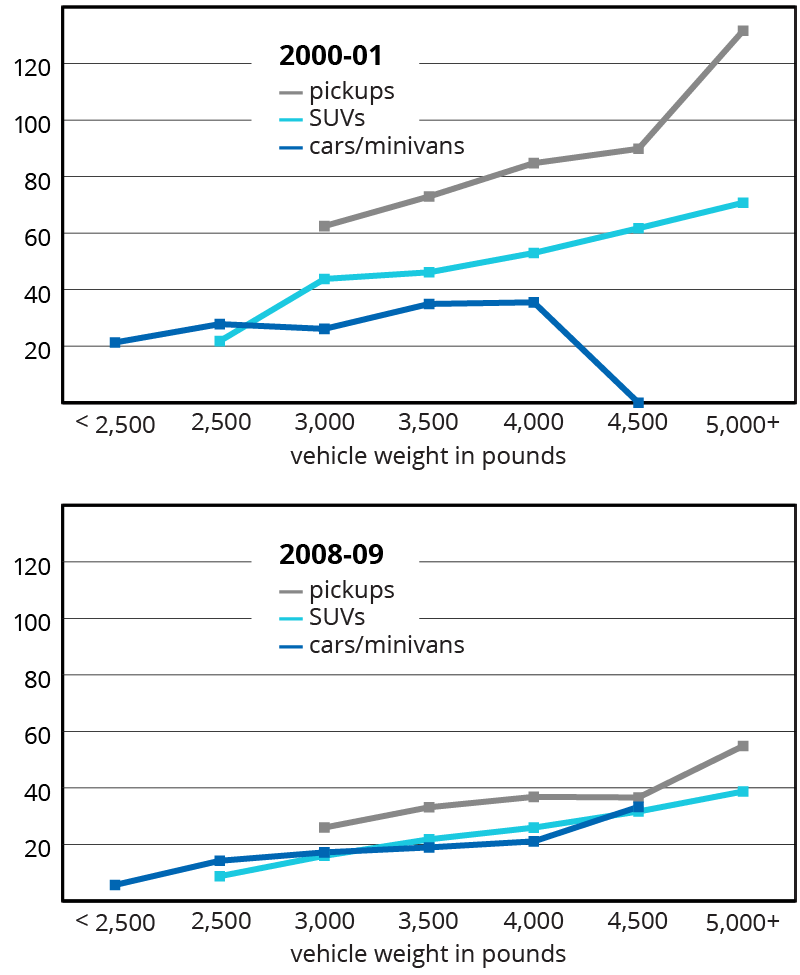
It used to be that SUVs were both more deadly to others, because of something dubbed poor “crash compatibility”, and not particularly safe (or perhaps i should say: not as safe as they could have been) for their own occupants due to a propensity to roll over; see this 2005 IIHS study that looked at 1999-2002 model years. It was a bit of a lose-lose proposition.

The latest version of looking at the risk of dying in any particular car, which covers model year 2005-2008, shows a marked decrease in SUV rollover deaths, presumably due to design changes in SUVs the most prominent being stability control “Recently calculated driver death rates for 2005-08 models show that drivers of SUVs are among the least likely to die in a crash. That change is due largely to ESC (Electronic Stability Control)”

Who is your Crash Partner?

Those studies look only at the risk of death to the driver of any particular vehicle — without regard to any other factors of the collision. It has long been known that SUVs pose a higher risk to others, because of their rigid frame design, which is also rides higher; in a collision with a car, particularly a t-bone, the rigid frame tends to slice into the car, disproportionately killing the car occupants. Happily, design changes made to SUVs have helped the sit

uation, to the point where similar weight vehicles, whether they are SUVs or cars, have similar risk of death.

“Whether you’re in an SUV or just sharing the road with one,” Nolan says, “recent improvements to these vehicles are making you safer.”

The results don’t contradict the basic physics of crashes. Size and weight are still key, and a small, lightweight vehicle is going to fare worse than a big, heavy vehicle in a crash. In general, SUVs and pickups are heavier than cars, so in that sense different types of vehicles always will be mismatched. But the study shows that, beyond weight, differences in vehicle styles don’t have to be a safety problem.

— IIHS, Effort to make SUVs, pickups less deadly to car occupants in crashes is paying off, news release 9/28/2011

 Pickups remain problematic, though even they have shown improvement.

What if your Crash Partner is a Pedestrian?

None of the above addresses this topic. Other studies have shown SUVs/Light Trucks are significantly more dangerous to pedestrians compared with automobiles: “Analysis of these three databases has clearly demonstrated that pedestrians have a substantially greater likelihood of dying when struck by an LTV (light truck or van) than when struck by a car.”  The fatality and injury risk of light truck impacts with pedestrians in the United States, Devon E. Lefler, Hampton C. Gabler, Accident Analysis and Prevention, v.36, pp. 295-304, Elsevier (2004)  (see also an earlier paper/version from the same authors sounded the alarm  did anyone pay attention, or even care?  The Emerging threat of Light Truck Impacts with Pedestrians is basically the same article)

Similar study published in 2005 Injury Prevention: United States pedestrian fatality rates by vehicle type by L J Paulozzi of the CDC, using 2002 FARS data “Compared with cars, the RR (relative risk) of killing a pedestrian per vehicle mile was 1.45 (95% CI 1.37 to 1.55) for light trucks… The greatest impact on overall US pedestrian mortality will result from reducing the risk from the light truck category”. This methodology is very straightforward, it takes the FARS data and segregates it by bodystyle (the paper does not state exactly how that was done; it looks easy, see below); and computes the RR (relative risk) based on Table VM-1, which is in Section V of FHWA Highway Statistics 2002. UNFORTUNATELY, the fhwa stopped reporting VM-1 in that way. Commencing with 2007 they no longer differentiate between passenger cars and LTVs; inexplicably they now differentiate by wheelbase, thus that data is useless for this purpose; so i guess we’ll never know how many more pedestrians are killed by LTVs (SUVs, pickups, etc). There are some footnotes to VM-1, saying methodology changes due to motorcycle reporting that do not seem to explain this change.

However, the data is all available in any Traffic Safety Facts Annual Report, e.g. here is 2011 and 2012 (search the library for newer ones). It is in Tables 7, 8, 9, 10 for Passenger cars, Light trucks, heavy trucks, and motorcycles. It lists VMT, and registration data; the only thing left to do is to extract from FARS the quantity of non-occupant fatalities split by those 4 vehicle types. I’ve already added a “synthetic” field to my FARS mysql data called sMODEL, it is based on the FARS field MODEL.

Here is a newer meta-study, that i would guess references the Paulozzi study and has very similar result, that i need to look up from Traffic Inj Prev. 2010 Feb;11(1):48-56. doi: 10.1080/15389580903390623.Do light truck vehicles (LTV) impose greater risk of pedestrian injury than passenger cars? A meta-analysis and systematic review. ” the risk of fatal injury in pedestrian collisions with LTVs compared to conventional cars was odds ratio 1.54, 95 percent confidence interval 1.15-1.93″

(given the dramatic change in the mix of the US vehicle (higher percentage of light trucks) fleet since whenever the cross and fisher data came from (mid 70s)…. it would be interesting to know if anything could be shown more statistically in, say, 2005.

There’s something called the “household” fleet, see exhibit 1 of the NHTS (Nat. Household Trans Survey)… mixture changed from 80/20 (automobiles/light trucks) to 50/50(!) from 1977 to 2008

There’s also this from the Cross and Fisher data (mid 1970’s or so):

TYPE OF MOTOR VEHICLE DRIVEN BY MOTORISTS IN THE FATAL AND NON-FATAL SAMPLES

[…]

Table 12 shows that trucks are involved in a proportionately greater number of fatal accidents (19%) than non-fatal accidents (9.4%). More than 80% of the trucks were pickups or vans; the remainder were larger types of trucks. These data suggest that the likelihood of fatal injuries increases as a function of the size of the vehicle. For instance, dividing the proportion of fatal cases by the proportion of non-fatal cases yields a ratio of .9 for passenger cars, 1.9 for pickups and vans, and 3.2 for larger types of trucks. However, because of the small number of cases involving a truck, these data can only be considered suggestive.

Bad weekend in Scottsdale

Adot Incident 2609053 Update / FINAL on cyclist McCarty death: azcentral.com  The motorist who killed Shawn McCarty was fined a total of $420 (and the case is apparently closed). Regardless, It would appear that $420 is the “normal” fine schedule that anyone would pay. That would mean that the enhanced fine for 28-735 (section B) was exactly ZERO. How can that be? Would a judge or magistrate actually make that decision, or it is some sort of court “bug”? Continue reading “Bad weekend in Scottsdale”

One Arizona legislator REALLY doesn’t like photo red cameras

Our legislative elves have been hard at work trying to de-rail photo-enforcement. Again (click here for last year’s festivities). The biggest single item is supposedly dead as of March 6, 2012 — this would have referred a ballot measure which would prevent cities and towns from using photo-enforcement.

Safety studies have consistently shown a net safety benefit for photo-red enforcement. Net means that there are fewer serious injuries and fatalities. A few studies have shown an increase in the number of collisions accompanying the safety gains. See, e.g. the IIHS study, Red Light Running Kills, linked at trafficsafetycoalition.com. Or more locally, also see Scottsdale-based redmeansstop.org.

Here is a list of items in the current session (50th 2nd Regular. The Spring of 2012) of the Arizona Legislature, assembled by the Traffic Safety Coalition:

  • SB1315 – mandate personal service or certified mail for photo enforcement tickets
  • SB1316 – mandate that photo enforcement cameras cannot take pictures of red light running violations unless the light has been red for at least one second
  • SB1317 – mandate a study of intersections with red light cameras
  • SB1318 – force photo enforcement companies to obtain a PI License for each worker
  • SCR 1029 – put photo enforcement ban to the voters for approval

As noted above Senate Concurrent Resolution 1029 is for the time-being anyway dead… The first thing I noticed that was odd is that they are all in the senate. Upon closer inspection all four of the the senate bills have only one sponsor, and all four are the same guy; a Frank Antenori (R-30, Tucson). He clearly doesn’t like photo-enforcement, and is apparently making it his life’s work to defeat it’s effectiveness; if not ban it outright.

Aside from safety issues, the cameras can, and do, provide evidence that has been used to solve crimes; including (that I know of) catching a hit-and-run driver who seriously injured a cyclist in Tucson, a hit-and-run-driver who killed a cyclist in Tempe, and a assault-robbery-murderer in Tempe.

Stats?

Arizona has a particular problem with red-light running; despite improvement over the years, Arizona continues to be over-represented. For example in 2009 Arizona had 37 red light running (RLR) fatalities while New York had only 29…. Arizona being three times as dangerous as New York on a per capita basis.

The words below, written over 10 years ago continue to ring true today, from a 07/13/00 article in USA Today, Ariz. has deadliest red-light runners in USA:

Arizona has the nation’s deadliest red-light runners, with three of the country’s worst cities for fatal intersection crashes, according to a study of federal transportation data obtained by USA TODAY….  Arizona had by far the worst death rate among states, with 6.5 fatalities for every 100,000 people… Arizona also had three of the four most dangerous cities. for red-light fatalities. Phoenix topped all urban areas, followed by Memphis, Mesa and Tucson

In addition, cities with speed limits of 45 mph and higher on surface streets faced more serious red-light -running accidents… The Phoenix police officer says said that with an average of 330 days of sunshine a year, it’s typically usually perfect driving weather. That doesn’t mean motorists drive perfectly, however. Just the opposite. “If we got more rain or inclement weather, maybe it would slow people down some, particularly at the intersections,” Halstead said says. “As it is, they zip around the city at a pretty good clip.” And, according to the institute’s study, Phoenix drivers run red lights at an unrivaled pace. The city has by far the nation’s deadliest rate of fatal red- light running crashes, nearly five times the national average. Arizona and other fast-growing Western states have been particularly stung by red light crashes “because their wide open roads are suddenly seeing schools, businesses, and busy intersections crop up,” says said Phoenix traffic engineer Paul Wellstone. “The West has a reputation for being a drivers’ paradise; a place you can lay on the accelerator and not worry about the traffic and dangers. That’s changing now. Cities are struggling with getting their citizens to slow down.”

 The FHWA has a page on red light running.

Is Phoenix Safe?

[ Updated Sept 2018; this year’s Allsate 2018 America’s Best Drivers Report lists Phx rather low (less “safe” than average); not sure if anything has changed in methodology(?). ]

Sept 2015 Update: Each year we’re treated to this recurring tidbit of stupidity via Allstate Insurance press release which always gets picked up and published in the media: Arizona’s urban drivers score well for safety. ‘Well’ for safety?  Unfortunately Arizona remains significantly less-safe (i.e. more dead bodies) than average in US, and far worse than the best state.  Like as much as hundreds of percent worse, depending on which metric is chosen (VMT vs. per capita)
NHTSA state-by-state stats.


Phoenix was reputed to be America’s 7th safest city, according to this survey which looked at three factors relating to insurance. Clearly the stuff of newspaper-filler stories. Intrigued, I see that the survey involves ranking cities in three categories 1) Crime, 2) Natural disasters, and 3) Traffic safety; though it wasn’t clear how they were weighted. For example, traffic fatalities claim far more lives than murder, and the number of deaths in the U.S. due to natural disaster is miniscule.
That being as it may, their source for traffic safety rankings is the “Allstate America’s Best Drivers Report” (tm!), which Allstate claims “Reveals Safest Driving Cities”.

What it actually measures is the statistical likihood of having an auto insurance claim. Which Allstate claims, and I think sounds reasonable, as a proxy for the number of MV collisions. The next leap, which is demonstrably false, is that fewer collisions translates into “safety”. One glaring data point is enough to disprove this: cities of similar size are frequently and for good reasons ranked against one another; it just so happens that Phoenix and Philadelphia have virtually the same population, and are currently the 5th and 6th largest city in the U.S. Actual fatality data reveal that Phoenix is significantly more dangerous than Philadelphia, yet Allstate’s proxy data says just the opposite:

NHTSA Fatality Data Allstate data
City Killed population killed per 100K time between collisions rank (higher=worse)
Philadelphia 95 1547297 6.14 60.2% worse 6.2 years 187
Seattle, WA 30 616,627 4.87 25% worse 8.0 years 147
Phoenix AZ 159 1593659 9.98 1.1% better 10.1 years 74

Source: NHTSA Traffic Safety Facts 2009 (latest year available), Table 124 811402.pdf, and Allstate (follow link above; current year result they refer to as 2011, is similar to 2005-2010 ). Notes: overall U.S. fatals/population/ratePer100K = 33,808/307,007,000/11.01

So, Allstate’s data merely shows that Phoenicians suffer from fewer fender-benders than Philadelphians; but say nothing about safety.

Why is Phoenix so dangerous? The main reason is probably because it’s “Dangerous by design”, with a higher priority on moving more cars, at higher speeds; and a lower priority on getting everyone to their destinations without being killed. More driving could explain some but not all of the gap; this, in itself, a symptom of poor land-use choices.

I threw Seattle into the table simply because of this recent op-ed that aggravated me: why-seattle-is-safer-than-phoenix. Phoenix and Seattle are quite dissimilar in population, but here again the Allstate data claims Seattle is significantly more dangerous than Phoenix when just the opposite that’s true.

2014 Update

Here’s the figures based on Allstate released in Sept 2014. Phoenix is the “best” large city at 9.2 years; and coincidentally Philadelphia is the “worst” large city at 6.2 years.

Auto Insurance Center Fatality Statistics

An outfit called the Auto Insurance Center put out a statistical roundup that looked only at fatal crashes (covering data years 2005-2015) and then normalized each stat to each state by population, and then ranked the states. It’s a FARS data-mining exercise that comes up with sometimes curious stats of dubious value but interesting nonetheless, e.g. “Fatal car crashes caused by road rage were the most prevalent in Indiana (almost 13 fatalities per 100,000 residents)”. Variations like that tend to come from wide variations in reporting, not that there’s a lot more road rage in one state versus another.


By the way

I always have trouble finding this page at www-nrd.nhtsa.dot.gov (which can be found by searching for FARS, then clicking on “publications”) where it lists publications like Traffic Safety Facts; e.g. 2009 Traffic Safety Facts Data Summary Booklet ; and 2009 Traffic Safety Facts FARS/GES Annual Report, they list back to about earlier 1990’s.