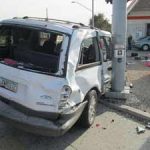
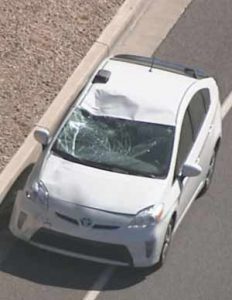
Yikes. Police officer involved crash resulting in several serious injuries, including a motorist and people walking on the sidewalk. Anyways, lots of dollars. He was never charged, of course; despite speeding at 30+mph over the speed limit. Continue reading “Glendale officer’s deadly crash costs city $3.8 million”
4/14/2016 Bicyclist Donald Neu was killed riding westbound Riggs Road near Arizona Ave when he was struck by a driver who “drifted” into the rather wide, designated BL.
Note that, according to that description of events, the driver has “failed to keep proper lane” (§28-729) and should be charged with 28-672, a criminal misdemeanor — assuming other more-serious charges are ruled out. Are police (in this case, MSCO) aware of this? In this triple serious injury, they were. See more about 28-672 .
28-735 is all well-and-good, and as far as I know can be “stacked” on 28-672, but it (28-735) is nothing more than a fine.
Arizona already has a law that functions very much like a “Vulnerable User Law“, it is applicable in virtually all cases where a driver causes a collision resulting in a pedestrian serious injury/fatality; and in many cases where the victim is a bicyclist.
[ UPDATE: in 2018 the legislature increase penalities for the law referenced below; see 28-672, 675 & 676 ]
On March 3, 2012 bicyclist Sean Mccarty was riding in a bike lane in north Scottsdale when a motorist for unknown or unstated reasons swerved or drifted partially from Lane 2 into the bike lane, striking and killing the bicyclist. Possible criminal actions on the part of the driver such as excessive speed, or impairment were quickly ruled out by investigators, and the motorist was very quickly issued two traffic citations, 28-735 (the “three foot” rule) and another for 28-815D (driving in a bike lane prohibited); and paid a fine of $420 [1]. Very similar situations occurred in the fatal collisions of both Allen Johnson in Pima County, and Jerome Featherman in Green Valley. Continue reading “Arizona already has a “Vulnerable User Law””
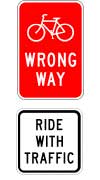
The most concise, least able to be misconstrued, message about which direction a bicyclist must operate, is “Ride With Traffic”, it’s the inscription on a R9-3cP plaque. But what is “with traffic”, or “the flow of traffic” or “the direction of traffic”? And why do we so often hear “ride right”, “bike right”, “Be a Roll Model: Ride on the Right” or some other clever-sounding catchphrase? Continue reading “Ride With Traffic”
There was a study published in 2007 which took FARS (for traffic fatalities) and GES (for injuries) data, and combined with NHTS (National Household Transp Survey. 2001) data to try to quantify relative risk of fatality/injury by travel mode per trip. Full text and full .pdf are both available free online: Continue reading “Crash Injury Rates by Mode of Travel”
The original story about this Dec. 27, 2014 death has a long list of horribles, emphasis added:
Preliminary test results indicated that Erica Flynn’s blood-alcohol level was .283, more than three times the legal limit, after the crash that killed 66-year-old Kathleen Mae Searcy on Dec. 27, the records show.
Flynn, 30, was southbound on Arizona Avenue in a Toyota Camry when she ran a red light and struck Searcy’s Honda Accord, which was making a left turn on a green arrow at the San Tan Freeway, records show.
Data from Flynn’s vehicle indicated she was driving at a speed of 75 mph – 30 miles over the posted speed limit – and did not brake prior to impact, according to police.
Police are seeking the driver of a dark-colored GMC Sierra pickup truck w/large chrome wheels that was involved with a fatal hit and run collision 27th Ave near Bethany Home Road, Phoenix. Bicyclist Darryl Fitzgerald Summers was killed in the crash.
51-year-old Darryl Summers dies after hit-and-run crash; police looking for dark truck: Police say Summers was following all safety protocol including wearing a helmet and reflective vest, having bike lights and reflectors, and riding with traffic. Still, he suffered life-threatening injuries and was taken to the hospital where he later died.
After a decade (or more?), Arizona lawmakers have finally banned photo-enforcement; but only on roads which are part of the State Highway System. Lest you be confused, the state highway system includes not only the interstates and other “controlled-access”/ freeways, but many miles of country highway, and also includes some what would appear to be normal city streets.
The state of arizona did used to have photo enforcement years ago on some freeways; but were removed by executive, not legislative, action.
photo: KPHO /KTVK. The red pickup struck the rear end of a school bus that was already stopped.
Rear-end crashes are, by far, the most common motor vehicle crash. Looking at all MV-MV (that is, motor vehicle crashes excluding single-vehicle crashes), a whopping 47% were classified as rear-end, using 2012 Arizona data. That’s almost 50,000 rear-end collisions a year, just in Arizona!
3/24/2016 The urge to call every boom-boom that drivers become involved with reaches absurd proportions. This chase ended only when police intentionally caused the suspect’s vehicle to crash. This is not an accident. Yet some members of the media insist on saying things like “Thursday’s pursuit ended with a rollover accident when the suspect crossed the median, rolled his truck and then was ejected”. Sorry tucsonnewsnow.com/KOLD-tv 13, this was no accident. #crashnotaccident. Continue reading “High-speed chase suspect also wanted in Tucson hit-run”
Let me start by saying I really like road diets (a.k.a. lane diets), because they have at least the potential to reduce motorist’s peak speeds, while maintaining flow. Continue reading “Broadway Road Lane Diet Tempe”
 Ann Day was killed in a headon crash with a suspected impaired driver, ~ 8AM, May 7, 2016. Day was traveling eastbound on Ina Road near the Westward Look Resort, near Tucson (Pima County)