Background, The city of Tempe was elevated to LAB’s Bicycle Friendly Community ‘Gold’ status in 2015; it had been ‘Silver’ for many years before
I guess their rating is up for reconsideration (every 4 years, maybe?) Continue reading “Tempe BFC”
Cycling, traffic safety, traffic justice, and legal topics; energy, transit and transportion economics
Background, The city of Tempe was elevated to LAB’s Bicycle Friendly Community ‘Gold’ status in 2015; it had been ‘Silver’ for many years before
I guess their rating is up for reconsideration (every 4 years, maybe?) Continue reading “Tempe BFC”

I can’t possibly keep up with all this… but just to point out, these regulations affect the companies; and have nothing to do with operation and rules of the road. The latest being Scottsdale:
Renting a bicycle or scooter in Old Town Scottsdale? Here are the new rules to know
In one oblique reference to rules-of-the-road, it mentions/claims “Renters can ride … scooters on sidewalks”; I don’t have time to unpack yet another set of local ordinances but I don’t see how that’s possible ; see e.g. here for Phoenix and Tempe operating ordinances. Continue reading “Scottsdale (and now Tempe) regulates scooter/bike sharing companies”
The state of Delaware passed a package of updates to rules-of-the-road in 2017; as outlined by bikelaw.com
In October 2017, Delaware’s governor signed the Bicycle Friendly Delaware Act, placing into state law some cutting-edge, pro-bike reforms that put Delaware emphatically into a category of one among U.S. states when it comes to favorable statutory law treatment of cycling. The highlights:
1. requirement that drivers have to change lanes to pass;
2. the “Delaware Yield” at stop signs;
3. deletion of the “as far to the right as practicable” provision;
4. no aggressive honking at cyclists.
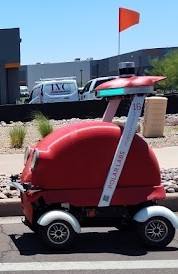
Autonomous Deliver Robots were enabled in Arizona in 2018, and further re-vamped the law in 2020.
Side-note:This all reminded me of the pizza delivery robot in an episode of Black Mirror.
As of Sept 2025, Doordash says they are rolling out “Doordash dot” for testing.
Polar labs based in Tempe/Mesa have been testing for some time (?early to mid-2024. At the time I saw them, pictured right, they were still accompanied by a “chaperone” following on an ebike).
Polar Labs appears to be supplying doordash.
Just what is an e-scooter? … what rules of the road apply?
For our purposes here, an e-scooter is an electric powered “kick” scooter that is sized to accommodate up to most adults; with weight limits being typically 220lbs. They travel on level ground up to about 15mph. A very popular model, the Xiaomi which is no longer sold at retail is said to be typical, and the basis for most of the scooter sharing companies, a la Bird, Lime, etc.
[UPDATE: it seems quite possible something changed after 2020? see comment and stats]
[UPDATE: Something DEFINITELY changed as of FARS 2022; see below]
Executive Summary
Each of these has the potential to skew crash reporting statistics. Motorized bicycles have not seen wide use, but ebikes are expected to become much more common
I propose adding a few new “Body Style” definitions: 1) bicycle (well, pedalcycle), 2) motorized bicycle, 3) ebike; this would not require any changes to the Arizona Crash Forms, simply an update to the Crash Form Instruction Manual.
It is expected that ebikes will see large growth in use in the coming years; e.g, the WSJ reported: Continue reading “Motorized bicycles, Ebikes and crash reporting”
In 2018, Arizona passed e-bike legislation, adopting the model legislation promoted by the industry. Quick reference, as enacted:
 [Update — It’s all passed and signed as of 5/16/2018… see below ]
Late in this legislative season (53 2nd regular), an ebike bill has once again surfaced from Rep Worsley; this time as a “striker” in the former dark sky lighting special plates bill HB2266.
The bill is suddenly, as is always the case I guess with strikers, being heard, scheduled for 3/20/2018 in the senate where it passed unanimously… Continue reading “Ebike bill rides again”

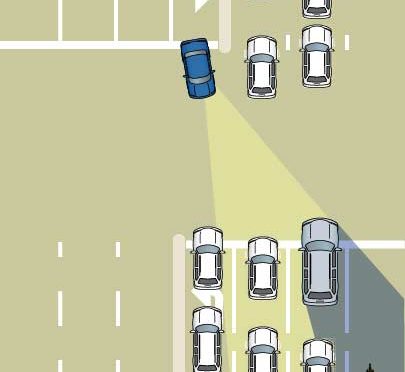
A Cross-type Bike-MV collision occurs when a bicyclist and motorist who are traveling in opposing directions collide while the motorist is making a turn. If both are traveling in proper direction, it would be a left cross; as illustrated between the blue vehicle and the bicyclist in the illustration. For a counter-flow bicyclist, a right-cross can occur.
(This in in contrast to to a hook collision, which involves a turning motorist and a same direction cyclist. ) Continue reading “Left Cross Collision”
An ebike bill PASSED in 2018: HB2652. Below info is for historical purposes…
[5/10/2017; bill stalled. Never got a House floor vote]
[Current Status as of 3/1/2017: passed the Senate by wide margins, also passed House T&I Committee but they implied it would need to be amended to pass the floor; as of 3/19 it’s not passed the house; see below ]
 As of spring 2017 there is an e-bike bill working its way through the legislature. SB1273 (2017, 53rd/1st Regular session). This bill, if passed, would address some or all of the confusion documented at length in these pages, at least for e-bikes. The bill’s prime sponsor is Bob Worsley (R-Mesa)
, is senate president so I’d have to assume it’s going to pass ; [correction, Yarborough is, so I have no idea how i got that wrong] and is moving fast, as of the time of this writing (early February 2017) it has already passed the Senate Transportation and Technology Committee unanimously with little debate. Besides being senate president, Worsley is the chairperson of the senate Transp committee. I have no idea about the house but there’s little apparently standing in the bill’s way. Continue reading “Arizona Electric Bicycle Legislation (bill died)”

I’ve been following this since as far back as 1999 (a deaf-mute bicyclist was arrested and held in jail overnight because he lacked ID); with some interesting updates in 2014 (police demanding ID from an ostensibly “jaywalking” pedestrian).
The rules revolving around operators of a motor vehicle are pretty clear; drivers must have a valid drivers license for other reasons (e.g. to comply with §28-3151 ), and the DL satisfies the elements set forth in 28-1595: name, address, height, etc — but for everyone else it’s remain vague, and in fact court rulings have (repeatedly) looked at the non-motorist provision and struck it down, most recently in 2003 Atkins; and the law hasn’t changed since. Continue reading ““Evidence of Identity” Rides Again”

In mid December 2016 Sfbike.org (SanFrancisco Bike Coaltion) issued a warning regarding how Uber autonomously driving cars make right turns. At nearly the same time Uber has de-camped from CA (see e.g. this 12/22/2016 article from recode), literally loading their fleet onto car carriers and driving them to…. Arizona! The decision was based on CA’s regulatory environment for autonomously-driven cars; Uber decided they didn’t want to pursue special permitting which the CA DMV said was required, whereas Arizona has no special permitting required — so long as there’s a live driver sitting in the driver’s seat. More about Uber, below. Continue reading “How to make a right turn”
[UPDATE: spring 2018 in AZ State legislature, HB2652, has PASSED; how this relates to local laws isn’t completely clear to me]
This is not coincidentally similar to legislation passed in California in 2015, and pushed by People For Bikes along with the e-bike industry, so start there. I say similar because it’s odd it doesn’t follow the class 1/2/3 in the CA (and as of Aug 2018 the AZ law?)
Electric bikes fall under the category of what Arizona calls a Motorized Bicycle at the state level. There are a number of gotchas involved, which have been copiously documented on these pages, e.g. start here. The main gotcha is illustrated below about unwittingly needing a drivers license, insurance and registration.
No municipality can fix these gotchas, they can only be addressed by the state legislature. I can only speculate the idea is for Tempe (or whoever; there is similar effort for MAG to recommend/adopt model regulations) to adopt rules that would in effect only kick in when the state “fixes” the state statutes. Continue reading “Arizona e-bike model municipal law”
 Although the vast majority of vehicles are driven at the “normal speed of traffic” — there are many classes of vehicle (or device) which are by their nature sometimes or always driven at less than the normal speed of traffic, yet are generally allowed on the roadway. These include both motorized and non-motorized vehicles. Operation of these vehicles/devices is allowed unless specifically prohibited; for example bicyclists and motor-driven cycles are not permitted in the roadway on limited access highways. They can also be prohibited by minimum speed limits, however as noted here, in Arizona “Posted minimum speeds are rare. There are NO KNOWN posted minimums on any street in Arizona”.
Besides bicycles, there are many classes of vehicle permitted on any street in Arizona with limitations as noted, these are just examples, there are probably others: Continue reading “Slow by nature”

Speed limit signs, maximum speed limits that is, are seen all over town, in the city, and in the country. Some types of roads have “statutory” maximum speed limits, and the limit signs need not be posted; for example residential areas have a statutory limit of 25mph. Continue reading “Speed Limit”
Bicycle Laws in the United States-Past, Present, and Future is an ambitious, scholarly article written by attorney Ken McLeod, who also happens to be a member of LAB’s s Legal Affairs Committee. And has written much of the content available on LAB’s site relating to laws and legal matters, e.g. bike-law-university and the paper is reflective of the information there, just perhaps in a more technical/scholarly format. Continue reading “Bicycle Laws in the United States-Past, Present, and Future”