I might mention that the Arizona legislators say they don’t like it when the feds tell them what to do… so here they seek to tell the cites/counties/towns what to do.
Arizona legislators are seeking to prohibit cities and localities from running any sort of photo enforcement, including both speeding and red light cameras. Here is why I like red-light cameras: red light runners compilation and if you don’t like that one there are dozens more like it.
SB1352 (or SCR1029, which would become yet another ballot initiative, is also in play). As of this minute the senate bill has been narrowly voted down. You can follow the SB1352 here (select the 50th, 1st regular session; if need be)
Should State DOTs Prefer Bicycle Lanes or Wide Curb Lanes? A.L. Dennison, 2008 [.pdf] This report was produced for ADOT in cooperation with US DOT/Federal Highway Authority.
Bicycle facility advocates have long debated the respective merits of bicycle lanes (BLs) and wide curb lanes (WCLs); this report investigates their claims… This study found no apparent relationship between fatal bicycle/motor vehicle collisions and type of bike facility… A significant handicap to any analysis of bicycle travel or safety is the paucity of reliable data.
Of great interest to me was the categorization of bicyclist fatalities over a four year (2003-2006) period, based on police reports. Somehow I missed this report entirely even as I echoed its complains about the “paucity of reliable data” for cyclist/traffic collisions while researching Manner and Fault in Bicyclist Traffic Fatalities: Arizona 2009.
According to my (from ADOT’s Arizona Crash Facts) records there were 15, 27, 35, 30 fatals in 2003, 2004, 2005, and 2006, respectively. This totals 107, but the report says that “We obtained 85 (97%) of 88 microfilmed fatal bicyclist/motorist crash reports submitted to AzDOT by police agencies in Arizona between 2003-2006”. The missing 3 (88-85) are explained in a footnote. But one wonders, where are the other 19? (=107 – 88). Does that mean that not all fatalities are submitted to ADOT? … so the answer i am told is that it covers the time period 17-Oct-2003 to 25-Sept-2006, which makes sense.
[Update: revisting this on 2/27/2013 the problem mentioned just below seems to be fixed or otherwise is a non-issue — you can just use iframes directly within wp’s built-in editor with no problems, see e.g. driver-convicted-in-horn-honking-incident, which also by the way wraps the iframe in a div tag — div style=”clear: right; float: right; margin-bottom: 1em; margin-left: 1em;” — and that looks nice ]
There is a bug/feature/problem with wordpress’s built in visual editor (tinyMCE) in that it just goes ahead and removes iframe tags. An iframe tag is used for, among many other things, to embed youtube videos. Another popular usage example is to embed a google map, or calendar.
here is what some youtube embed code might look like:
<iframe title="YouTube video player" width="480" height="390" src="http://www.youtube.com/embed/oUkiyBVytRQ" frameborder="0" allowfullscreen> </iframe>
Are police even looking? Having a mirror is enough to narrow the field dramatically as it tells you not only the make (said to be a Kia), a specific color (silver) and typically even the particular model and specific model-year.
But are police even looking? Why is the mirror — obviously a key piece of evidence — in the possesion of the victim, and not of the police?
The same bill is back HB2130 (2011, 50th 1st regular session), except that the exception for bicyclists would only apply when they are aged 16 or older. This was to address (appease?) some concerns that arose at the committee hearing in 2009.
Original article written for 2009; 49th 1st regular session
a la Idaho. The “Bikes Safe at Stop Sign” bill has been introduced in the Arizona Legislature; you can follow it here: HB2479 (2009, 49th 1st regular session). The bill will make its debut on March 4 before the Military Affairs and Public Safety (MAPS) committee. Continue reading “Bicycle Stop Sign changes proposed”
Story from the Arizona Republic; I copied the whole thing because it was only a few sentences long (my emphasis added):
Woman dies when motorized bike collides with car in Phoenix
by Jack Highberger – Jan. 20, 2011 12:26 PM The Arizona Republic-12 News Breaking News Team
A 53-year-old woman died Tuesday night (1/18/2011) when her motorized bicycle collided with a car on Dunlap and 25th avenues. The woman was driving the motorized bicycle on a sidewalk when she entered the crosswalk and collided with the car, said Sgt. Tommy Thompson of the Phoenix Police Department.
She was not wearing a helmet at the time of the collision.
She was taken to the hospital where she later died. The driver of the car, who is also a 53-year-old woman, was not charged by Phoenix police. Authorities said it’s illegal to operate a motorized vehicle on a sidewalk.
this text is in a block quote. Lorem ipsem dolar Lorem ipsem dolar Lorem ipsem dolar Lorem ipsem dolar Lorem ipsem dolar Lorem ipsem dolar Lorem ipsem dolar
… And you can also add in fancier CSS3 styles like box-shadow, text-shadow, and box-radius — they work, but the visual editor stripped the radius and box-shadow: -webkit-border-radius: 10px; -webkit-box-shadow: 5px 5px 5px rgba(0,0,0,0.5); text-shadow: 3px 3px 1px rgba(0,0,0,0.3); Continue reading “WordPress Minutia”
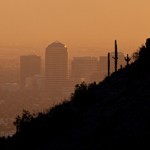
You have to read between the lines to even get the hint that much (most?) of this pollution comes from vehicle use — both from entrained dust (dust that is kicked up by cars/trucks whooshing by) or emissions (NOX -> ozone, and fine particulates from combustion, particularly from “clean” diesel engines. )
Experts warn of poor Valley air quality The Arizona Republic. A familiar brown cloud is settling over a cool, dry Valley, prompting air-quality experts to warn that residents could be in for a particularly dirty winter.
Bad air expected for Valley through the holidays Bob McClay/KTAR PHOENIX — The Valley’s brown cloud season has arrived, with poor air quality that irritates respiratory systems … Mark Shaffer with the Arizona Department of Environmental Quality. …said the high pressure creates an air bubble that collects ozone below 5,000 feet.
For those of you who don’t follow such minutia, the Phoenix area is what is termed a “Serious Non-Attainment Area” for various forms of air pollution. This leads to, of course, some amount of human misery especially via various lung diseases, but it also brings the specter of loss of federal funds if the air isn’t cleaned up. Some local (state, or maybe county?) agency must produce a plan to clean up the air to the satisfaction of the EPA; that plan (critique here dated 9/13/2010: EPA Disapproves Air Quality Plan for Phoenix ) was rejected in part because “EPA has determined that the SIP (State Implementation Plan) over-emphasized emission reductions needed from construction-related activities and de-emphasized emission reductions from other sources”, you know, other source like, for example, those produced as a result of using motor vehicles.
AP Story U.S. lagging in reducing traffic fatalities. With all the feel-good news items about how fatality rates are supposedly so low, it’s good to get some perspective. The US is way behind in reigning in traffic deaths, and has fallen behind most other developed countries in both per-mile and is waaay behind in per-capita rates. Traffic deaths remain the leading cause of death for a huge swath of Americans.
And Arizona is even worse than US averages. For contrast, see what we’ve done with photo-enforcement in Arizona.
The large improvements in particular in US in the past few years are likely simply the result of poor economic conditions (no job means no job to drive to; and no money to spend driving around) — and not of some sort of systemic shift. Continue reading “U.S. lagging in reducing traffic fatalities”
It all started around the middle of November. My site was running very slowly. (Someone besides me even noticed it!). The slowness was limited to wordpress in the blog — i.e. static html pages loaded just fine, in fact very fast, well under 1 second typically (e.g. azbikelaw.org/excerpts always did and continues to pop right up). Continue reading “Godaddy troubles, slow wordpress. Grid hosting solution?”
Cycling on the sidewalk is generally far more dangerous than doing so properly in the roadway. All stats and studies that I am aware of reinforce this fact. For example, in the city of Phoenix’s 2007 Bicycle Collision Summary in the majority of the bike-motor vehicle collisions the cyclist was riding on the sidewalk just before the collision. (308 of 440 total collisions = 70%); and these numbers are pretty consistent, in the previous 2005 summary, it was 72%.
As we all know, bicyclists must follow the same rules as other vehicle drivers; but from time to time one hears of a story such as this one: Continue reading “Bicycles aren’t vehicles”
This is an update on the progress of two temporary traffic circles that were put up by the city of Phoenix in the Ahwautkee area. See original story for background.
The circle at Equestrian Trail and Apaloosa Drive will become permanent, and design is underway and a public meeting was held in early October, 2010. See AFN story.
Some good news is indicating the Equestian circle is having the desired effect: “Wilcoxon said that since the temporary roundabout was installed in July 2009, speeding has dropped significantly, from 21.7 percent of vehicles observed by city staff to only 1.7 percent”.
The circle at 36th and Coconino did not enough (or any, according to the news article) support, and so the temporary stuff was removed in September (or maybe October) 2010 and that is that. My own take on this is that since practically no one lives on 36th Street, this circle had no “champion”, and thus it withered.
According to item at biketempe.org, and thread at azfixed.com… Bike commuter Jay Fretz was killed in a a collision at the intersection of Alamenda and McClintock Drive in Tempe at approximately 6:30p Monday 5/17/2010. Police say the driver on McClintock ran the red light and hit and killed the bicyclist as he was crossing through the intersection. Continue reading “Commuter cyclist killed in Tempe”