The spring 2026 legislative season (57th, 2nd Regular) is apparently up-and-running already! Senator John Kavanaugh (R-Scottsdale) has proposed legislation that would limit a bicyclist’s speed in certain places.
| SB1008 bicycles; mobility devices; speed limits |
There was a veritable media blitz; here are a few:
12/9/2025 AzCentral (and Arizona Republic newspaper); “a 15 mph speed limit for cyclists on bike lanes and multi-use paths”, “in response to concerns about the high speeds of e-bike”
12/9/2025 AzFamily “Arizona lawmaker moves to curb speeding e-bike, electric scooter riders”; ” “ ‘All of the e-bikes can easily go above 20 miles an hour. Some of them can go up to 40 miles an hour’ “; “Arizona streets and trails are seeing a surge of new traffic: e-bikes and electric scooters”; ” ‘What we really need is a maximum speed limit on sidewalks and multi-use trails — because pedestrians are also on those…’ Kavanagh said”
12/9/2025 ABC15 “… speed limit on sidewalks and multi-use paths”
12/9/2025 KTAR interview w/ Senator Kavanaugh.
The main themes are that electrically powered devices like motorized skateboards, electric bikes, electric scooters, etc, can go really fast, are often ridden recklessly by “younger riders”, etc. So in order to protect pedestrians legislation is needed.
We should start off by saying that because of these concerns, virtually all jurisdictions have regulations concerning shared use paths.
We should also start off by noting that while over 1,000 per year people die on Arizona’s roadways including hundreds of pedestrians per year due to collisions with drivers. I am unaware of any (that’s zero) pedestrians killed in a bicycle (or ebike, escooter, etc) collision for as long as I’ve been following Arizona crash statistics for over two decades. Bike-ped, and bike-bike crashes are not tracked, by definition, as traffic collisions, presumably because they are believed to be so rare.
I don’t believe regulation of human-only powered bicycles is necessary on shared use paths; but the some regulation of motorized devices is appropriate. Paths vary widely in their configuration, so a one-size-fits-all approach (the 15 and 5mph) isn’t ideal. For example, the South Mountain Shared Use Path is twenty feet wide.
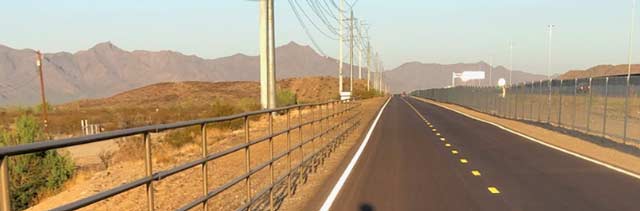
A 15mph limit here is too low, and to be required to slow to 5mph to pass a single pedestrian walking at the edge is completely unnecessary for anyone’s safety.
Tucson: A Better Model for Regulation
TCC: Chapter 5 Bicycles and Shared Mobility Devices. Highlights:
- Bicycles have no “speed limit”; ebikes max 20mph.
- Bike (and ebike) riders must yield the right of way to pedestrians.
- Passing a pedestrian or equestrian must slow to no more than 10mph.
- Gas powered bicycles are banned from paths.
- Note that Tucson does not allow any bicycle on sidewalk (unless signed).
It’s worth mentioning that the proposed statewide “speed limit” on paths for both bicycles and e-bikes would SUPERCEDE the City of Tucson’s rules. The proposed state law allows jurisdictions to lower limits, but not raise them.
Many Paths belong to the Federal Government
The many canal paths all over the Phoenix metro area are owned and regulated by the (Federal) Bureau of Interior (and incidentally don’t allow e-bikes). See “ebikes on SRP Canal Paths”, here — ebikes are at present banned from all these paths. It’s not clear how a state regulation would work in conjunction with federal law.
Here a some legal thoughts related to the proposed SB1008
Path Confusion
The term multiuse path is not defined in ARS. It first appeared with the e-bike law of 2018, but without definition. The correct term appears to be Share Use Path, which is defined in MUTCD: (the MUTCD is incorporated by reference into ARS)
Shared-Use Path—a bikeway outside the traveled way and physically separated from motorized vehicular traffic by an open space or barrier and either within the highway right-of-way or within an independent alignment. Shared-use paths are also used by pedestrians (including skaters, users of manual and motorized wheelchairs, and joggers) and other authorized motorized and non-motorized users.
A bicycle lane is NOT a bicycle path — the various news reports apparently simply got that wrong, because the interviews don’t support that. Fun fact, I am unaware of ANY bicycle path anywhere in Arizona. Here is what ARS says about bicycle paths and lanes, §28-815.
C. A path or lane that is designated as a bicycle path or lane by state or local authorities is for the exclusive use of bicycles even though other uses are permitted pursuant to subsection D of this section or are otherwise allowed by state or local authorities.
Sidewalk
Despite the news reports and Sen. Kavanaugh’s own statements: the bill as proposed does not mention or include anything related to sidewalks. Sidewalks are defined in ARS at §28-601.
Sidewalk use by bicyclists (and ebikes, etc) is not regulated in state law; and is an extremely dense topic, see especially Arizona Supreme Court decision Maxwell v. Gosett., a 1980 decision that remains good law in Arizona.
It is regulated locally by many or most jurisdictions, including e.g. bans (Tucson), directionality (Tempe and Yuma). And many other subtle variations. See this article for a deep dive into Arizona’s sidewalk situation.
What about motorized bicycles?
These were not included in the bill, but I’d guess that was an oversight. Background: before the e-bike law was passed in 2018, there was and still is, another category of helper-powered bicycle, now called a Motorized gas powered bicycle, §28-2516. There is presently nothing in state law to prevent or regulate these on sidewalks or paths.
The passing speed is probably infeasible (this issue is addressed in the ‘new’ bill SB1073, see below)
Senator Kavanaugh in the interview noted the passing speed clause “may not exceed five miles per hour when passing another person” has a problem, that will be amended. I think it has a bigger problem — he presumably meant to apply only when passing a pedestrian or equestrian, rather than “another person”; but it still has problems: many joggers/runners move at 5 to 10mph. It would be legally impossible to pass such people, a law-abiding bicyclist would need to just follow behind them indefinitely.
It’s also quite difficult to ride that slowly; it’s easy to lose balance and fall.
Tucson (see below) deals with this by making the maximum passing speed 10mph. But wouldn’t it be better to simply give pedestrians (and equestrians) the right-of-way. And make bicyclist have to exercise “due care” in passing?
The Maximum speed of 15mph is too low
See pic above, some paths are very wide and designed for higher speeds. Others aren’t. “Due care” clauses would be more appropriate.
Again, Tucson deals with this by setting the max speed to 20 for ebikes (and doesn’t especially regulate human-powered bicycles). It’s also worth pointing out if this bill became law, Tucson’s 20mph maximum for ebikes would become null and void, because the state law limit would supercede Tucson’s ordinance.
What about Cars driving on Shared Use Paths?
This is just rolling around in my mind… it’s clear cars (“vehicles”) are not permitted to use sidewalks §28-904. What I’m wondering about Share Use Paths? Like I said at the top of this article, virtually all or actually all jurisdictions have local regulations regarding paths, but it just got me wondering… and maybe this whole law (at the state level) is completely unnecessary. A common local ordinance, e.g. City of Phoenix is “no motor vehicles allowed” on paths (need to look up ordinance). Note that bicycles, and even bicycles with motors (like electric bicycles), as well as electric scooters ARE NOT MOTOR VEHICLES at the state level.
Oh Great, There’s a whole ‘nother bill
| SB1073 speed limits; bicycles; sidewalk; paths.
Not to be confused with the original: SB1008 bicycles; mobility devices; speed limits |
Good lord, why are there two separate bills from the same sponsor that are nearly identical? I spent (by which I mean, wasted) 10 minutes of my life comparing the two…
SB1008 is presumably dead, with the proviso that politicians love to use dead bills as “strikers” (strike-all amendment to entirely replace a bill’s language. It’s a political shenanigan, and shouldn’t be allowed.).
The new bill attempts to address my concern above regarding the max passing speed of 5mph; and now reads 5mph more than the person being overtaken. That is certainly better, but still silly for, for example, the TWENTY FOOT WIDE path I mentioned. The new bill also adds a “R&P” speed limit — which is fine.
All other objections noted above remain (see above):
- I don’t like the way the bill is drafted: multiuse path is still not defined in ARS. Rules do not belong in statute 28-812, it’s an applicability statute.
- The blanket 15mph speed limit is too low, or rather inflexible; the R&P addition is reasonable.
- I still don’t think un-powered bicycles need any special speed regulation (other than R&P).
- The new bill still does not mention the word ‘sidewalk’, so what’s up with that?
This bill seems designed to capitalize on media frenzy that tend to involve electric MOTORCYCLES, (not bicycles, not electric bicycles, not electric scooters) and now the (or rather some) politicians want to “do something”.
I should mention that as of this writing in late January, the bill has had a first and second read on 1/12 and 1/14, but otherwise hasn’t gone anywhere — it’s not scheduled for any committee hearing.
This seems like a blow hard exercise by Mr. Kavanaugh, who hails from Fountain Hills, where many, many, many, bicycle riders take to the streets, paths, and sidewalks in that town. So I’m thinking this is a personal issue for him. Poorly written as a result. While “high speed” electrically powered vehicles seem to present a challenge, I think the greater safety issue here is the poorly worded protections in ARS for cyclists on roadways, and the corresponding reluctance of prosecuting attorneys to take any meaningful action when cyclists are hit, mamed, or killed. Goodyear comes to mind. Time is better spent, Mr. Kavanaugh, with agressive new legislation that strengthens protections for vulnerable road users, including pedestrians. I seem to recall some very good proposed legislation circulating on this website a bit ago. Maybe that should be shared with the good senator from Fountain Hills.
Personally, I’d welcome bicycle/e-bike speed limits on shared-use paths – regulated at the state level. Many of the paths cross jurisdictional boundaries (city/county/state/federal) and regulating at the state level makes more sense to me.
We ride on shared use bike paths regularly, and a speed limit of 15 mph (for all bikes, e-bikes or otherwise) would be the max I would ever recommend. These paths are just too busy, at least all the ones that we’ve been on. With kids running loose, dogs on flexi-leashes, blind curves, walkers and runners that are 2 and 3 abreast, etc., it is unsafe to go any faster on a shared-use trail in my opinion.
Our legal, Class 1 e-bikes cannot sustain 20 mph on the level without significant effort from the rider. If there is a head wind, you would have trouble getting up to 20 mph. Realistically, we find it is possible to sustain 15 to 18 mph, with moderate effort. We had a legal, Class 3 e-bike and it was the same – very difficult to sustain 28 mph on the level for any length of time. Almost all legal, classed e-bikes start to taper off the e-assist a mile or two mph below the max legal assist speed for the class. Of course, illegal e-bikes can sustain higher speeds and should be regulated.
I have been riding a motor assisted bicycle sense 1988 when I came to own the bike barn in Phoenix. Don’t have a drivers license at all, haven’t for years. I know what works and what does not. A bicycle with no motor assist or electric assist (same thing), can easily pedal 20mph and greater at times. However to travel much over 20mph in some bike lanes is way out of line because of the condition of some of the lanes. The narrowness of some lanes make it impossible to travel safely as well. When I must use the sidewalk I generally consider myself to be the one that is to yield right of way to all other things I encounter using said sidewalk. I also slow my speed way down while on the sidewalk because I can encounter many things coming onto the sidewalk that are not expecting a bicycle to be there. It is my responsibility not to hit anything. When in the bike lane I always ride with traffic, Just as a car would do for the same reason that a car does. When passing a bicycle in the bike lane I wait until there is a clearing of the car lane and then use the car lane to pass, maintaining the three foot rule. Just like a car is required to maintain when going past a bicycle. When I am on a side street, (which is absolutely the preferred place to be traveling) I find it much safer to travel up to 25mph so as to travel without cars needing to pass me. The less passing me the better. When I am traveling a residential area (a 25mph or less) I tend to travel in the middle of road until I come to a cross road because things can come from both sides of the street. If I have cars coming toward me or passing me I often have to stop and let them travel by me then resume my travel so as to avoid like the plague, travelling close to parked cars because a car door can open at any given moment or a animal can run in front of me from under or in front parked cars giving me no time to react. These are the ways that I travel to keep myself alive. As I understand it, a bicycle is supposed to do all the things as a car would and maintain a right most position while doing so until such time as a left turn is being made. Left turn just like a car would turn indication included. There are many people doing stupid things on bikes, regular or assisted, that can get them killed. You can not win when hitting or being hit by a car. The last thing I want to say is, people need to be educated about bikes and where they are to travel and what they should do around them. It needs to be highlighted when issuing a drivers license. It needs to be consistent and well understood by all. One last thing I want to mention, when traveling near people on an electric bike the rider needs to realize that the people often don’t hear them so make sure they know your coming up behind them before you go by and many people walking have earphones on so make sure they are aware of you before you pass by as well. Common sense thinking keeps everyone better off.
Here is Flagstaff City Bicycle Codes:
https://www.codepublishing.com/AZ/Flagstaff/html0819/Flagstaff09/Flagstaff0905000.html#9.05.001.0001
The old code (most recently revised 2011) simply had a “path” definition.
This bill needs to be adjusted to engineering definitions. For example, a bike lane is part of a roadway under ARS 28-601 and AASHTO language. Bicycles are not to impede traffic in certain conditions under ARS 28-704C. I think it is important that bicycles keep up with traffic where they can and not be forced to impede which is contradictory and unsafe. I think the author of the bill might be referring to something different when the phrase “bike lane” is used so to me, this bill needs a very competent technical edit.
Assuming the author does plan on limiting bicycle use in a bicycle lane on a roadway to 15 mph, 28-704C will have to be adjusted along with a few other statutes such as 28-815. Right now, those two statutes work for safe and efficient flow of traffic, but intermixing bicycles and vehicles with the bicycle at a mandatory 15 mph is dangerous to both the vulnerable user cyclist and to the vehicle traffic users on any roadway above that speed.
Additionally a passing speed of 5 mph is OK if that is the pass speed and not the total speed. If it is the total speed or actual velocity of the cyclist, then any time a cyclist encounters a jogger, they have to slow down and remain behind that jogger which is quite impracticable. While many cyclists can maintain balance at 5 mph, not all are so adept. Finally, it seem clear from the language that the bill is using this as a total speed or velocity for the cyclist and not referring to the passing speed. Even if the bill is changed to a passing speed, how is the cyclist to determine what speed the jogger is at? Does this bill require a speedometer for the cyclist? Most bicycle riders do not have one installed.
Scooters have their own category and should be addressed within that category and not confused with the definition of Bicycle. Scooters do NOT have wheels that are 12 inches. If the bill makes a scooter to be a bicycle then we have an issue with children’s “bikes” which are really play devices. The sidewalk rules apply to bicycles (12 inches) and not play devices. Does this change mandate that children on play devices ride in roadways? Needs a lot of clarification here.
Electric personal mobility devices may fall under the definition of “Pedestrian” in ARS 28-101. Does this bill aim to change that definition? Unclear.
So with all the motorized skateboards and mobility devices and electric or gas bicycles or … you name it … we can’t just drop all these into one barrel and write a rule. There has to be distinction.
Not a bad notion, but overly complicated and enforcement is where it all fails.