Road taxes

[ UPDATE The article below was first written in 2011. Be sure and see public-safety-fee-going-into-effect beginning late 2018. This is the first significant change in vehicle use taxes in Arizona in nearly three decades ]

[UPDATE: Yet another externality of fuel is the uncompensated release of toxic, carcinogenic compounds into the air we breath gas-stations-venting-ten-times-more-gas-vapor-than-once-believed , primarily benzene. Another positive for zero tailpipe emissions vehicles like BEVs (battery electric vehicle); which receive significant tax breaks by not paying any road tax as well as reduced VLT ]

From time to time, we will see a recurring theme to the effect of “bicyclists don’t pay gas tax so they don’t deserve to use the road”. (for a good roundup of this and other similar issues see bicycledriving.org) There are certain elements of truth to this — bicyclists don’t purchase gas, it’s true. And there’s also an implication that motorist are “paying their way”, but that’s just not true. Gas taxes (and other direct taxes on automobiles) nowhere near cover the costs of building, maintaining, and operating roads. And that’s not to mention the (much larger) costs associated with death/mayhem and pollution impacts on human health and the environment. And none of that is to mention other more intangible costs like defending sea lanes worldwide; and propping up unsavory regimes so that oil can continue to flow freely. Continue reading “Road taxes”

Summer Ozone season kicks off

Here is the obligatory pollution story:

Maricopa County’s ozone season starts today with a fresh burst of heat and sunlight, two key ingredients needed for unhealthful levels of the smog to form.

Temperatures could rise to nearly 100 degrees today as a strong high-pressure system creates the ideal conditions for ground-level ozone. The other elements – vehicle exhaust, power-plant emissions, gasoline, paint and industrial solvents – are always in abundant supply.  Read more…

My gripe? While I agree that vehicle exhaust is always in abundant supply, I don’t imagine power plants contribute any significant amount of pollution to the Phoenix area. The closest big power plant is Palo Verde nuke which is by definition smog-free. There are a bunch of small-scale power plants within the valley but they tend to be natural gas fired, which is very very clean smog-wise. The nearest big coal plant, which are among other pollutants very smoggy are hundreds (?) of miles away.

I wonder how much of smog is contributed other than from vehicle exhaust (and fueling)?? I doubt very much.


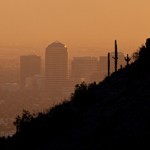
Expect extra-dirty air


Michael McNamara/The Arizona Republic

You have to read between the lines to even get the hint that much (most?) of this pollution comes from vehicle use — both from entrained dust (dust that is kicked up by cars/trucks whooshing by) or emissions (NOX -> ozone, and fine particulates from combustion, particularly from “clean” diesel engines. )

Experts warn of poor Valley air quality The Arizona Republic. A familiar brown cloud is settling over a cool, dry Valley, prompting air-quality experts to warn that residents could be in for a particularly dirty winter.

Bad air expected for Valley through the holidays Bob McClay/KTAR PHOENIX — The Valley’s brown cloud season has arrived, with poor air quality that irritates respiratory systems … Mark Shaffer with the Arizona Department of Environmental Quality. …said the high pressure creates an air bubble that collects ozone below 5,000 feet.

For those of you who don’t follow such minutia, the Phoenix area is what is termed a “Serious Non-Attainment Area” for various forms of air pollution. This leads to, of course, some amount of human misery especially via various lung diseases, but it also brings the specter of loss of federal funds if the air isn’t cleaned up. Some local (state, or maybe county?) agency must produce a plan to clean up the air to the satisfaction of the EPA; that plan (critique here dated 9/13/2010: EPA Disapproves Air Quality Plan for Phoenix ) was rejected in part because “EPA has determined that the SIP (State Implementation Plan) over-emphasized emission reductions needed from construction-related activities and de-emphasized emission reductions from other sources”, you know,  other source like, for example, those produced as a result of using motor vehicles.

EPA Disapproves Air Quality Plan for Phoenix

Positive incentives

I thought that this story: Capital takes bag tax in stride, is an interesting example of a negative incentive. And it got me to thinking about incentives affect behavior. Incentives are entertainingly the central theme of the best selling book Freakonomics, which I disussed here.

So the story is that Washington D.C. enacted a law that mandates that anyone who sells food must charge 5 cents for each bag given. Customers can either bring their own bags, or not use a bag, or pay the nickel. There were the usual predictions of the world coming to an end, however the WSJ story claims no major disruptions have occurred, and even some who opposed the tax initially now have changed their minds.

The bags often become floating trash and muck-up the Chesapeake watershed — a negative externality. The tax is designed to cut disposable plastic bag consumption and, it is hoped, plastic bag waterway pollution by 50%.

Here where I live, we have no such bag tax, of course, but it is trendy for grocery retailers to offer customers a nickel credit for each bag brought in that is then reused — a positive incentive.

Looking around here, it is obvious that the (coincidentally) equal positive incentive has had very little impact on bag usage, whereas the incentive in D.C. has had a large impact. I’ve also noticed that initially the grocers offering the incentive volunteered the credit, and now they seem to “forget” or not notice to give the credit unless the customer points it out, and most/many aren’t likely to do that to earn a nickel or a dime.

I’m thinking there must be a lesson here for things like free parking; which is that positive incentives have little impact, while negative incentives have a huge influence on behaviors.

book: Power Hungry

I just got finished with Power Hungry: The Myths of “Green” Energy and the Real Fuels of the Future by Robert Bryce.

The basic gist is that everything you “know” about power, particularly if you are an American, is wrong. His data is no doubt correct, but I think he goes out of his way to sometimes mislead. For example he claims that the United States economy is somehow very energy efficient. To prove his point he gives figures for the change in energy intensity over some period shows that the US is “winning”, beating such countries as France and others. The trouble is, a simple trip to wikipedia shows that actual, and not the percentage change in Continue reading “book: Power Hungry”

Phoenix city parks to charge $5 fee for parking

More on driver’s attitudes towards parking:

“I’m kind of flabbergasted,” … “It seems like we’re getting taxed right and left. They shouldn’t be charging for this. It’s going to be a financial burden for some people.”

And what is “this”? Why, (formerly) free parking of course. Parking must be “free” and plentiful. And I’m sure it could be a burden for some, but let’s keep things in perspective; Phoenix recently instituted a 2% grocery tax.

The plan would charge $5 a day, yearly passes would be available for $75. [arizona republic]

Little drips make a big mess

More externalities of mass motorization.

The Arizona Republic ran this USA Today story under the better-named  headline “Gulf spill can’t rival oil seepage from cities: Over time, tiny drips add major pollution to oceans”.

“Human-caused spills send more than 300 million gallons of oil into North American waters every decade, an amount roughly double the highest estimate of the BP spill”… “the largest human-caused source of oil into the environment is the byproduct of millions of autos and other oil-powered devices.”

Land-based oil spills add up, too

USA Today, 6/30/2010 Continue reading “Little drips make a big mess”

Burning 10,000 barrels a day

In order to mitigate marine damage, some of the oil that is leaking from the blown-out BP / Deepwater Horizon well, around 10,000 barrels a day is being burned into the open air in a completely uncontrolled combustion. [story from AP: BP starts burning oil from leaking ruptured well, June 16, 2010]

BP or whoever can theoretically run around an pick up every tar ball and clean off every pelican, but who is going to clean the air? As is usually the case, nobody does.  So everyone gets dirtier air. It’s just blowin’ in the wind. Just another externality of oil and gas consumption.

Ezra Klein had a good piece on externalities in last week’s Washington Post:

Think gas is to pricey? Think again Continue reading “Burning 10,000 barrels a day”

Agressivity and SUVs

No, not aggressive driving. This is why (truck-based, not so-called “crossover”/car-based) SUVs and pickups are bad for everybody.

The term agressivity refers to…

The effects of vehicle model and driver behavior on risk,  Accident Analysis & Prevention, Volume 37, Issue 3, May 2005, Pages 479-494
doi:10.1016/j.aap.2004.08.002

We find that most car models are as safe to their drivers as most sport utility vehicles (SUVs); the increased risk of a rollover in a SUV roughly balances the higher risk for cars that collide with SUVs and pickup trucks. We find that SUVs and to a greater extent pickup trucks, impose much greater risks than cars on drivers of other vehicles; and these risks increase with increasing pickup size. The higher aggressivity of SUVs and pickups makes their combined risk higher than that of almost all cars. Effects of light truck design on their risk are revealed by the analysis of specific models: new unibody (or “crossover”) SUVs appear, in preliminary analysis, to have much lower risks than the most popular truck-based SUVs.

Welfare Wagons

In a typical bit of masterful Jenkinsian prose, he lays out the case for raising fuel taxes, which I happen to agree with. However, he scolds “politicians” for not being courageous while at the same time not endorsing any such increase himself. This theme appears over and over in WSJ editorial opinions.

Even if you believe saving gasoline is a holy cause, subsidizing electric cars simply is not a substitute for politicians finding the courage to jack up gas prices. Think about it this way: You can double the fuel efficiency of any car by putting a second person in it. You can increase its fuel efficiency to infinity by refraining from frivolous trips.

These are the incentives that flow from a higher gas price. Exactly the opposite incentives flow from mandatory investment in higher-mileage vehicles. You paid a lot for a car that costs very little to operate—so why not operate it? Why bother to car pool? Why not drive across town for a jar of mayonnaise?

Welfare Wagons, WSJ, May 12, 2010

Use taxes are the best way to reflect the externalized costs of an activity.  E.g. in this example taxes on motor fuel. Fuel taxes have been falling for years, this makes the cost of driving less and less — which, as Jenkins points out, tends to make people drive more and more. There are a couple of reasons the tax is falling, one is the simply that taxes are levied on a per gallon basis and the amounts rarely change (Arizona has levied the same tax for around 20 years), this means the real price of the tax is continuously falling. for 20 years. Another is the tendency for vehicles to become more efficient over time, resulting in a lower tax per mile traveled.

City Liability

The Arizona Republic did a roundup of the city of Phoenix’s motor-vehicle  liability claims paid over the about the past 5 years, 2005 – most of 2009. It was about $15M

Phoenix pays millions… March 6, 2010.

On one hand it seems like a rather moderate amount. And not all of these claims has to do with what would normally be viewed as a traffic crash (like e.g. the bus-door-closing ones). Yet still it illuminates just another unpaid (“external“) cost of our car-culture.

Cities, townships, counties, states, and the federal government all run enormous fleets of motor vehicles, running in the many millions of vehicles. Liability expenses being just one of the smaller costs; fuel, capital cost, maintenance and so forth all add up to more.

The vast majority of these expenses are not paid via any sort of use fees (e.g. gasoline tax) on automobiles — but rather from general fund sources; property taxes, general sales taxes, income taxes, and so forth. And my favorite, the new grocery tax; yes we have to pay city sales taxes on groceries, in part to bankroll Phoenix’s vehicle fleet. I’m thinking government entities don’t even pay the so-called “road taxes” on fuel, nor do they pay other use taxes, like Arizona’s VLT (Vehicle License Tax). More on Road Taxes in Arizona. Continue reading “City Liability”

More on the socialized cost of parking

An integral part of unrestrained car use is having somewhere to put the darn things when we’re not driving them. Enter the “free” parking space.

They aren’t, of course, actually free — thus someone else is paying, not the driver using it, it is external to the cost of driving; call it socialism for drivers. Thus leading to ever more demand for more driving and more parking spaces.

from the Arizona Republic 12/28/2009; Ahwatukee Park-and-Ride Lot Expanding.

In the example mentioned in the story, 353 spaces are being added to the existing 562 for a cost of $3M. That’s $8,500 per space. But that is only the cost of construction (or land but that is cheap); the ongoing costs aren’t listed but they are significant. A not exhaustive list would look something like; lighting, maintenance like sweeping and cleaning, and re-sealing asphalt, full-time(one employee ~ 50hrs/week) security during operating hours, cost of operating the small building (heat and cooled approximately 24×7, even though no one is usually there; didn’t these people ever hear of a programmable thermostat?).

see Doug Shoup’s book mentioned here; The High Cost of Free parking.

In the particular example of a transit park-and-ride lot it gets even more interesting because of the cross-subsidies involved in mass transit. One wonders if the best use of presumably limited transit funds is to build parking spaces for the relatively well-off remote suburban commuters. This lot serves only one bus line; a rapid/express (no intermediate stops) route between Ahwatukee and downtown Phoenix. The line only runs one way, and only in the morning and evening. Thus the parking spots have low turnover — one spot equals one round trip rider.

Photo Enforcement in the mainstream media

The WSJ (news side) did a story on photo enforcement. Since there’s so much activity on this issue in Arizona, we figured prominently in the story.

Overall, it strikes me that it was fairly typical of such stories. The point of view of photo enforcement opponents, “it’s all about the money” is well represented, and I think that’s fair. But what troubles me, though, is the lightweight treatment of the safety aspects and the science involved. Consider:

Studies are mixed on whether traffic cameras improve safety. Some research indicates they may increase rear-end collisions as drivers slam on their brakes when they see posted camera notices…

A study of crash causes released by the National Highway Traffic Safety Administration last July found about 5% of crashes were due to traveling too fast and 2% were from running red lights. Driving off the side of the road, falling asleep at the wheel and crossing the center lines were the biggest causes identified.

Get the Feeling You’re Being Watched? If You’re Driving, You Just Might Be. William M. Bulkeley, the Wall Street Journal, March 27, 2009, p. A1

The truth, or rather, the problem with that analysis is it ignores the relative severity of rear-end vs. an intersection collision. The 5% figure is interesting and misleading at the same time. It refers to the National Motor Vehicle Crash Causation Survey.

The article also talks about use of automated license plate reading technology being used for other (not traffic enforcement) uses, such as catching those with outstanding fines or whatnot.

Meanwhile, just wandering around the internet, I noticed the author of Traffic: Why We Drive the Way We Do (and What It Says About Us), a wonderful book by the way, Tom Vanderbuilt, blogged on the same article as well, with similar criticisms “to compare them so casually is typical of myopic mainstream-media reporting when it comes to traffic safety”. He also puts traffic dangerousness into terms of it being an externality of driving, just one of many, of course.

WSJ: just say no to taxes; and personal responsibility

In yesterdays ed, Tax My Products, Please the WSJ argues that Ford CEO Mually’s call for higher fuel taxes is like “a Google executive demanding a tax on software”.

That analogy being as it may; what they are really renewing is their intentional obliviousness to externalities. And the tacit cost-shifting that inevitably results. Combusting fuel is damaging on its face (even if you don’t “believe in” global warming — as the WSJ editorial board clearly does not). Both in environmental damage and the toll it takes on human health.

So, who pays for all the negative externalities arising from automobility? Drivers don’t; the costs are all shifted to “society”.

They firmly support the status-quo; dead-set against cap-and-trade, and dead set against any increase in fuel taxes. Fuel taxes, which are supposed to fund road construction and maintenance have been dwindling in real dollars for years. The gas tax, which is levied per gallon, hasn’t budged in years; and does not adjust for little things like inflation. It has been at the current federal rate of 18.4 cents per gallon as long ago as 1993 (going on 16years! The arizona state gas tax hasn’t changed in even longer). This leaving a gap which is filled from other funds, like income, sales, and property taxes. (sources that have nothing to with driving).

This underpricing inexorably (remember WSJ eds, the laws of economics?) causes a greater demand for driving, and more roads, and more driving…


To cap off this topic, I’ve pasted below the one letter-to-the-editor that ran in print edition today, March 20, 2009. At first I thought the writer was being ironic, but apparently not. On closer inspection, it seems that he is of the something-for-nothing school. He believes, for example, that a 5,000lb. truck can or should get “more than 30mpg” (though he doesn’t say gallons of what; perhaps it is rocket fuel or something). To support his belief, he cites an acquaintance that has done so; but for unstated reasons, no one sells what would certainly be a highly desirable vehicle — perhaps a conspiracy? In the real world, expect to get about 15mpg in a 5,000 pound vehicle. If automakers (and that includes not just the big-three, but all of them worldwide) could make their engines twice as efficient; THEY WOULD DO SO.

In response to Ford CEO Alan Mulally’s call for higher gas taxes (which you report in “Tax My Products, Please,” Review & Outlook, March 17), I would like to say that Americans don’t want smaller vehicles. We have great distances to travel, mountains and plains to cross in all seasons of the year. We tow our boats and other contrivances. We haul our children around and travel with them over the continent. Our businessmen drive long distances since they can no longer own corporate jets. What we want is a more efficient internal combustion engine, not a smaller car.

And do not tell us it cannot be done. It can be done, because efficient engines can be created today with off-the-shelf parts bought from General Motors, Ford or Chrysler.

A friend of mine has converted a GMC Vortec V8 gasoline engine for his 2.5 ton pickup truck and the engine delivers more than 30 mpg. Why can’t we buy this type of vehicle at the dealer? Why does individual ingenuity have to point the way to corporations that have the money, skill and engineering brainpower to deliver a more efficient engine? Why do we have to pay more at the pump?

The suggestion that consumers should pay more in gasoline taxes is a cop-out on the part of the auto makers, politicians and everyone else who supports it. This is not Europe. This is the United States of America, a vast country with amazing distances and varieties of geography and climate.

We do not want higher gas prices. We want more efficient engines to power our vehicles. We want the Big Three to use their brains to create something new, not deliver a rehash of junk from a bunch of whiners.

Bernard P. Giroux
Fall River, Mass.