
The Bicycle Bicycle Passing Clearance Sign (R4-19) was added to the latest edition of the MUTCD, the 11th edition Dec 2023 (here’s the bicycle chapter: part 9 .pdf). The sign is not presently in in Arizona’s MOAS (Manual of Approved Signs). — I’m not sure what’s up with that since Arizona state law does have a specific minimum passing law as required by the standard in order to use the sign.
Here is some background on how the Passing Clearance sign was developed on its way to be added to the MUTCD.
Section 9B.15 Bicycle Passing Clearance Sign (R4-19)

Option:
The Bicycle Passing Clearance (R4-19) sign (see Figure 9B-1) may be used in jurisdictions that have defined in law or ordinance a specific clearance to be provided by motor vehicles when they pass bicycles.
The specific clearance displayed on the Bicycle Passing Clearance (R4-19) sign may be adjusted to reflect the applicable law or ordinance.

Standard:
The Bicycle Passing Clearance (R4-19) sign shall not be used in jurisdictions that do not have a specific passing clearance to be provided by motor vehicles passing bicycles, as defined in law or ordinance.

Guidance:
The Bicycle Passing Clearance (R4-19) sign should not be used on roadways with bicycle lanes or with shoulders usable for bicycle travel.
I consider the messaging of three foot rules to be weak compared to the more direct and unambiguous statement that bicyclists are allowed to use the full lane, so read on…
Bicycles Allowed Use of Full Lane Sign (R9-20)
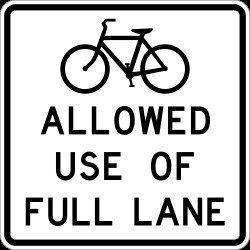 The “allowed” sign, (R9-20) supersedes the older “may” sign (R4-11, often referred to as BMUFL for short) in the 11th edition. I was not aware of this change and have no idea where it came from; and I’m sortof annoyed by it. I preferred the “change lanes to pass” optional placard which is apparently GONE. Curiously the older sign, as well as the optional placard, continue to be available in Arizona’s MOAS (Manual of Approved Signs); and the newer sign IS NOT in the Az MOAS, as of this writing March 2026… while the BMUFL (see below) are still there? What’s the plan for that?
Other Bike-related signs
I didn’t have time but other signs of interest are in the warning (yellow/diamond shaped) section: Bikes in street / in road. Bikes Merge. See section below for a complete list of changes submitted thru Federal rule-making; and just browse through Part 9, Bicycles.
Bicycles May Use Full Lane (MUTCD 2009 edition)


For posterity, here’s an image of a Bicycle May Use Full lane R4-11 sign (along with the Arizona-optional plaque) that appears in previous editions of MUTCD, as well as currently (as of this writing March 2026) in Arizona’s MOAS (Manual of Approved Signs)
Section 9B.14 Bicycles Allowed Use of Full Lane Sign (R9-20)

Support:
01 The Uniform Vehicle Code (UVC) defines a “substandard width lane” as a “lane that is too narrow for a bicycle and a vehicle to travel safely side by side within the same lane.”

Option:
The Bicycles Allowed Use of Full Lane (R9-20) sign (see Figure 9B-1) may be used on roadways where no bicycle lanes or adjacent shoulders usable by bicycles are present and where travel lanes are too narrow for bicycles
and motor vehicles to operate side-by-side.
The Bicycles Allowed Use of Full Lane sign may be used in locations where it is important to inform road users that bicyclists might occupy the travel lane.
Section 9E.09 describes a shared-lane marking that may be used in addition to or instead of the Bicycles Allowed Use of Full Lane sign to inform road users that bicyclists might occupy the travel lane.
Arizona’s MUTCD
Arizona adopted a supplement to the 11th edition as of January 2026. (a bit late?). In any event the supplement has no part 9 (the bicycle part of the federal) which means the federal Part 9 is adopted wholesale.
As mentioned above, Arizona has a MOAS (Manual of approved signs) that has NOT (as of May 2026) incorporated any of the 11th edition signage changes. There is a MOAS changes page, with the most recent update being Aug 2025 and it only R-sign changed/added was R4-108 which deals with trucks in roundabouts.
List of Changes to the new MUTCD
Hmmm, so I can’t find what amounts to a change list for the 11th edition; but the proposed changes were published in the 12-04-2020 Federal Register, it’s kindof interesting because it explains the reasons for a change. Every section contains some bit of reasoning… however when something changes it’s not clear why the change was made. Here are a few examples (there were many many changes/additions that involved bicycles/part 9):
BMUFL changed to BAUFL language change:
595. In Section 9B.14 (existing Section 9B.06), FHWA proposes to
change the legend of the existing R4-11 (Bicycles May Use Full Lane)
sign to “Bicycles Allowed Use of Full Lane.” The standardized sizes
of the sign would not change and the proposed legend would continue to be of commensurate size for its application, ensuring adequate levels of legibility and recognition. FHWA proposes this change because the legend of the existing sign, which was introduced in the 2009 edition of the MUTCD, conveys a warning message on a regulatory sign while the proposed legend would be consistent with regulatory signs that display notification of vehicle codes governing rules of the road.
In addition to this change, FHWA proposes to redesignate this sign
from R4-11 to R9-20. FHWA proposes this change to group this sign with several other proposed bicycle-related signs with the R9 series
designations.
Getting rid of the noxious Share the Road:
This is one we’ve been agitating to get rid of for a long time!!
152. FHWA proposes to delete existing Section 2C.60 SHARE THE ROAD
Plaque (W16-1P) and replace it with a new proposed Section 2C.66 IN
ROAD and IN STREET Plaques (W16-1P, W16-1aP) that contains Option and Standard statements regarding the use of these optional signs to warn drivers to watch for other forms of slower transportation traveling along the highway, such as bicycles, golf carts, or horse-drawn vehicles. Since its adoption in the 2000 MUTCD, research \36\ has shown that the “share the road” message when applied to bicyclists does not adequately communicate the responsibilities of either user group on the roadway. Road users are unclear whether “share the road” means that drivers should give space when passing or that bicyclists should pull to the side to allow drivers to pass. FHWA is proposing the IN ROAD/IN STREET plaques to replace the SHARE THE ROAD plaque based on this research and for consistency with all in road vehicle types.
—————————————–
\36\ The Article, “Bicycles May Use Full Lane” Signage
Communicates U.S. Roadway Rules and Increases Perception of
Safety,” by George Hess and M. Nils Peterson, published August 28,
2015, can be viewed at the following internet website: .
——————————————–
Signage is great, but the actual infrastructure needs to facilitate the multiple uses of roadways. Specifically, I concerned with the striped “buffer zones” I see on roadways particularly in Scottsdale and Phoenix. These buffers never provide a 3-foot clearance to the left edge of the bike lane, and they often steel real estate from the bike lane further narrowing its useful width. Besides, how are these buffers interpreted in relation to statute? Who has right of way in them? If a collision occurs in the buffer, how does ARS 28-735 apply? Do municipalities treat these buffers differently? I think a better solution would be to paint a green stripe 3 feet into the right hand travel lane as measured from the left bicycle lane line and provide signage indicating passage left of that line is required when a bicycle is present.
By not allowing the signs next to bike lanes, it encourages motor vehicles to see the entire travel lane as their right, while passing bikes in a bike lane within inches of them. Really dumb.
The whole 3-ft thing hasn’t been very helpful in my view. For example, consider that many police believe that that law does not apply when there are separate Lanes, see e.g. point number 6 here https://azbikelaw.org/tempe-bfc/
And overall, there’s been virtually no 28-735 tickets issued except as a result of crashes (since the amount of clearance being less than 3 ft was inescapable), despite the law having been on the books for decades.
Precisely the point! These insuficient buffer lanes can be interpreted as “adequate” separation, regardless of the plain language of the law. These grand experimental bicycle infrastructure schemes by well-meaning trafic planners only increase the hazard and diminish the due rights o cyclists. The only fix I see is legislative, but I’m not holding my breath.
Here’s a pretty good roundup of mutcd part 9 stuff:
https://www.facebook.com/groups/roadbikecycling/posts/1790810918133499/
There are no penalties for passing too close if the motorist does not cause a collision.
28-735. Overtaking bicycles; civil penalties
A. When overtaking and passing a bicycle proceeding in the same direction, a person driving a motor vehicle shall exercise due care by leaving a safe distance between the motor vehicle and the bicycle of not less than three feet until the motor vehicle is safely past the overtaken bicycle.
B. If a person violates this section and the violation results in a collision causing:
1. Serious physical injury as defined in section 13-105 to another person, the violator is subject to a civil penalty of up to five hundred dollars.
2. Death to another person, the violator is subject to a civil penalty of up to one thousand dollars.
C. Subsection B of this section does not apply to a bicyclist who is injured in a vehicular traffic lane when a designated bicycle lane or path is present and passable.
Ed, I just saw this and thought I’d reply.
You say that Arizona adopting a state supplement in January 2026 was “(a bit late?)”. In accordance with 23 CFR 655, states have up to two years after publication of a MUTCD edition or revision to adopt it unchanged, develop a state MUTCD supplement, or develop a state MUTCD. Arizona met this deadline. Any state supplement or MUTCD must be in “substantial conformance” with the national MUTCD. As part of the 11th Edition rulemaking, FHWA further restricted the ability of states to modify MUTCD Standards or Guidance to reflect state-specific practices. The entire two-year period was used by Arizona DOT to analyze the 11th Edition, propose modifications to the state MUTCD supplement, negotiate with FHWA with respect to what would or would not be included, and then publish the final supplement.
In past work with NCUTCD, I was involved with the development of the Bicycles May Use Full Lane sign. The wording on that sign was carefully selected and vetted by experienced professionals and practitioners to provide a simple clear message with minimal likelihood of misinterpretation. The revised legend will probably function adequately, but is longer.
In the Federal Register notice for the draft MUTCD, FHWA proposed replacing the Bicycles May Use Full Lane sign with Bicycles Allowed Use of Full Lane, but the draft MUTCD published for review still showed the older sign. This may have affected the docket comments submitted, as reviewers of the draft saw the older sign being retained, albeit with a different code.
It’s my understanding ADOT is now working on updates to the Manual of Approved Signs (MOAS) now that the Arizona Supplement is complete. This process takes time and ADOT has limited staff to perform this work.
As part of the 11th Edition, FHWA added Standard provisions forbidding agencies from using alternative signs if a standard sign is available for that specific situation. Paragraph 13 from Section 2A.04:
“Where a standard sign provided in this Manual or the “Standard Highway Signs” publication (see Section 1A.05) is applicable, an alternative legend sign or alternative sign design shall not be allowed in place of the standardized legend or design except as provided in this Manual.”
This in effect means that agencies cannot use the “may use full lane” legend even if they prefer it or see it as providing better direction than “allowed full use of full lane”.
I was a subconsultant on the 11th Edition revision of the Arizona Supplement and I currently am under contract as Executive Secretary to NCUTCD. In the past, I also managed the MOAS for ADOT. The above reflects what in my professional judgment is an accurate summary of events, but is not intended to be or should be read as an official position of ADOT, NCUTCD, FHWA, or any other organization or agency.
Richard, Thanks for the detailed reply and clarifications