Assembled below for quick reference is a compendium of the consensus view of all traffic safety subject-matter experts about where to ride — this generally applies when riding straight ahead, and between intersections or other conflict zones. For why this is not only safest, but legal, see take-the-lane.
What the Experts Say…
Arizona Dept of Transportation
Arizona Bicycling Street Smarts is a short book based on bicycling traffic expert John Allen’s Bicycling Street Smarts; augmented with references to specific Arizona statutes, and published by the State of Arizona Department of Transportation (ADOT). The full title is Arizona Bicycling Street Smarts: Riding Confidently, Legally and Safely, and is available online in its entirety.
WHERE TO RIDE ON THE ROAD
… In a wide lane, you are safer if you stay 3 to 4 feet to the right of the cars.RIDING IN A NARROW LANE
On a multilane road with narrow lane, ride in the middle of the right lane.Understand that the law is on your side. The law gives you the right to use the road, the same as a motorist, and to make other traffic slow down for you sometimes. The driver approaching from the rear is always required to slow and follow if it’s not possible to pass safely.
It may seem dangerous to make a motorist slow for you, but it’s not….
On a road with two or more narrow lanes in your direction – like many city streets – you should ride in the middle of the right lane at all times. You need to send the message to drivers to move to the passing lane to pass you. If you ride all the way to the right, two cars may pass you at the same time, side by side, and squeeze you off the road.
Many cyclists believe they are safer and more comfortable riding further to the right than this booklet recommends. They fear being passed uncomfortably close by a motorist, or feel intimidated by impatient drivers. Riding too far to the right is very dangerous for several reasons…
— retrieved from azbikeped.org Chapter 2.
American Automobile Association
The AAA is America’s oldest motorist’s organization:
When a road is too narrow for cars and bikes to ride safely side by side, bicycles should take the travel lane, which means riding in or near the center of the lane. — Share the Road & Save a Life, retrieved 4/4/2015 (local copy)
IPMBA
The IPMBA (International Police Mountain Biking Association) is the preeminent supplier of training to law enforcement and other public safety cyclists.
Cyclists do not have to ride only on the far-right side of the road. Most MVCs (Motor Vehicle Codes; including Arizona) allow them to leave the right side when … the width of the street makes it unsafe, especially in situations where riding too close to the roadway edge would encourage a driver to pass despite having insufficient room. In these situations, the cyclist should “take the lane,” that is, ride in the center of the traffic lane. — The Complete Guide to Public Safety Cycling, 2nd Edition; p. 76
The Summer 2005 issue of IPMBA newsletter was devoted to bicycle law enforcement and safety issues.
Effective Cycling
John Forester initially wrote Effective Cycling decades ago, not much changes over the years in bicycling traffic safety basics — from the latest edition:
Proper positioning in lanes of different widths. Cyclists should ride in the center of narrow lanes and just to the right of cars in wide lanes. — Effective Cycling, 6th Edition, page 294
League of American Bicyclists
The League is America’s pre-eminent nationwide bicyclist’s organization.
Lane Positioning — Ride just to the right of traffic. If the lane is too narrow for a vehicle and cyclist to share, the cyclist should ride in the center or right of center of the lane as passing in a narrow lane is unsafe.
Predictability: …proper lane positioning – decreases the likelihood of a crash — excerpted from (LAB) League Cycling Instructor (LCI) Training Manual dated 2/5/2010.
The basics are taught in LAB Smart Cycling: Traffic skills 101.
Lane Position Rule
Ride just to the right of the motorized traffic when the lane is wide enough to safely share. When lanes are too narrow to safely share, ride in the center of the lane or just to the right of the center in the right hand tire trackEducating Motorists
Be aware that when a road is too narrow for cars and bikes to ride safely side by side, bicyclists should take the travel lane, which means riding in or near the center of the lane…. and
Don’t blast your horn when approaching bicyclists.— retrieved Aug 2011 from bikeed.org Chapter 3, page 4, and Chapter 4 page 7
Here’s a more recent brochure from LAB “Smart Cycling Manual”, “:
Where should I ride on the road?
If you don’t feel there is sufficient room for the lane to be shared (side-by-side) you should ride in the middle of traffic lane where other vehicle will have to wait until it’s safe to pass you rather than share the lane. This is called “taking the lane”…
On busier roads with just one lane in each direction, you may have to be more assertive and take the lane by riding in the center of the lane. By doing this you’re communicating that motorists will have to wait behind you until it’s safe for them to cross into the other side of the road… Remember that if motorists can tell from farther away that they can’t squeeze past you (when taking the lane), they’ll be able to plan their lane change earlier, causing less frustration and increasing safety for both parties — LAB Smart Cycling Manual, retrieved 2/12/2017
Law Officer Training: The Law Officer’s Guide to Bicycle Safety
Developed by MassBike (page available on archive.org) under a grant from NHTSA in 2002. This is a model nationwide training guide for law enforcement officers:
Use of Lanes … But narrow lanes require a different approach. The bicyclist who rides in the far right of a lane
that is not wide enough to share with motor vehicles invites motorists to pass unsafely. Riding in the center of such a lane indicates clearly to faster drivers that a partial or complete lane change is necessary in order to pass”— Reference Guide (link now dead, but available on archive.org), page 12. [here are archival copies of the .pdf and .ppt]
There is also a companion youtube video illustrating the point “…merging to the middle of a narrow lane increases safety, motorists who wish to pass must use the next lane”
A presentation version of the material Curriculum_no_video.ppt is available. There is also an equivalent .pdf floating around out there somewhere. There is a good, concise explanation of impeding laws in the presentation, slide 57.
There’s some extensive background on how the program was developed in the Summer 2005 issue of IPMBA newsletter.
NHTSA / Enhancing Bicycle Safety: Law Enforcement’s Role
 nhtsa.gov: Resource Guide on Laws Related to Pedestrian and Bicycle Safety
See this comment for NHTSA/FHWA materials “Enhancing Bicycle Safety: Law Enforcement’s Role”, a 2 hour computer-based class that is unfortunately no longer available (even though as of this writing in May 2016 the web page claims it is) (also, there is a 7-minute youtube available from NHTSA). The 2-hour content does appear to be available in its entirety at bicycledriving.org/law/enforcement
Bicycling and the Traffic Law : Narrow Lanes : There are other reasons that it may be unsafe for bicyclists to keep to the far right of the lane. One of these is when a lane is narrow… — slide 13.
.
AZGOHS (Arizona Governor’s Office of Highway Safety)
You (bicyclists) may ride far enough from the road edge to stay clear of surface debris, potholes, rough pavement, drain grates, and pavement joints, as well as to avoid pedestrians, dogs, parked vehicles, and other objects. You (bicyclists) may occupy any part of a lane when your safety warrants it. Never compromise your safety for the convenience of a motorist behind you. — see azgohs-supports-cyclists-rights
MetroPlan Orlando: Enforcement for Bicyclist Safety
Metroplan Orlando is the regional transportation planning agency for the Orlando Florida metropolitan area; analogous to our MAG (Maricopa county Association of Governments) for the Phoenix metro area. Metroplan has published the guide Enforcement for Bicyclist Safety which was distributed to all law enforcement agencies in their area. [since those links are broken, as of 2023, the same concepts for law enforcement are here at Understanding Cyclists’ Position on the Roadway: for our friends in Law Enforcement.]

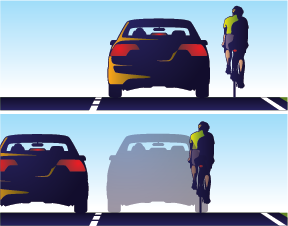
Most traffic lanes are too narrow to safely accommodate a motor vehicle and cyclist side by side. Cyclists who keep right so motorists can pass them without changing lanes actually encourage close passes and sideswipes…It may shock many to learn that a 12-foot-wide lane is considered a “substandard width” for the purpose of this (the “as far to the right as practicable”) statute… Lane control is the most effective strategy for bicyclists to defend themselves against common motorist mistakes (see diagram).
— diagram and text excerpted from MetroPlan’s Enforcement for Bicyclist Safety
American Bicycling Education Association
From the American Bicycling Education Association’s Cycling Savvy program, 10 tips for successful cycling:
Ride Big: Most roads have lanes that are not wide enough to be safely shared by cars and bikes operated side-by-side. You are allowed the full use of a lane that is not wide enough to share. Ride far enough to the left in the lane to communicate to motorists that the lane is not wide enough to share. Motorists may squeeze past you within the lane if you don’t.
Riding big makes you visible and encourages motorists to give generous passing clearance. It also gives you someplace to go if a motorist does come too close.
Also see this (free!) video lecture from Cycling Savvy: Traffic Law: Bicyclist Position on the Roadway. It’s free, and part of a series of video lectures on bicycle traffic safety available for a modest price.

Ohio DOT / YayBikes!
YayBikes! has an article with same name: Where to Ride on the Road, accompanying it is an excellent video funded by Ohio DOT illustrating narrow vs. wide lane positioning, door zones around parked cars, as well as special hazards of sidewalk cycling.
The video is primarily aimed at youth bicyclists, but the lessons apply to all ages: “Teach kids to ride visibly and predictably on the roads; and not to be too far to the right”… On dooring: “to her, it just seems that the safest place to be is as far to the right as possible… but a car door could open at any time”.
Separated Sidepaths / Sidewalks
With regard to sidewalks — In a nutshell “riding on the sidewalk is dangerous, often illegal and not recommended for adults” (p. 13, Smart Cycling Quick Guide, LAB, retreived 2/15/2016).
Strictly speaking, this wouldn’t be riding “on the road” but because many propose that cyclists can avoid collision danger by using a sidewalk or separated sidepath, it’s included here.
The inherent design-flaws in a path which is parallel to, but separated from and adjacent to a roadway are so well known that their use by competent adult cyclists is universally and strongly discouraged. The main problem as it relates to bicyclist-MV collision risk is that every intersection is more dangerous (to the cyclist) compared to using the parallel roadway. Additional serious problems include increased bike-bike, and bike-ped, bike-other (skaters, etc) collision risks on the paths themselves.
Some states actually compel bicyclists to use parallel paths, with what are referred to as “mandatory sidepath” laws. Many states, including AZ, once had such laws and have since repealed them — see bicycledriving.org section called mandatory sidepath use.
Arizona REPEALED its mandatory path law as of 1989 (chapter 269, HB2303 Bicycle Paths; roadways. 39th Legislature 1st Regular session) — this shows clear legislative intent.
Effective Cycling
Nowadays we know that cycling on urban sidepaths is much more dangerous than cycling on urban road… the urban sidepath is the one type of bikeway that the federal government specifically warns against. Because of the extreme dangers of sidepaths, the Effective Cyling Program recommends that you never ride on them, regardless of the laws of your state except where the path parallels a controlled-access freeway or is completely seperated in other ways from the street system, as along a riverfront”
— Effective Cycling p. 262-263
AASHTO Guide for the Development of Bicycle Facilities
The Guide points out the troubles with sidepath facilities:
When two-way shared use paths are located immediately adjacent to a roadway, some operational problems are likely to occur… they require one direction of bicycle traffic to ride against motor vehicle traffic, contrary to normal rules of the road…
When the path ends, bicyclists going against traffic will tend to continue to travel on the wrong side of the street. Likewise, bicyclists approaching a shared use path often travel on the wrong side of the street in getting to the path. Wrong-way travel by bicyclists is a major cause of bicycle/automobile crashes and should be discouraged at every opportunity.
At intersections, motorists entering or crossing the roadway often will not notice bicyclists approaching from their right, as they are not expecting contra-flow vehicles. Motorists turning to exit the roadway may likewise fail to notice the bicyclist. Even bicyclists coming from the left often go unnoticed, especially when sight distances are limited”
— AASHTO Guide for the Development of Bicycle Facilities,1999 p. 33-34
Arizona Dept of Transportation
ADOT Traffic Engineering Policies, Guides and Procedures (PGP), emphasis added:
…Moreover, signs and markings placed along shared-use paths are sometimes interpreted as implying that bicyclists are expected to use the path instead of the adjacent roadway. This can lead to harassment of bicyclists who are otherwise safely and legally using the roadway. — retrieved from Section 1031 SIGNING AND MARKING OF SHARED-USE PATHS, ADOT PGP.
From Arizona Bicycling Street Smarts (emphasis added):
SIDEWALK AND PATH RIDING
Many people consider sidewalks a safe place to ride because cars don’t travel on them. Unfortunately, sidewalks aren’t safe. Stay off them, except where you have no choice.
Trees, hedges, parked cars, buildings and doorways create blindspots along a sidewalk, which is too narrow to allow you to swerve out of the way if someone appears. A pedestrian on the sidewalk can sidestep suddenly, or a small child can run out from behind an adult. Never pass a pedestrian until you have his or her attention.
And cars do use sidewalks – at every driveway and cross street. Since there are no clear rules for travel on a sidewalk, your only choice is to ride very slowly and look in all directions before crossing a driveway or street.
A shared use path can sometimes provide a useful shortcut, and it can be pleasant and scenic. Use it with caution. Even if you are supposed to have the right of way, the path may be too narrow for safe maneuvering. Pedestrians are unpredictable, and intersections are often hazardous. A path can get crowded with inline skaters, dog walkers and careless, inexperienced bicyclists. Most shared use paths are no place for a fast ride or high-speed commuting trip.
— retrieved from azbikeped.org Chapter 9.
…
Encouragement to use sidewalks is pervasive, whether offered by the well-meaning but mis-informed or the self-serving; though the risks are well understood by traffic engineering and safety experts, as noted above. Statistics are hard to come by because traffic crash stats generally exclude injuries arising from crashes (whether they be falls, single “vehicle” bike crashes, bike-bike or bike-ped) that do not involved a motor vehicle. This leaves examinations of hospital records coupled with surveys to try to establish relative risks e.g. (emphasis added):
Accid Anal Prev. 1999 Nov;31(6):675-86. Toronto bicycle commuter safety rates. “The relative rates for falls and injuries suggest these events are least common on-road followed by off-road paths, and finally most common on sidewalks. The rate of major injuries, an injury that required medical attention, was greatest on sidewalks…”
Accid Anal Prev. 1998 Jan;30(1):29-43.
Ottawa-Carleton commuter cyclist on- and off-road incident rates.
“The relative rates for falls and injuries suggest it is safest to cycle on-road followed by off-road paths and trails, and finally least safe on sidewalks. While there were no major injuries reported on sidewalks, the relative rate for these events on paths was greater than the rate for roads… Results suggest a need to discourage sidewalk cycling…”
.
.
And according the the Massachusetts Bicycle Bill of Rights, in a narrow lane a motorist is required to pass a cyclist by completely passing out of the lane as they would any other vehicle and that if it is not safe to pass, then the motorist must “WAIT” until it is safe to do so.
I ride a Velomobile, a human powered vehicle that can be capable of maintaining the posted speed limits. Even so I am passed going over the crest of hills and around blind corners. I am passed on strait aways where cars will pass me and force oncoming traffic onto the opposite shoulders. This will happen even when I am doing the speed limit.
Please see ADOT Study of Business 40 (a.k.a. Route 66) that surveyed five years of bicylist-MV crash data. .ppt or web-viewable.
Of the 75 bike-MV crashes, ONE was motorist overtaking (the motorist was cited).
the major souce of collisions was attributed to wrong-way riding (on the path/sidewalk).
Conclusions: “Discourage wrong-way riding. Encourage on-street riding”
Here is the text of the mandatory path law that was REPEALED (chapter 269, HB2302 Bicycle Paths; roadways. 39th Legislature 1st Regular session) in 1989,
28-815C
Wherever a usable path for bicycles has been provided and adjacent to a roadway, bicycle riders shall use the path and shall not use the roadway.
see: http://azbikelaw.org/floor-notes-legislative-intent-and-bicycle-law/
here is the descriptive language from the City of Flagstaffdraft code revisions annotated:
The (LAB) LCI Manual focuses almost entirely on shoulders being strictly in the context of rural roads:
Riding on the shoulder of rural roads?
1. Ride far enough to the right to allow faster traffic to overtake without crossing the centerline or changing lanes
2. Where motor traffic speed is much greater than cyclist speed, allow extra overtaking room.
3. Scan ahead for surface hazards- common on rural, less well-maintained roads
4. Surface may deteriorate quickly due to lower roadway construction standards for shoulders as opposed to roadway
5. Shoulder may end abruptly
6. Longitudinal cracks or seams between roadway and shoulder – caution when crossing
7. Rumble Strips or Grooves – some types may cause loss of control
8. Moving onto the roadway (treat this movement as a lane change)
Lane Positioning
Ride just to the right of traffic. If the lane is too narrow for a vehicle and cyclist to share, the
cyclist should ride in the center or right of center of the lane as passing in a narrow lane is unsafe.
Lanes may be striped to narrow or a hazard may narrow the usable width of the lane. On roads
where other vehicles on the roadway are traveling above 45 mph or the sight lines are poor, riding
on the shoulder is recommended.
—
The LCI manual also gives this more-specific guidance regading lane widths (this is nothing to do with shoulders); They specificy minimum (a la aashto, among others) 14 foot for sharing, then somewhat oddly they say that you must claim the lane in <12 foot -- i.e. what about 12-14 feet?:
A. Multi-Lane and High-Speed Arterials ... Safety depends on width of the outside through lane. Wide curb lanes (14'+) provide space for bike and car to share side-by-side. 14 feet is the minimum for safe lane sharing but this is not adequate if there are frequent trucks or buses. Lanes less than 12' are too narrow for safe sharing and the cyclist must claim the lane. All traffic must travel at the cyclist's speed, which during rush hours may annoy some motorists. In many states it is illegal to delay more than 5 motor vehicles and the cyclist must pull over to let motorists pass.
I think my quote got truncated; the pluses of a separate path for bicyclists are covered in the article, the minuses are those listed above (e.g. harassment of cyclists using the roadway, greater intersection conflicts)
Planned path along Shea Boulevard would benefit cyclists
Mon Nov 12, 2012 8:19 AM
…But Ed Beighe, author of azbikelaw.org, said that while most might agree a separate path is a good thing, “there are pluses and minuses.”
Here’s a discussions of issues with paths — e.g. “…This is the precise reason that sidewalk and parallel pathway cycling has shown a significantly higher rate of motor vehicle-bicycle collisions. See…”
http://www.richardcmoeur.com/opinbike.html
A wonderful article from July 2013 issue of http://www.lawandordermag.com; the full article is available from the ABEA. (note to self: a copy is archived in “cases” folder of off-line storage)
BICYCLE LAW ENFORCEMENT
Enforce Laws with Mutual Respect
by Kirby Beck
Here is the opening portion of the article, the Myths/Facts were explained very well:
Roads are for motor vehicles: In fact, roads are still for moving people and motor vehicles are but one
type of conveyance by which people move. Slow vehicles are unsafe: Most enforcement officers know that speed kills; however, a perception has developed that vehicles that are slower than other traffic create a hazard; in truth, slower is still safer.
The “right” of speed: Many people believe that you can’t use the road if you can’t keep up. If a heavily loaded truck is unable to accelerate from an intersection or up a hill, most motorists understand and merely tolerate it or pass it when they are able. Yet if the vehicle is a bicycle, intolerance and outrage develops in some drivers. As with all slow-moving vehicles, bikes must use the right lane unless they are preparing for a left turn, but despite common misconceptions, they still have a right to the roadway.
It is safest for bicyclists to stay out of the way: This myth has sadly contributed to the majority of crashes and near-misses cyclists experience. Hugging the edge of the road is actually dangerous for a number of reasons. Most traffic lanes are too narrow to safely accommodate a motor vehicle and cyclist side by side. Cyclists who keep right so motorists can pass them without changing lanes actually encourage close passes and sideswipes. Cyclists who ride farther left and control the lane report no such problems. Motorists pass them in an adjacent lane. If they have to slow down and wait for an opportunity to pass, that’s OK. Empirical evidence shows that any delays motorists experience waiting to pass are usually 30 seconds or less.
Bike lanes make cycling safer: In fact, bike lanes were created because of the myth listed above and the desire for a separate space. Bike lanes force cyclists to ride on the edge, sometimes even in the “door zone” of parked cars, where they might be directly hit or startled into swerving in front of traffic. Channeling bicyclists to the right of other traffic encourages them to be unpredictable — unexpectedly passing slower traffic on the right. When cyclists are forced to ride on the edge of the roadway conflicts arise at intersections and driveways—the most common location of bicycle/motorist crashes. There the cyclist’s position conflicts with turning cars—thru cyclists are to the right of right-turning vehicles and are often screened from the view of drivers turning left.
Bicycle paths are safest for cyclists: Since paths fall outside the scope of traffic laws, behavior on them is unregulated, unpredictable and unenforceable. Conflicts and crashes increase at intersections. Unlike roads, paths don’t go everywhere people need or want to go.
Cyclists riding in the middle of the traffic lane will impede traffic: Where “impeding” laws exist, nearly all clearly state that only drivers of motor vehicles can illegally impede. In the six states where the law does not specifically exclude non-motorized vehicles, it provides for the reasonable speed of the vehicle in question, thus accommodating farm tractors, horse carriages and bicycles. Why is it cyclists are being cited for “impeding” when they are actually driving defensively and in a manner reasonable for their vehicle?
…
Author’s bio:
Kirby Beck is retired after 28 years with the Coon Rapids, Minn. Police. He is a certified IPMBA police
cyclist instructor trainer. He is an expert witness in bicycle crash cases. He can be reached at kirby@
kbeckconsulting.com
Another possibility is the International Police Mountain Bike Assoc… the IPMBA offers internationally recognized Certification and Training Courses — so they are set up to fully train officers in not only how to ride but also in the legal minutia:
The IPMBA Police Cyclist Course: What Do They Do for Five Whole Days?:
From the book: The Complete Guide to Public Safety Cycling, 2nd Edition (google preview), this was somewhere referred to as a textbook for IPMBA training(?):
tales of uninformed LEO’s and judges who willfully misinterpret the AFRAP (As Far Right As Practicable, a.k.a. FTR, Far To the Right) rules are, according to this commuteorlando.com story, a trend
Speaking of FTR (Far to The Right) laws (thanks Mike!); In June 2013 Maine tweaked their FTR law
http://www.bikemaine.org/coalition-news/ld-1460-a-bill-to-revise-maine-bicycle-law-becomes-law
by adding a clarifying clause “except when it is unsafe to do so as determined by the bicyclist” after the AFRAP (As Far Right As Practicable). Sec. 4. 29-A MRSA §2063
Good wording regarding shoulder use in the FLORIDA BICYCLE LAW ENFORCEMENT GUIDE
from floridabicycle.org see also ARIZONA Bicycle LE Guide (based/copied from Florida guide; with az statutes plugged in and adjusted as necessary).
(my emphasis added):
Roads with flush shoulders: where no bicycle lane is marked, a white edge line is typically marked to indicate the edge of the roadway; any pavement to the right of the edge line is shoulder pavement, not a bicycle lane unless it is marked with the bicycle lane symbol.
Since the definition of “roadway” excludes shoulders, cyclists are not required to ride on paved shoulders that are not marked as bicycle lanes, although they may prefer to do so. A cyclist who rides on a paved shoulder typically needs to maintain 2 feet of clearance from the pavement edge. The cyclist should still travel on the right because (1) this reduces crash risk at intersections and driveways (drivers don’t expect traffic on shoulders to approach from the “wrong” direction) and (2) whenever the cyclist enters the roadway (e.g., to pass a pedestrian or other cyclist, cross an intersection, keep clear of a
vehicle approaching to enter the roadway at a driveway, avoid debris or obstructions, etc.), right-side operation becomes mandatory
Mass. / MassBike LEO video; much newer (2014 vs. 2004) than the massbike materials mentioned above.
Some reference materials:
Subject: Re: [LCI Group] Course for police officers?
Florida Law Enformcement Video
https://www.youtube.com/watch?feature=player_embedded&v=Mqvgr-cH_A8
North Carolina materials (prepared by LCI Steven Goodridge; and contains links to many other state specific material):
http://humantransport.org/ncbikeed/?page_id=57
WeBike’s materials are (i think) generic and not specific to any state:
http://www.webike.org/services/enforcement
Here is what the LAB had to say about CHEROKEE SCHILL case in Jessamie County, Kentucky.
There was a 3 part series of articles, first was Steve Clark who runs the BFC program, and went out and rode with Cherokee; next legal guy Ken Mcleod; and finally exec director Andy clarke.
Steve Clark continues to seem to say the right things. The laws of KY are problematical for slow moving vehicles. And as (I) expected, Andy Clarke is the weak-link in defending cyclists’ rights.
I wanted to share this tip about “riding big” (tip #4 from CyclingSavvy) with you based on another near miss (I read about your post on FB, was that near Bartlett? Thank you for sharing). I remember you once told me you rode far right because ‘that is where they want us’ but actually all the education from traffic safety organizations want bicycles to be a visible and normal part of the regular traffic flow, and to avoid right edge hazards. You and I both know this requires more education for responsible driving and driving with care, as many motorists do not understand that bicycles have first come first serve rights just like any other traffic and safe passing. Training drivers to not take advantage of courtesy by trying to squeeze by, instilling safe passing behavior, teaching patience over convenience, and balancing the transportation system to provide for equal protection of all users, is our public responsibility.
There can only be one best practice for any particular situation — it is the consensus (actually, unanimous, as far as I’ve found) viewpoint of traffic safety experts that bicyclists riding in a lane too narrow to share side-by-side ride to the *left*, away from the edge, to be safest.
If you have a different viewpoint, you should be honest and admit that your claims conflict with that of all known traffic safety experts. I’ve collected them here: http://azbikelaw.org/where-to-ride-on-the-road/
I would rather hope that you continue to educate yourselves — but i would also direct you to this group’s (“Cyclists are Drivers!”) “description” (upper right sidebar somewhere). If you cannot align yourselves with these precepts feel free to leave the group instead of spamming it up with get-out-of-the-way, and “dead right” mentality.
One of the problems for cyclists undoubtedly is that they use, or try to, intution to try to determine correct riding position, this quite likey would mislead them into a poor lane position when riding in narrow lanes… as Ezra Hauer writes in A case for evidence-based road-safety delivery
“Intuition and experience are fallible guides to road-safety delivery”
It’s possible to find poor advice from safety non-experts, for example these “bicycling tips” from the AAOS (American Academy of Orthopaedic Surgeons) in cooperation with the AAM (Alliance for Automobile Manufacturers). Their tips range from the innocuous (drink plenty of water) to what amounts to anti-cyclist propaganda. The general tone is that bicycling is a recreational activity, and shouldn’t ever impede or inconvenience (the obviously more important) motorists:
I could say something snarky about a the advice that comes from a lobbying group that promotes the interests of car manufacturers, and a professional organization of people who make money by repairing broken bicyclists… But I’ll leave that to the imagination 🙂
Bad advice about bicycling in popular media abounds, in this case the bad advice comes by way of analogy from a Max Accordino, the tour director for Silo City Paddling:
In this case, the “expert” (presumably, a boating expert, not a road-traffic expert) is mis-applying a boating rule, the law of gross tonnage, to road traffic when it has no application. If the law of gross tonnage applied on the road, cars would have to yield to any truck.
Interesting opinion piece on Seth Davidson’s blog regarding a fake news / trolling incident involving a lane diet backlash (“bikelash”?) in LA’s Playa del Rey area:
Cyclist Guy Hackett prevailed when a Lee County sheriff’s Cpl. Chad Heinemann issued him an FTR citation, showing common misconceptions/ignorance of both the law and traffic safety, fortunately in this case the cyclist prevailed with the judge saying upon dismissing:
“I looked at the conditions of the road to make a determination whether or not it would have been safe for the cyclist to be utilizing his bicycle to the far right of the right lane and I don’t believe that would be safe for the bicyclist, I find Mr. Hackett not guilty.” — Cyclist fights for right to ride in full lane, and wins
Unfortunately, Hackett reports that he continues to be harassed by the sheriff’s department
Some police do get it, e.g. quoted for the story from neighboring Collier county, and showing a reasonable understanding that the bicyclist gets to decide when a lane is too narrow to share “Some may agree or disagree with him, but we have nothing to refute that he doesn’t have the right to take that lane,” said Commander Bill McDonald of the Collier sheriff’s office. “There is a statute that disallows impeding traffic, but it only applies to motor vehicles, McDonald noted”
There’s a good roundup here in this comment about safety reasons why a bicyclist wouldn’t want to ride on a sidewalk (vs riding IN a lane)
https://azbikelaw.org/woman-bicyclist-killed-in-collision-w-truck-horse-trailer/#comment-128155