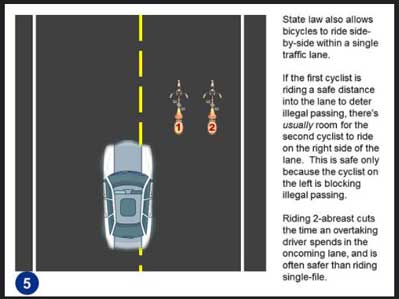
Another excellent, as usual, Legally Speaking with Bob Mionske, Two-by-two, covers the two abreast issue, covering specifically a situation in Wisconsin. Here’s the low-down on Arizona law:
§28-815 B. Persons riding bicycles upon a roadway shall not ride more than two abreast except on paths or parts of roadway set aside for the exclusive use of bicycles.
Note that our statute, unlike the Wisconsin equivalent, does not have any conditions. Wisconsin statute [346.80(3)(a)] .”Persons riding bicycles or electric personal assistive mobility devices upon a roadway may ride 2 abreast if such operation does not impede the normal and reasonable movement of traffic.”
But since Arizona cyclists are subject to all the other bicycling rules that doesn’t really matter.
An oft repeated claim that the whole two-abreast thing is a grey area because of the stay-right rule:
§28-815 A. A person riding a bicycle on a roadway at less than the normal speed of traffic at the time and place and under the conditions then existing shall ride as close as practicable to the right-hand curb or edge of the roadway, except…
If we stipulate that none of the exceptions applies at the time, the argument goes, that the “left” (the one further from the curb/edge) cyclist is by definition in violation of this rule. I know of no case law on this subject, and I would conjecture that it’s unlikely there ever will be. [UPDATE though these are not binding precedents a couple of appeals which contradict this arguement: There are two superior court decisions which reversed lower-court convictions for not one but two left-2-abreast riders for violating Arizona’s FTR law (Far To the Right, also known as AFRAP, as far right as possible) in a narrow lane. This kind of ruling does not create precedent, but gives a clear direction of things, see the Arizona v. Roberts, and Arizona v. Picsopo orders, linked at azbikelaw.org/take-the-lane ]
As a practical matter, most places where it would matter around here are urban arterials that have been built with narrow, multiple lanes. Because they are narrow; the ride-right rule, §28-815 A does not apply. Because they are multi-laned; the impeding rule, §28-704 C does not apply (and §28-704 A only applies to motor vehicles, not all vehicles). Another common scenario are rural two-lane roads with narrow-lanes; any slow driver (including bicyclists) may impede (that is to say they may be impeding other traffic without committing any violation) so long as they comply with 28-704C, the duty to pull out/off roadway when safe.
So, the bottom line is if you would be allowed to impede when riding single-file — e.g. and most often because of a lane that is too narrow to share — then you may also impede two abreast.
Also note that it is always illegal to ride more than two abreast in the roadway, regardless of its impact on impeding, or anything else.
Other gray areas of abreastness: how does one cyclist pass a pair of cyclists riding two abreast? Does riding two abreast in the roadway, abreast of a third cyclist on the shoulder equate to three-abreast? What about a bicycle lane — is a bicycle lane part of the roadway?
It also occurs to me that groups of cyclists often appear from behind to be operating many-abreast when in fact (as seen from above, say) they are no more than two abreast.
Safety
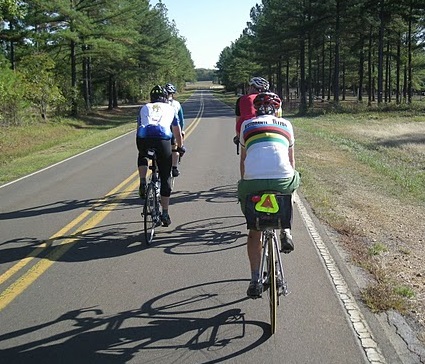
Federal Rules
This only applies in a federal jurisdiction, e.g. a national park…
36 CFR § 4.30 Bicycles.
…
(h)Prohibited acts. The following are prohibited:
…
(4) Operating a bicycle abreast of another bicycle except where authorized by the superintendent.
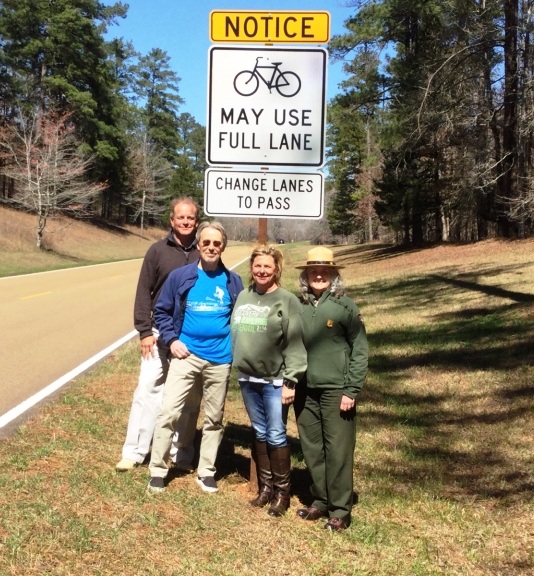 It’s not clear where this mis-guided rule comes from. Where applicable, bicyclists are required by federal rules to ride single file; this is not a conflict, just pointless, when a lane is too narrow to share bicyclists (any number of bicyclists, including one) may legally, and should, control the lane, while motorists who wish to travel faster may change lanes to pass when safe. See, e.g. the Natchez-Trace Parkway where BMUFL/CLtP signage was added in early 2017 to remind drivers that a bicyclist is entitled to use the entire lane. This was kindof interesting; Natchez Trace Parkway Bicycle Planning Study published in 2016. The study recommends erasing the SLMs. (no mention of the Natchez would be complete without mentioning this sad-sack, Marshall Neely III who went to jail after running down a bicyclist)
Federal Mandatory Sidepath Rule
I’ll make mention here, although it’s not related to two-abreast, the Federal Gov’t has a so-called “mandatory sidepath rule”; and sadly it’s very recent, 2011 as part of S. 1813 Moving Ahead for Progress in the 21st Century Act.
Similar discriminatory rules in other places have been going away over the years, e.g. Arizona’s version was repealed in 1989 and a quick check at iamtraffic reveals only eight states have a mandatory sidepath rule. I’m not sure how the sausage got made but here you have it:
23 U.S. Code § 203 – Federal lands transportation program
(d)Bicycle Safety.—
The Secretary of the appropriate Federal land management agency shall prohibit the use of bicycles on each federally owned road that has a speed limit of 30 miles per hour or greater and an adjacent paved path for use by bicycles within 100 yards of the road unless the Secretary determines that the bicycle level of service on that roadway is rated B or higher.
There’s a longer, more thorough rundown of this obnoxious law on John Allen’s page.
you forgot 28-704 section C.
C. If a person is driving a vehicle at a speed less than the normal flow of traffic at the particular time and place on a two-lane highway where passing is unsafe, and if five or more vehicles are formed in a line behind the vehicle, the person shall turn the vehicle off the roadway at the nearest place designated as a turnout by signs erected by the director or a local authority, or wherever sufficient area for a safe turnout exists, in order to permit the vehicles following to proceed.
This usually combats the me me me and I can’t pass.
azbikelaw replies: well, I wouldn’t say I forgot it, i have a link to it, along with a description.
Date: June 25, 2012 9:58:02 PM MST
To:
Subject: Surprise, AZ incident
I’m sure this has happened to most cyclists and it certainly wasn’t my first time – but I think it should be reported. I started to contact Surprise Police, then thought perhaps the Coalition could be more effective.
Three of us, safety-conscious retirees, were riding south on Bullard shortly before 7 am today. The street is four lanes, very little traffic. The two behind me were riding side-by-side. A police car started following us closely, although she could have easily pulled into the other lane and passed. At the stop light she came alongside and informed us that we had to ride single file at the far right; we were not allowed to take up a lane. She was polite enough and probably believed she was correct. We acknowledged her and rode away in single file, although we knew Arizona law permits two abreast riding.
I looked at the Surprise legal page and found nothing regarding riding single file (though I could be mistaken), so I assume they should follow the Arizona rules. The point is education! Obviously police officers should be familiar with the law.
Sandy
—
Sandy:
you can get the specific statute references here:
http://azbikelaw.org/two-abreastness/ (this article) and
http://azbikelaw.org/take-the-lane/
And in the latter reference, i would especially point out the Pima County Attorney’s / Sheriff’s office memo that is linked there, it which deals directly with this issue — in short there were on-going problems with PCSO wrongly ticketing the “left” two-abreast cyclist. Surprise, of course isn’t in Pima county; but all of the analysis and reference are to state statute.
Also of note in the second reference is two specific two-abreast cases in pima county (Roberts and Piscopo) who were ticketed and found responsible at trial for violating 815A (not riding far enough to the right), despite it being a “narrow” lane. Both cases were reversed on appeal. It’s pretty sad that police and (lower court) judges get this so wrong.
When the lane is narrow, cyclists are advised to move further LEFT in order to prevent vehicles from squeezing by. I would further advise multiple cyclists to do so two-abreast (particularly on a 4-lane road, where there is always another adjacent same-direction lane that is available for overtaking) because you are more likely to be seen sooner by overtaking traffic
So the only question is, was the lane in which you were riding at the time “too narrow for a (one!) bicycle and a vehicle to travel safely side by side within the lane”?
Around where I live, somewhere between most, and the vast majority of lanes are clearly too narrow; but obviously this varies.