
[Update 2017: please also see “Change Lanes to Pass placard R4-11aP available for use in Arizona]
Apparently I’m a little behind the times, a new version of the MUTCD was released in Dec 2009 and includes a couple of new items for cyclists:
Section 9B.06 Bicycles May Use Full Lane Sign (R4-11) , sometimes denoted as BMUFL and
Section 9C.07 Shared Lane Marking. (known colloquially as a Sharrow)
The last time I wrote about Shared Lane Markings, see Sharrow / Shared lane marking (SLM), they were “experimental”.
The 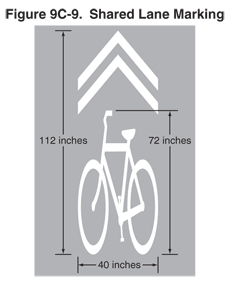 SLM seems like a really good idea that is practically useless in the vast majority of the hundreds of square miles of Phoenix because they are not allowed discouraged (the actual Guidance says “The Shared Lane Marking should not be placed…”) on roadways that have a speed limit above 35 mph”) — that’s practically all of them where sharing is an issue in Phx metro area.
It’s worth noting the 35mph recommendation applies only to SLMs (sharrows) and not to BMUFL signs. BMUFL can be used on roads with any speed limit; this apparently was still confusing so there is an official interpretation that says so: Interpretation Letter 9(09)-19 (I) – Use of R4-11 Sign on Roads with Speed Limits above 35 mph
Sign Size
Sign size minimums are given in Table 9B-1. Bicycle Facility Sign and Plaque Minimum Sizes of the MUTCD; the BMUFL sign minimum is 30×30 inches, there is no smaller variant. That’s pretty big, by comparison, an R3-17 Bike Lane sign is only 24×18. I mention this only because somebody posted a picture of a too-small BMUFL sign; that would be non-compliant.
The BTC of the NCUTCD
This handy link shows all the status of any recommendation (looks like anything back to 2010); e.g the sharrow has some pending proposals approved by NCUTCD Council in 2017 are rather weak tea, I’m afraid. The changes don’t modify the present, and bad, 4′ placement minimums (the current 11′ w/parking spec is increased to 12′ so at least that is a good start)… offering instead an “option” to center them in the lane. They don’t touch the “should not” language about 35mph. Though even at 12′ from the curb it’s still can be in the door zone (it would need to be nearly 12’8″ to meet the NCHRP 766’s recommendation/guideline/logic referring to door zone bike lanes)
ITE Traffic Control Devices Handbook
Regarding the dreadfully poor minimum guidance on SLM positioning the ITE Traffic Control Devices Handbook gives much stronger and useful guidance as detailed in an article at bikewalknc.org where there are several tables from the handbook reproduced — it says, e.g. in a no-parking situation with a 12.0′ lane should have a sharrow positioned 6.0′ … in other words, centered in the lane. Simple. From the Handbook: “Another approach is to center the marking in a lane that is too narrow to share. This clearly indicates a bicyclist is allowed full use of a narrow lane, and is likely to produce more consistent overtaking behavior…”.
Also, Dan Gutierrez has an excellent set of pictures/diagrams (here’s another set, Here’s another much longer set; note that apparently now you need to log into facebook to see these) that illustrates that 11′ really isn’t enough over parking considering the door zone. I wasn’t completely clear from all those slides, but I think he’s saying 13′ should be the minimum in order to stay out of the usual door zone; and that they were working on recommendation for streets without parking.
Around here, I rarely encounter on-street parking (on busy roads; virtually all of the arterials around suburban Phoenix in the newer areas are no parking)… so i hadn’t given it much thought.
In the common arterial around here: no-parking, narrow-multi-laned arterials (usually 11′ lanes) — it seems to me that 6′ from the curbface to centerline of the marking is about right (has anyone done the math?) is appropriate. Narrow meaning not wide enough to safely share side-by-side with a vehicle — generally recognized as anything 14′ or below (see e.g. AASHTO).
Proper Placement of SLM

Note that the MUTCD only specifies the minimum distance of placement, as measured from the curb to the center of the marking; for safety, the placement should be centered in the effective lane.
The specification for when parking is allowed is a scant 11′ and is not enough to get out of the door zone. See photo example of a properly, for safety, placed SLM next to parking. Otherwise you would have the same safety problems as with door-zone Bike Lanes. (see also below for reference to Bike Lanes Next to On-Street Parallel Parking which contains dimensions for SLMs next to on-street parking)
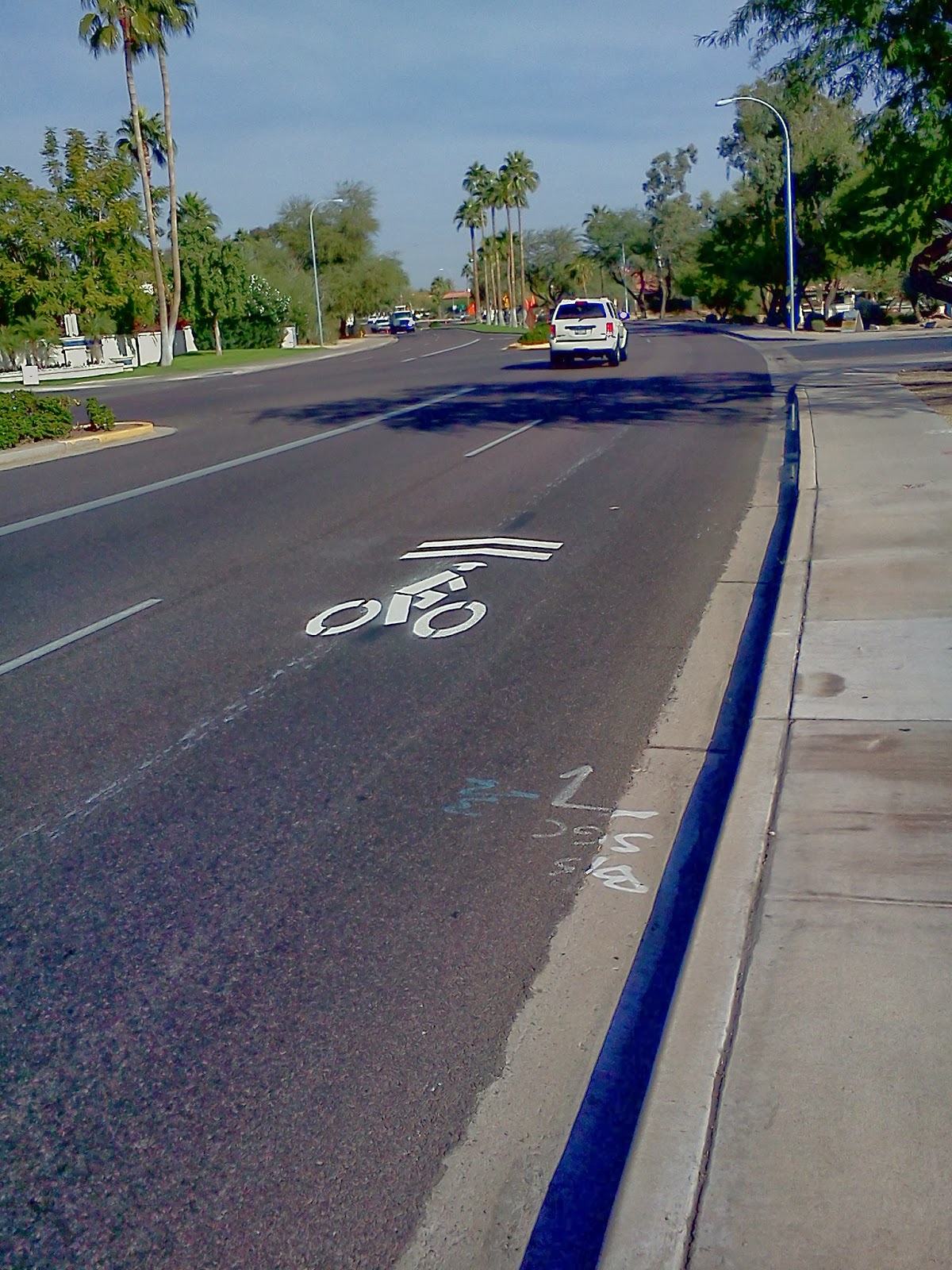
When there’s no parking, the SLM should simply be centered in the effective lane; see this bad example, which was an error and was quickly corrected; nevertheless that bad placement met the MUTCD standard(!). Here is how it looks when corrected. There’s a discussion immediately below about the symbol used in this photo.
Here’s a good-news story about a sharrow that was initially poorly placed in the door-zone of parked cars, but was moved into a proper position in 2015, City of Oceanside, CA.
Non-Standard SLMs?
For some reason some cities have sometimes been using non-standard markings; this seems baffling, and have no idea why they do this. The one correct marking spec’ed in Fig 9C-9 is depicted above. I’ve seen this both in Phoenix (though in some places the correct symbol is used); and Tempe. The use of the “helmeted rider” stencil is specifically mentioned in FHWA MUTCD Part 9 FAQ; the answer is quite clear an unequivocal: no you cannot substitute symbols:
Q: Can I use the Helmeted Bicyclist Symbol pavement marking in lieu of the conventional Bicycle Symbol pavement marking for incorporation into the Shared Lane Marking shown in Figure 9C-9?
A: The Helmeted Bicyclist Symbol pavement marking (see Drawing B in Figure 9C-3) may be used for the Bike Lane Marking. However, for uniformity the conventional Bike Symbol pavement marking (see Drawing A in Figure 9C-3) as shown in Figure 9C-9 should be used for all Shared Lane Markings because that was the symbol tested during the experimental stages that yielded the best result.
Research
Separate infrastructure advocates tend to dismiss shared lane markings as at best ineffective; see below for some references to e.g. the Ferenchak and Marshall TRB working paper “Relative (In)Effectiveness of Bicycle Sharrows on Ridership and Safety Outcomes”. The research has limitations which tend to be overlooked in the popular press (Atlantic Cites, Tree Hugger, streetsblog, etc).
Here’s some recent (2015) published research from the journal PLOS/one:
“Bicycles May Use Full Lane” Signage Communicates U.S. Roadway Rules and Increases Perception of Safety George Hess , M. Nils Peterson
Although limited in scope, our survey results are indicative and suggest that Departments of Transportation consider replacing “Share the Road” with “Bicycles May Use Full Lane” signage, possibly combined with Shared Lane Markings, if the intent is to increase awareness of roadway rights and responsibilities.
There are several references to studies done measuring bicyclist positioning on facilities with properly-centered (in the effective lane) SLMs next to on-street parking, see: DOORING IS REAL. SO STOP PUTTING BIKE LANES IN THE DOOR ZONE which links the research paper Bike Lanes Next to On-Street Parallel Parking by Paul Schimek… These references report that the percentage of riders outside the door zone increased significantly.
Speed Reduction Markings

Here’s an application of Speed Reduction Markings in combination with Shared lane markings. Escondido, CA. they are on an uphill approach.
Section 3B.22 Speed Reduction Markings
Support: Speed reduction markings (see Figure 3B-28) are transverse markings that are placed on the roadway within a lane (along both edges of the lane) in a pattern of progressively reduced spacing to give drivers the impression that their speed is increasing. These markings might be placed in advance of an unexpectedly severe horizontal or vertical curve or other roadway feature where drivers need to decelerate prior to reaching the feature and where the desired reduction in speeds has not been achieved by the installation of warning signs and/or other traffic control devices.
.
List of States that have not adopted BMUFL sign
Because of the way the MUTCD works in individual states, in 17 states the entire MUTCD is adopted wholesale, is adopted subject to supplementation (as in Arizona; where there is no supplementation regarding part 9), not adopted, or even specifically disallowed…
New York: “The R4-11 sign shall not be used in New York, as its message is not an accurate reflection of Section 1234 of the New York State Vehicle and Traffic Law, and could mislead inexperienced bicyclists into occupying inappropriate, and unsafe, positions within a roadway.”
there are others, but I can’t find them now…
.
I posted today about the “helmeted bicyclist symbol” from the 2009 MUTCD that is replacing the diamond symbols on bike lanes that I have ridden on recently. I just noticed it this morning, but couldn’t find a reference online for exactly when they started doing that in Phoenix. I’m with you regarding the sharrows; most of the Valley would not appear to be suited for them. Perhaps downtown streets?
Yes but 75 percent of Phoenix is residential roads.
I wonder why the 35 mph limit is there?
The 35 MPH wording was inserted during final debate at the January 2007 meeting of the National Committee on Uniform Traffic Control Devices. Approval would have been unlikely without this provision (it had already been voted down in June 2005).
Note that the 35 MPH wording is a Guidance condition; i.e. recommended but not mandatory. An agency can install SLMs on roadways with higher speed limits, as long as engineering judgment or an engineering study indicates that it is appropriate.
rcm
Re: Shared lane use (“sharrow”) placement
Richard C. Moeur, PE, 02/01/2010
Remember that the MUTCD dimensions are intended to define reasonable minimums, not establish blanket recommendations. It’s expected that other design guidelines, such as the next AASHTO Guide for Bicycle Facilities (currently a final NCHRP draft), will provide much more detailed guidance for shared lane
markings, similar to how the current Guide provides details on bike lanes.
In lanes without on-street parking, the width of the outside lane will be the critical factor in SLM placement – not traffic volume, bicycle volume, presence or absence of curb or gutter, etc. If the lane width (excluding gutter) is 14 feet, then a 4 ft offset is appropriate, as the lane can accommodate a motor vehicle and a bicycle side by side in that lane. If the lane is narrower than 14 ft, then UVC 11-1205.a.3 (and the law in most states that is similar to this provision) releases bicyclists from any obligation to stay to the far right. In these narrower lanes, SLMs should be placed near the center of the lane, as a placement to the right will likely encourage unsafe passing by overtaking
traffic within the lane – which can then increase the risk of a hit-from-behind crash, and reduces overall safety.
A recent study of lane positioning vs. passing offset in narrow non-sharable lanes showed a marked difference in passing offset based on lane position. Riding to the right side of the lane was much more likely to encourage passing by overtaking traffic with less than 3 feet of separation, whereas riding
toward the lane center (remember, this is a “non-sharable” lane) was associated with much wider passing separation distances – an important factor in the many states with “3-foot-passing” laws.
Press Release from Phoenix Political Pedal Power (P4)
January 3, 2012, For immediate release
Phoenix Political Pedal Power strongly appreciates that the City of Phoenix has begun to use Shared Lane Markers (SLM, aka Sharrows) for increasing cycling safety when street configurations warrant them. The first use is on 48th St approaching Guadalupe Rd. where the right-most traffic lane is too narrow to be shared by a cyclist and motorist at the same time.
The presence of a Sharrow has meaning to motorist and cyclist alike. To the motorists, it means that cyclists may be using the whole lane in compliance with State Law, ARS 28-815.A.4. To the cyclist, it indicates the safest position relative to the configuration of the road and is a discouragement to motorists trying to squeak by when there is insufficient room for a safe passing.
We hope motorists and cyclists alike will continue to Share the Road in this new configuration. In this case, Arizona Law provides for the cyclist to use the whole lane when it “is too narrow for a bicycle and a vehicle to travel safely side by side within the lane”. Sharrows have been used in other Cities and States for a few years and the results have been better for all users of the roads.
See P4 on FaceBook at http://www.tinyurl.com/p4bike. P4 functions as the political action arm of Arizona Bicycle Club (ABC), a 501(C)4 organization advocating save and effective cycling, and organizes many rides for all abilities and skill levels. ABC is a member of the League of American Bicyclists which provides education by certified instructors in cycling safety and ratings of the cycling friendliness of communities, States and businesses.
For information, call Gene Holmerud, LCI #1193 at 602.243.6136 or 602.390.5344
###
Searching the http://transportation.org site , this popped up, the history of the BMUFL sign:
http://scote.transportation.org/Documents/Bike1BikeUseFullLaneSign(3Pgs).doc
“The TRB Highway Capacity Manual assumes that no lane sharing occurs on
lanes 12 feet or narrower”
http://greatergreaterwashington.org/post/15292/maryland-leads-but-counties-hesitate-on-new-bike-signs/
Frequently Asked Questions – Part 9 – Traffic Control for Bicycle Facilities — Markings / Q4
Q: Can I use the Helmeted Bicyclist Symbol pavement marking in lieu of the conventional Bicycle Symbol pavement marking for incorporation into the Shared Lane Marking shown in Figure 9C-9?
A: The Helmeted Bicyclist Symbol pavement marking (see Drawing B in Figure 9C-3) may be used for the Bike Lane Marking. However, for uniformity the conventional Bike Symbol pavement marking (see Drawing A in Figure 9C-3) as shown in Figure 9C-9 should be used for all Shared Lane Markings because that was the symbol tested during the experimental stages that yielded the best result.
This is a great, concise statement about BMUFL, from pvcycling.wordpress.com
now “cycling in the South Bay” https://citsb.com/2016/07/16/the-stubbornness-of-a-good-idea-2/
Paper from the TRB 95th Annual Meeting Compendium of Papers
The Relative (In)Effectiveness of Bicycle Sharrows on Ridership and Safety Outcomes (link now dead) by of Ferenchak and Marshall. The first version of this study was only available with a fee from TRB. The new version can be downloaded for free at ScienceDirect; now titled Advancing healthy cities through safer cycling: An examination of shared lane markings.
Finds that areas that “…had only sharrows installed experienced a significantly smaller drop in injuries per year per 100 bicycle commuters (6.7 fewer injuries) than block groups with bike lanes (27.5) or even those with no infrastructure installed (13.5). This work raises concerns about the effectiveness of sharrows and highlights the importance of providing adequate infrastructure for bicyclists”
But unfortunately doesn’t seem to be well-controlled; i.e. apples vs. oranges problems. It also raised the question about the exposure metric of using bicycle commuters.
Here is Patricia Kovac’s critique and review of of Ferenchak and Marshall (or on figshare); excerpt:
and some commentary in this google groups thread; as well as a May 2017 video from Toronto on John Allen’s page.
This sharrow/BMUFL combo was added to Oak St just E of 60th St in Scottsdale in spring of 2017
Commentary from April 13, 2017 – As seen in the photograph below, Scottsdale has recently added a large Bikes May Use Full Lane sign on the pavement before the bottleneck in the westbound lane of Oak Street just east of 60th Street. This will be welcomed by those of us who frequently cycle from Scottsdale to Phoenix via Oak Street.
Oak Street was once a very safe street for cyclists riding over the hill from Central Scottsdale to East Phoenix. It is still a popular cycling route, although many years ago, Scottsdale decided to make the intersection at 60th Street safer for pedestrians crossing Oak Street to enter the desert of Papago Park. The problem is that the intersection is in a dip between two rises near the top of the hill. Motorized traffic approaching from the west is hidden by a slight rise. Pedestrians would start to cross the street from north to south only to realize too late that a speeding motorist was approaching from the right. The options were to stop in the middle of the street and hope not to be run down or to run across the eastbound lane, but many of us are so old that we can no longer sprint to get out of the way of traffic.
Editorial July 2023 by Snyder/PfB about why he thinks sharrows are no good.
There are a couple of references, but the meat of his argument is what I’ll call the “facilities thing”:
“Sharrows do, however, accomplish something pernicious which I did not anticipate. They allow officials to take credit for doing something for bicycle safety without impacting car traffic, even though that something is next to nothing. It’s just pretending”
His editorial becomes the basis for a July 2023 momentum mag article
They refer to an unnamed “…study published in the Journal of Transport and Health found that…”. It’s weird they don’t bother to give a reference. But it would appear to be none other than the June 2019 F&M paper referenced in the above comment and analysis.