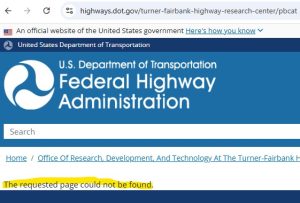
[update: the PBCAT tool was restored as of sometime on August 11, 2026]
PBCAT, the Pedestrian and Bicycle Crash Analysis Tool, is an open-access crash typing application, it’s produced by the US Dept. of Transportation, USDOT.
The internet archive site of USDOT’s page describes it as:
PBCAT is designed to help State and local transportation safety practitioners and researchers develop new variables to describe collisions between motorists and non-motorists on trafficway or non-trafficway locations. High quality crash type descriptors are frequently missing in crash databases but are important for varied safety approaches. PBCAT users can apply PBCAT crash types and contextual factors to help identify preventable crash scenarios and inform a variety of strategies and solutions to improve non-motorist safety. The data can be used to help improve the safety of infrastructure, vehicle and interactive technologies, behaviors, and policies to reduce non-motorist crashes and injuries.
The federal gov’t has inexplicably removed access, and their page now just says “The requested page cannot be found”. Hmm. Why would that be? Why would the federal gov’t be opposed to a tool that helps identify policies to reduce non-motorist crashes? Why would the federal gov’t be opposed to a tool that helps identify preventable crash scenarios? Why would the federal gov’t be opposed to a tool that can be used to help improve the safety of infrastructure?
You be the judge. It’s been suggested it might have something to do with President Trump’s DOT Secretary Sean Duffy’s references to “DEI Bike lanes”; along with the recent expunging of many other safety-related pages on DOT’s website.
All bicyclist and pedestrian fatalities are crash-typed in the FARS database, since 2013. FARS is the annual list of all traffic fatalities in the United States. You can view PBCAT results for all Arizona bicyclist fatalities from 2013-2023 (2024 is available but the spreadsheet hasn’t yet been updated).
NACTO makes available resources related to five proven safety countermeasures that were removed from FHWA website
This doesn’t include access to PBCAT*, but does provide a public service by archiving what FHWA used to call “proven safety countermeasures”… they were removed for no stated reason. No evidence, or even claims, just poof and it’s gone. Weird?
* PBCAT used to be a Windows program years ago. The current version (V3) is a web-app meaning I suppose if push came to shove, they’d have to release the code with a FOIA request(?).
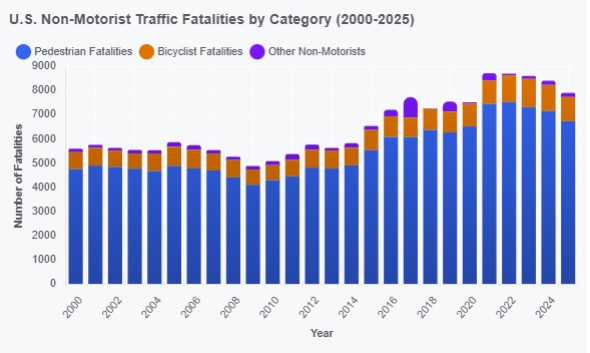
years 2000-2024 are final figures from FARS/NHTSA. 2025 is an estimate. The chart was produces by google, and notes that:
-
-
- The U-Shaped Curve: The graph shows a clear multi-year dip throughout the 2000s, hitting its absolute historical low point in 2009 (4,883 total fatalities) before starting a steady, aggressive climb upward.
- The Pedestrian Surge: The dramatic overall increase seen after 2014 is almost entirely driven by the rapid expansion of the bottom segment (Pedestrian Fatalities), which grew from fewer than 5,000 annual deaths to over 7,500 at its peak.
- The Bicyclist Baseline: Bicyclist deaths (the middle segment) remained remarkably flat between 600 and 800 for the first 15 years of the chart, only climbing past the 1,000-annual-death threshold during the recent 2022–2024 tracking cycle.
-
Below is an attempt to embed an interactive chart using google/AI’s help ; it’s failing for some reason i can’t understand:
U.S. Non-Motorist Traffic Fatalities by Category (2000–2025)
In case anyone is following this page, access to the PBCAT tool was restored as of sometime on August 11, 2026