Unfortunately, the Arizona Revised Statutes (ARS) specifically grants the power to local authorities to further regulate bicycles in §28-627 , including allowing them to require “…the registration and licensing of bicycles”.
So does your city require registration? What about the city you’re riding through? Who knows? You would have to comb through every city’s ordinances, and even then you might find that things aren’t as they seem 🙂
Phoenix
Phoenix’s ordinances are happily all online (see Chapter 36, Article IX). It that link doesn’t work, try phoenix.gov/citygovernment/codes/citycodes/ and look for “Phoenix Municipal Code”. It is currently (as of 2013 anyway) served up at phoenix.municipal.codes (check out chapter 36, vehicles and traffic), and no longer municode.com
Sec. 36-98. License requirement.
Every owner of a bicycle, before the same shall be operated on any of the streets, alleys or public highways in the City, shall obtain a license from the Division of Licenses.
Sec. 36-101. License fee.
For each license required by section 36-98, a charge of fifty cents shall be made.
Sec. 36-103. Number plates–Display.
Number plates on bicycles shall be permanently fastened to the bicycle so as to be clearly legible and readable.
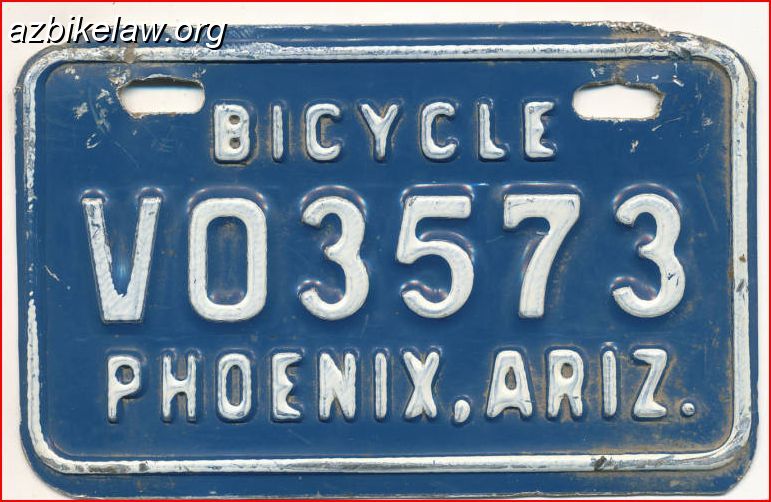
At this point I’m getting pretty jazzed up that i can get a license plate for my bike, and for only 50 cents!
Now, I should say that I have never heard or seen one of these bicycle license plate, nor have i ever heard of not having one causing a problem — but hey, if i can avoid trouble for the cost of 50 cents, I’m gonna do it! Alas it was not to be, after making two calls (June 2, 2009) I gave up

#1: The Licensing Division. The guy I spoke with said there is no such thing, and if there were such a thing, this would be the right place. He wasn’t interested in any further discussion.
#2: Phx Police “info line”. I spoke with Officer Clack. He said he never heard of such a thing, and that “we (the police) would never ask for it”. He figures there are a lot of old laws on the books, and that I shouldn’t worry about it.
Similar laws are on the books of probably every city in Arizona. Feel free to leave your experiences with bicycle license plates.
Below is a letter sent to Tucson Mayor and City Council members from TPCBAC, biketucson.pima.gov , advising against instituting a bicycle licensing program:
March 31, 2011
Re: Bicycle Licensing
Honorable Members,
In response to the Budget Option Balancing Systems (BOBs) item regarding bicycle licensing, the Tucson-Pima County Bicycle Advisory Committee (TPCBAC) has voted unanimously against the licensing of bicycles.
One of the goals that the League of American Bicyclists (LAB) asked Tucson to meet for the Platinum Bicycle Friendly award was an increase in riders in the metro area. Bicycle licensing will be in opposition to this goal for the following reasons:
• It would almost certainly cost more to run the program than a merely nominal charge would generate. Either the “tax” would be onerous to the citizens who own bicycles or the program would not be self-funded. A $10.00 fee would not pay for the licensing program and $25.00 for bicycles that often sell for that amount at swap mewould be prohibitive for the owners.
• Licensing will have a negative impact on visitors with bicycles and part-year residents. It will affect El Tour de Tucson, Tour of the Tucson Mountains, and other annual events. These events are important to Tucson’s economy and many local businesses.
• Enforcement will be difficult. There will be a segment of bicycle owners that will not pay the licensing fee. Whether they simply are unaware of it, think they are exempt because they are “passing through,” or just obstinate, there will be people who don’t comply. The TPCBAC does not believe that the cost of enforcement would be offset bya $10.00 fee.
• Adding a bicycle licensing division to City government is contrary to the BOBs line item to eliminate jobs.
In addition, cyclists already pay a 9.1% sales tax; bicycles do not create potholes which require maintenance; bicycle parking is less costly than automobile parking; many Tucson residents do not drive and their multi-modal forms of transportation should be accepted without additional fees; and cycling helps reduce obesity for a healthier Tucson.
Cyclists don’t cost that much. LAB reports that annually, 43,000 people lose their lives on U.S. roadways costing about $260 billion. (2.6 million non- fatal collisions). Only 720 are cyclists. The cost of collisions and crashes of cyclists simply does not equate to overall roadway crash costs. There is a need to maintain vast storage yards for crashed motor vehicle that are removed from the roadway. Not so for bicycles. Bicycles are the third safest form of transportation (third to elevators and public busses).
The TPCBAC offers these alternate suggestions for ways to save the city money or to raise revenue:
• Tucson can add a box to the water bill for bicycle enhancement funding. This would be similar to the current voluntary $1.00 donation to Open Spaces and Green environment that is currently on the water bill. Many bicyclists have expressed a willingness to donate to such a fund if it will be used for roadway cleaning. Many motorists who want cyclists to not “take the lane” due to debris may also wish to contribute.
• Tucson can implement a “crash fee” that is assessed against any motorist that a) causes a crash as observed by the investigating officer (i.e., citation for running a red light, etc), and b) requires roadway cleanup and debris removal from the roadway regardless of which vehicle creates the debris.
• The Clean and Beautiful program is an excellent way to use volunteers to perform maintenance and clean-up. Many cyclists have experience with equipment (including street sweepers) and have expressed a desire to run the street sweepers themselves if the City will make them available. The City can reduce liability by including volunteers in appropriate training programs, and then save money by letting the volunteers help out.
The above is not an exhaustive list of reasons to avoid licensing and likewise, merely scratches the surface of alternate ways of generating revenue. Certainly, the City of Tucson can work to build a community that is truly unique and outstanding.
For the foregoing reasons, and further reasons not articulated in this letter, the T-PCBAC objects to the licensing of bicycles in Tucson and respectfully asks that the licensing of bicycles be removed from the Budget Option Balancing Systems.
Thank you for your attention herein.
Eric Post, Enforcement Sub-Committee Chair, TPCBAC
(520) 207-9601
cc: Pima County Board of Supervisors
CITY OF GILBERT — no registration required.
so i broke down and hunted up gilbert’s code: http://library.municode.com/index.aspx?clientId=12036
bikes are in chapter 62; and also search on bicycle/bike, etc. don’t turn up any sort of registration
There are a whole bunch of “reserved” ordinances in the bike section so it may well be there was a requirement in the past that got repealed.
i also called gilbert police’s “crime prevention hotline” (as directed from this web page where it actually says “to register your bike…” http://www.gilbertaz.gov/police/biketheft-tips.cfm )
And spoke to a very nice lady who was unaware of any such requirement.
She explained the only registration they have is a form they hand out where the owner fills in things — BUT THE POLICE DO NOT EVEN RETAIN A COPY — the idea is simply to get the owner to write down the identifying information so the owner can more easily locate it in the event of theft.
CITY OF TEMPE — registration by residents is REQUIRED. I am not aware that this is ever enforced, and/or if it were, what the penalty would be.
http://www.tempe.gov/index.aspx?page=820&parent=3933
See Chapter 7, bicycles
http://www.tempe.gov/Modules/ShowDocument.aspx?documentid=8704
CITY OF CHANDLER — Registration “is encouraged”. The Police have an online form for registration
CITY OF MESA — Registration REQUIRED
http://www.mesaaz.gov/clerk/codebook/table_of_contents.aspx See Title 10
http://www.mesaaz.gov/clerk/codebook/CodeinPDF/T10/T10Ch1.pdf
By the way, and this is why I try to avoid reading all these damn local laws — bicyclists in Mesa are required to ride FRAP (as Far Right as Possible) with NO exceptions. E.g. turning left? sorry, you must right on the right. Lane too narrow to share? tough luck, ride in the gutter and hope for the best.
I have a State of Arizona bicycle license plate that I got when I was a kid for my first bike. It is blue, and looks just like the picture above, and yes you could send in 50 cents to register your bike. My mom sent it in. Have a great day!
Came across city of Avondale, AZ that supposedly requires bike licenses. Ridiculous, IMO for the reasons quoted earlier regarding the defeat of the issue in Tucson. I believe these city-based ordinances need to be repealed.
I had the blue Phoenix bicycle license plate for my first bike in 1950. We went to a bicycle event where Phoenix police officers worked with each child to make sure they knew the bicycle rules and assure you knew to walk your bike when using a crosswalk to cross the street. It was exciting to a six year old to have a real license plate