Cycling on the sidewalk is generally far more dangerous than doing so properly in the roadway. All stats and studies that I am aware of reinforce this fact. For example, in the city of Phoenix’s 2007 Bicycle Collision Summary in the majority of the bike-motor vehicle collisions the cyclist was riding on the sidewalk just before the collision. (308 of 440 total collisions = 70%); and these numbers are pretty consistent, in the previous 2005 summary, it was 72%.
What about legality, though? (roundup of laws across 50 states here)First, we will consider Arizona state law — The Arizona Revised Statutes (ARS). The short answer is there is no statute prohibiting sidewalk cycling, it is therefore permitted. But the story doesn’t end there because in Arizona, local authorities are granted the authority to regulate all aspects of bicycle operation.
Arizona Revised Statutes
The longer explanation involves dissecting the rights and responsibilities of bicycle riders — §28-812 — which states that cyclists operating on the roadway or shoulder must follow the rules that apply to drivers of vehicles. Sidewalks are not part of the roadway or shoulder, see definitions in §28-601. In contrast, drivers of cars or other vehicles are expressly forbidden from driving on sidewalks, §28-904.
If this seems surprising, it also seemed that way to Arizona Supreme Court Justice Jack D. H. Hays too. Writing with reference to sidewalk cycling in the case of Maxwell v. Gossett (the whole case findings are reproduced below):
I am disturbed by the fact that the legal duties and obligations of persons on bicycles are not defined in the law. Some bicyclists ride with traffic, others ride facing traffic, and of course some ride in the crosswalk. Our statutes give no indication of what is and what is not appropriate.
This case was from 1980, and from what I can tell nothing has changed statutorially, and is still the law of the land.
I should also mention here that bicycles with wheels 16″ or smaller than 16″ — nominally a children’s “toy” bicycle , but also for example folding bicycles with small wheels — are not legally defined as bicycles at all, see definitions §28-101.
Localities
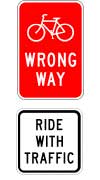
But we’re not done yet! ARS specifically grants the power to local authorities to regulate the operation of bicycles in §28-627 . This means that cities can, and most do, place regulations on the use of sidewalks by cyclists. Since there are dozens of independent cities, I can’t look at each of them but Phoenix is typical; see Chapter 36, Article IX (relevant codes are linked in ruling-cyclists-are-required-to-satisfy-nighttime-lighting-requirements). Highlights are that the direction of travel is not mentioned, cyclists must yield the right-of-way to any pedestrian, and that the city may ban cycling by means of erecting signs. Phoenix launched a major media blitz along with installing “dozens” of wrong-way signs around town in Oct 2015.
Tempe’s code (of 1988, I believe)(here’s an easy way to see the whole Chapter 7 Bicycles) adds that bicycles must be operated “with traffic” when on sidewalks — an unusual (but firmly grounded in safety) restriction, sec. 7-52(c), there’s also a (an overly?) restrictive crosswalk rule requiring that bicyclists yield to “all traffic”, sec. 7-52d. Tempe’s code was majoryly re-aligned in Aug 2019 but the same provisions were rolled forward into Chapter 19.
Here’s a few more; Flagstaff is allowed unless posted, basically just like Phoenix (codepublishing.com/az/flagstaff/ 9-05-001-0007 ). Prescott, the city of Prescott, is banned. Conversely, in Prescott Valley, it is allowed unless posted, see here for references to both PV and city of Prescott ordinances.
In Tuscon, it is generally banned unless a sign allows it, see 5-2 of Tuscon code. (curiously, I cannot find a definition of ‘bicycle’ in their city code — i guess that means the state’s definition applies).
Scottsdale doesn’t seem to have any special or particular rules about sidewalk riding; 17-83 says the chief of police (which is odd, typically codes like this say the city engineer or somesuch) may erect no riding signs on any sidewalk; unsure if there are any anywhere.
Mesa: sidewalk cycling can be prohibited by sign if posted in the POA (ped overlay area — basically downtown); not sure if they post them or not. See Title 10/ Chap 1 of the Mesa City Code.
Yuma is discussing major revisions as of early 2015 — for the current and proposed ordinance see this comment. Yuma has a suspiciously high, consistently the highest of all larger AZ jurisdictions, bicyclist most at fault rate of something like 73% — statewide average is 52%. [update: it passed, see new-yuma-sidewalk-ordinance for details]
See this comment for some other Arizona towns and cites, and may be updated (these links break a LOT)
Conclusion
There is no Arizona state law regulating sidewalk cycling, but cities can and do have their own set of restrictions and requirement. Furthermore, the case of Maxwell v. Gossett reaches the somewhat surprising conclusion that cyclists riding in crosswalks (i.e. the continuation of riding on the sidewalk) have much the same right-of-way as pedestrians.
Crosswalk Addendum
By way of some more background on the legality of cycling in crosswalks; an analysis prepared by the Tuscon City Attorney’s office in 1998 found that (my emphasis) “…it is apparent that under the present state of law in Arizona a bicyclist is not prohibited from riding on or across a crosswalk…”. This analysis, as would be expected, relies heavily on Maxwell.
Some recent (2010) activity by Tuscon-area law enforcement resulted in this white-paper ARS 28-815(A) – The Most Incorrectly Used Citation: Riding a Bicycle in a Crosswalk IS Permissive and Lawful in Arizona, by attorney Eric Post.
The jurisprudence regarding cycling in crosswalks is all going the same way, you can read these full published cases on google scholar. These cases are all construing similar laws, and of course, Maxwell had direct bearing in Arizona since it is an Arizona Supreme Court ruling. All conclude something to the effect of “…bicycle riders and users of other human-powered conveyances legally in the crosswalk were entitled to the same rights as pedestrians” (which is quoted from the Tuscon City Attorney’s analysis, linked above; which refers to several other persuasive cases).
- Nish v. Schaefer, 2006 WY 85; 138 P.3d 1134; — Wyo. Supreme Court 2006
- Pudmaroff v. Allen, 89 Wn. App. 928; 951 P.2d 335; — Wash. Court of Appeals, 1st Div. 1998. And reached the Wash. Supreme Court in 1999 fully upheld.
- Luellman v. Ambroz, 2 Neb.App. 855; 516 NW 2d 627 – Neb: Court of Appeals 1994
- Schallenberger v. Rudd, 244 Kan. 230; 767 P. 2d 841 – Kan: Supreme Court 1989
- Maxwell v. Gossett, 126 Ariz. 98; 612 P. 2d 1061 – Ariz: Supreme Court 1980 (also reproduced below)
- Crawford v. Miller, 566 P. 2d 1264 – Wash: Court of Appeals, 1st Div. 1977. This case is cited by Maxwell, and importantly says that “A crosswalk is not a roadway…” for the purposes of the cyclist applicability statute.
I didn’t know where else to put this, but for cross-reference purposes, see this case law from Illinois: Lewis v. Northern Illinois Gas Co., 422 NE 2d 889 – Ill: Appellate Court, 1st Dist. 1981. Illinois law explictly states a bicycle is not a vehicle for the purposes of prohibiting driving on sidewalk. (Ill. Rev. Stat. 1979, ch. 95 1/2, par. 11-1412.1.)
UVC
The UVC (Uniform Vehicle Code — a model set of laws) certainly clears up the confusion, but remember, this has never been adopted in Arizona:
UVC § 11-1209(c), Bicycles and human powered vehicles on sidewalks
A person propelling a vehicle by human power upon and along a sidewalk, or across a roadway upon and along a crosswalk, shall have all the rights and duties applicable to a pedestrian under the same circumstances.
Some states, e.g. Florida, have adopted this sort of law… would that be good? That’s a good question… In the meantime I would just be happy to see police actually learn and enforce the law as it exists. Instead they typically fault the wrong party, and even wrongly cite the bicyclist for phony violations.
There’s a good general article about issues with sidewalk cycing at cyclingsavvy.org, written referring to UVC rules Sidewalk Strife: Leave the roadway, and you leave some important rights behind.
Below is the full Maxwell opinion; in that case a juvenile bicyclist was riding thru a crosswalk when he was right-crossed by a motorist; both had a green signal.
Notably he was riding on the “wrong side”; which in the court’s opinion didn’t change result or outcome.
Maxwell v. Gossett, 126 Ariz. 98
612 P.2d 1061, 1062
Charles J. MAXWELL, next of friend of Jeffrey Jon Maxwell, Appellee,
v.
Celia Sharon GOSSETT and Thomas G. Gossett, husband and wife, Appellants.
No. 14676
Supreme Court of Arizona, In Division.
June 2, 1980.
Action was brought for injuries sustained by ten-year-old bicyclist in intersection collision with defendants’ automobile. The Superior Court of Maricopa County, Cause No. C-351976, Rufus C. Coulter, J., instructed the jury on contributory negligence by a child, but refused defendants’ instructions concerning alleged violation of traffic laws. Defendants appealed from an award of damages for the injuries to the bicyclist. The Supreme Court, Cameron, J., held that the trial court properly refused to give defendents’ requested instructions.
Affirmed.
Hays, J., concurred specially and filed statement
- There was no causal connection between possibility that ten-year-old boy may have been riding bicycle on wrong side of street and collision with automobile which occurred while he was in crosswalk at intersection; thus, trial court, in action for injuries sustained in the accident, did not err on refusing to instruct jury as to statute requiring that bicycles be ridden on right side of street, since it was immaterial to whether he was negligent while riding his bicycle in crosswalk. A.R.S. § 28-815
- Safety zone statutes had no application to facts in action for injuries sustained by ten-year-old bicyclist when struck by car while riding in crosswalk. A.R.S. §§ 28-101, subd. 40, 28-602, subds. 2, 2(a, b), 28-831.
- Statute which applies same traffic laws to bicyclists as to drivers of motor vehicles does not prohibit riding of bicycle in cross-walk. A.R.S. §§ 28-602, subd. 2, 28-812, 28-831.
- Issue whether ten-year-old boy was negligent in riding bicycle in crosswalk was question of general contributory negligence for which jury was properly instructed, not negligence based on violation of statute which applies same traffic laws to riders of bicycles as it does to drivers of motor vehi-cles. A.R.S. § 28-812.
Burch, Cracchiolo, Levie, Guyer & Weyl, P. A. by Barry A. MacBan, Daniel P. Jantsch, Thomas G. Bakker, Phoenix, for appellee.Hoffman, Salcito & Stevens, P. A. by Gene C. Stevens, James W. Evans, James W. Fritz, Phoenix, for appellants.
CAMERON, Justice.This is an appeal by the defendants from an award of $15,250 for injuries to Jeffrey Jon Maxwell, a minor, as a result of an intersection accident. We have jurisdiction pursuant to Rule 19(e), Rules of Civil Ap-pellate Procedure, 17A A.R.S.Defendants contend on appeal that the trial court erred in refusing to give instructions relating to various statutory duties and responsibilities of one who operates a bicycle on the public streets.The facts necessary for a determination of this matter on appeal are as follows. The intersection of 8th Avenue and Alma School Road is located in Mesa, Arizona. 8th Avenue runs east and west, and Alma School Road runs north and south. At the northwest corner of the intersection is a U-Totem convenience market, and to the east of the intersection, on the south side of 8th Avenue, is the Ida Redbird School.From the northwest corner, where the U-Totem Market is located, to the northeast corner, is a clearly marked crosswalk. On the morning of 1 February 1977, ten year old Jeffrey Maxwell was on his way to the Ida Redbird School. He stopped for candy at the U-Totem Market, put the candy in his pocket, and proceeded to ride his bicycle from the northwest corner to the northeast corner, in the marked crosswalk. At about the same time, the defendant, Mrs. Gossett, was proceeding west on 8th Avenue intending to make a right (north) turn onto Alma School Road, at the same intersection. The traffic light was green, and she made her right turn, ran into Jeffrey, and he was injured.The court instructed the jury on contributory negligence by a child of Jeffrey’s age, but refused defendants’ instructions concerning alleged violation of the Arizona traffic laws. Defendants’ offered instructions were as follows:
“R.A.J.I. Negligence 7- Violation of Statute
“If you find that any party to this suit violated any of the following laws, then that party is negligent. You should then determine whether that negligence was a cause of the Plaintiff’s injury.“§ 28-812, A.R.S., Traffic laws apply to persons riding bicycles
“Every person riding a bicycle upon a roadway shall be granted an of the rights and shall be subject to all the duties applicable to the driver of a vehicle by this chapter, except as to special regulations in this article, and except as to those provisions of this chapter which by their nature can have no application.“§ 28-101, A.R.S., Definitions
“In this title, unless the context otherwise requires:
“40. ‘Safety-zone’ means the area or space officially set apart within a roadway for the exclusive use of pedestrians and which is protected or is so marked or indicated by adequate signs as to be plainly visible at all times while set apart as a safety zone.“§ 28-831, A.R.S., Driving through safety zone prohibited
“No vehicle shall at any time be driven through or within a safety zone.“§ 28-815 A., A.R.S., Riding on roadways and bicycle paths; prohibition of motor vehicle traffic on bike paths
“Every person operating a bicycle upon a roadway shall ride as near to the right side of the roadway as practicable, exercising due care when passing a standing vehicle or one proceeding in the same direction.”
We will consider the failure to instruct as to each of the statutes cited by defendant.
A.R.S. § 28-815(A)
[1] This statute requires that bicycles must be ridden on the right side of the road or with the traffic. Jeffrey was riding his bicycle in the crosswalk at the intersection. Whether he had been operating the bicycle on the left side, contrary to the statute, before he entered the crosswalk, whether he intended to continue operating his bicycle on the roadway, contrary to statute, after he left the crosswalk, or even whether he intended to ride his bicycle on the. available sidewalk on the north side of 8th Avenue, is immaterial as to whether he was negligent while riding his bicycle in the crosswalk. We agree with the New Mexico Court of Appeals which stated in a similar case:
“The accident occurred at the intersection of Chelwood, a north-south street, and Menaul, an east-west street. The trial court found that decedent was proceeding in a southerly direction on Chelwood at the time of the accident. The Wylie vehicle was traveling in an easterly direction on Menaul. Even if we accept defendants’ contention that decedent was operating his bicycle on the left side of Chelwood in violation of the statutes alluded to, we must uphold the trial court’s finding of absence of contributory negligence.
* * * * * *
” * * * Here the evidence sustains an inference that the collision would not have been avoided even if the decedent had been obeying the statutory mandates relating to traffic flow. The violation of the statutes, if any, did not even cause or contribute to the accident in fact. * *” Wilson v. Wylie, 86 N.M. 9, 12, 518 P.2d 1213, 1216 (1973).
Causation is still a part of the law of negli-gence, Pacht v. Morris, 107 Ariz. 392, 489 P.2d 29 (1971), and we find no causal con-nection between the fact that Jeffrey may have been riding on the left hand side of the street before he stopped at the U-Totem Market and the accident which occurred while he was in the crosswalk at the inter-section.
“In this state, it is reversible error to give an instruction on a legal theory as to which there is not substantial evidence, (citations omitted) and it is equally re-versible error not to give an instruction on a legal theory within the issues of the case which is supported by substantial evidence.” Newman v. Piazza, 6 Ariz. App. 396, 398, 433 P.2d 47, 49 (1967).
The instruction, if given, would have been error.
A.R.S. § 28-831
[2] This statute states “no vehicle shall at any time be driven through or within a safety zone.” By definition, a safety zone is set apart for the exclusive use of pedes-trians, A.R.S. § 28-101(40), and, assuming a bicycle is a vehicle for the purposes of the statute, it would have been equally violative of the statute for either Jeffrey or Mrs. Gossett to drive or ride their vehicles in such a safety zone. Weare not concerned in the instant case with a safety zone, however. Jeffrey was not crossing the street in a safety zone. He was crossing the street in a crosswalk as defined by A.R.S. § 28-602(2)(a) and (b), and the safety zone stat-utes have no applicability to the facts in this matter. We find no error.
A.R.S. § 28-812
[3,4] Finally, defendants contend that by this statute, A.R.S. § 28-812, the automobile traffic laws apply to persons riding bicycles, and that, when read with A.R.S. § 28-831 defining safety zones and A.R.S. § 28-602(2) which defines crosswalks, it is unlawful to ride a bicycle in a crosswalk. We agree that this section generally applies the same traffic laws to riders of bicycles as it does to drivers of motor vehicles. The statute excludes, however, provisions “which by their nature have no application.” We do not read the cited statutes as prohibiting the riding of a bicycle in a crosswalk.
We are aware that teachers and concerned parents regularly instruct their children to dismount and walk their bicycles through the crosswalks or major intersections, and that their children, just as regularly, ignore this sound advice. However, this is a question of general contributory negligence for which the jury was properly instructed. It was not negligence based upon a violation of the statute. We find no error.
We note also that some courts have held that a crosswalk is not a part of the roadway for the purposes of the statute. In a case wherein a minor was hit by an automobile as she was riding her bicycle in an intersection, the Washington Court of Appeals, construing a Washington statute almost identical to ours, has stated:
” * * * Miller contends that at the time of the accident, Kelley Ann was a bicyclist subject to the requirements of the Motor Vehicle Code, RCW 46.61.755; the Crawfords contend that she was a pedestrian. RCW 46.04.400. The instruction directed the jury to determine which law applied. RCW 46.61.755 reads as follows:
Every person riding a bicycle upon a roadway shall be granted all of the rights and shall be subject to all of the duties applicable to the driver of a vehicle by this chapter, except as to special regulations in RCW 46.61.750 through 46.61.780 and except as to those provisions of this chapter which by their nature can have no application.
“This statute does not apply because it governs the rider of a bike in a ‘roadway,’ which is defined as ‘the paved, improved, or proper driving portion of a public highway designed, or ordinarily used for vehicular travel.’ RCW 46.04.500. A cross walk is not a roadway.” Crawford v Mil1er, 18 Wash.App. 151, 152-53, 566. P.2d 1264, 1265-66 (1977).
Judgment affirmed.
STRUCKMEYER, C. J., concurs.
HAYS, Justice, specially concurring:
I concur in the result. However, I am disturbed by the fact that the legal duties and obligations of persons on bicycles are not defined in the law. Some bicyclists ride with traffic, others ride facing traffic, and of course some ride in the crosswalk. Our statutes give no indication of what is and what is not appropriate. I think this is a matter for the legislature and I hope that they will take the time to determine what should be the rights and the obligations of those who use bicycles in today’s heavy traffic.
This was from the “Ask a Cop” column: Scottsdale Police Sgt. Bill Relyea answered this week’s question. Relyea is the Downtown Squad supervisor. He has been with the Scottsdale Police Department for 22 years.
Question: My wife and I have recently moved to downtown Scottsdale and we frequently walk the city sidewalks. We have noticed numerous people riding bicycles on the city sidewalks, especially in the area of Scottsdale and Camelback roads. These are the “casual” bikers, school kids, families, etc. It is difficult to get out of the way when you can see them coming, but it is worse when they come up behind you unexpectedly. The “serious” bikers who are equipped with helmets, multi-speed bikes and bike outfits are riding in the street.
What is the law on this subject? Is it legal to ride bikes on downtown sidewalks?
Answer: Thank you for your question. There are no provisions in the Scottsdale City Code that prohibit bicycle operation on city sidewalks. Likewise, there is no provision that requires bicycles to be ridden in the roadway. There are many reasons for this, the most important of which is children would be required to operate bicycles in the roadway.
Bicycle operators and pedestrians should always exercise due care when using sidewalks, crossing streets or exiting alleys. Both should be courteous, and when in doubt yield to one another – and always yield to vehicles.
Chapter 17 of the Scottsdale City Code addresses bicycle usage. Some of the applicable provisions are…
http://www.azcentral.com/community/scottsdale/articles/2009/05/07/20090507sr-askacop0508.html
Note that defintion of “Bicycle” is (excerpt)
“either: (a) Two tandem wheels, either of which is more than sixteen inches in diameter.(b) Three wheels in contact with the ground, any of which is more than sixteen inches in diameter,” and not “smaller than 16″” as stated above.
Thus, my Bike Friday Express tikit (http://community.bikefriday.com/tikit) with 16″ wheels is not a “bicycle.”
If a person is riding a bicycle on a sidewalk against traffice where there are no clearly marked bikelanes and approaches an exist from a shopping plaza where there is a vehicle stopped, the driver is talking on a cell phone and eye contact is made. The bicycle contines on the sidewalk and the vehicle is still stopped; yet once the bicycle clears the front of the vehicle, the driver of the vehicle then accelerates hitting the bicyclist throwing them into a lane of oncoming traffic.
Who has the rigt of way? The stopped vehicle seeking to exit the parking lot or the bicycle who is continuing on a sidewalk?
You write in the BUI article:
§28-812: Bicyclists are “…subject to all of the duties applicable to the driver of a vehicle”
§28-1381 DUI: a person must not “drive… a vehicle” under the influence, so includes bicyclists.
hence:
Driving on the sidewalk is illegal
28-904. Driving on sidewalk
A. A person shall not drive a “vehicle” on a sidewalk area except on a permanent or duly authorized temporary driveway.
Hi Jon,
That may have been true, except you missed *where* 28-812 applies: “A person riding a bicycle on a roadway or on a shoulder adjoining a roadway”.
Gave this to a Phoenix Police Officer last week. Their reply today was that riding a bicycle in a pedestrian crosswalk counter to roadway traffic flow is illegal.
The Officer and I agreed to disagree on the meaning of Maxwell V/S Gosset, but at least they are willing to listen to cyclists complaints.
I got hit by a car while I was on the sidewalk and I got fined for not being on the right sidewalk since they said the driver doesn’t have to look both ways when coming out. I haven’t been able to walk for 2 months and medical bills are stacking up, and it’s apparently 100% my fault and I got to pay the damage I did to his car with my body -.- as well as the fine. How lovely this world is! (sarcasm) I am currently feeling deeply depressed because of this event….
http://azstarnet.com/news/local/crime/article_dadcb133-f12a-58cf-b64a-ee78ab651dc9.html
This case relates to the death of cyclist Matthew Preston in 2001 in the city of Tucson.
“Preston was riding his bicycle north on the west sidewalk of North Tucson Boulevard in 2001 when he came to East Lester Street… Charles Eisner, heading east on Lester Street, had been stopped at the stop sign. He started to turn right onto Tucson Boulevard, in front of Preston.” — i.e. the cyclist was riding on the sidewalk/crosswalk counter-flow to the adjacent traffic.
http://bicycledriving.org/law/guide-to-improving-laws/feed
Hi paul,
More questions about sidewalk:
But how does this play with the state’s applicability statute? E.g. in NV (and i imagine all or most others?) “NRS 484.503 Traffic laws apply to person riding bicycle. Every person riding a bicycle upon a ROADWAY has all of the rights and is subject to all of the duties applicable to the driver of a vehicle…”. The sidewalk is not part of the roadway. So is riding on the sidewalk really unlawful in NV? I would argue that it is not.
Here is a link to an old (first published in 2006 column, back when he was writing in VeloNews) where Bob Mionske discusses crosswalks and cycling, specifically looking at Arizona.
I generally agree with his analysis, though sometimes I think it is more complicated than need be; e.g. to determine that it is in fact legal to cycle on the sidewalk under state law he draws a complex analogy from New Jersey law. I believe that the applicability law is much more straighforward than that. In any even, he agrees that cyclists can ride legally ride in crosswalks and discusses right-of-way when doing so:
“And that brings us to crosswalks; if you can ride your bicycle on the sidewalk, and if a crosswalk is an extension of the sidewalk, then by logic, you can also ride your bike in the crosswalk. However, while you can ride your bike in the crosswalk, the question of right-of-way still remains, because although a pedestrian has the right-of-way in a crosswalk, a bicycle is not a pedestrian. If you think about it, though, you’ll see that a pedestrian has the right-of-way while in a crosswalk and in observance of any traffic control signals. It stands to reason that if a cyclist is also in the crosswalk, and in observance of the traffic control signals, that the cyclist has the right-of-way in respect to vehicular traffic.”
I just came across this article while searching for stats on the relative danger of sidewalk riding v. road riding. Nothing to do with the law, but you stat near the top (72%) doesn’t match the stats in the linked study.
The 72% number appears to be that 72% of crashes happen with 150 feet of an intersection. As far as I can tell, the only sidewalk stat in the linked study is that 22% of crashes happened to riders on the sidewalk, which only tells us something useful if we have information about what %-age of total riding happens on the sidewalk.
hey neil,
i appreciate your comment. Below is what i meant when i said 345.
Essentially I infer that if a cyclist was struck in the crosswalk, he had come from the sidewalk.
Oh, yeah and i take your point about we don’t have any idea what percentage ride on the street versus sidewalk; in other words we have no “exposure data”. An another (bigger?) trouble with the phoenix summary is it doesn’t have any notion of severity. Also see this related article: http://azbikelaw.org/understanding-collision-summaries/
The figures in these tables was taken from p.12 and 13 of the 2005 collision summary; i haven’t looked at other years, but i doubt it changes much. Anyway take a look and tell me what you think.
Matthew Preston fatality; lawsuit versus City of Tucson; appeal
“On October 3, 2001, Matthew Preston, a graduate student at the University of
Arizona, was riding his bicycle northbound on the west sidewalk of Tucson Boulevard”
tips: you can seach Arizona Court of appeals (arizona has two divisions) by doing this google search:
bicycle site:www.cofad1.state.az.us
bicycle site:www.apltwo.ct.state.az.us
On August 11, 2004 cyclist Gerardo Munguia was killed as a Laidlaw bus turned right while cycling straight through the crosswalk. This appeal from AZ Court of Appeals Div 1 (strangely, i can’t find it on the CoA website anymore? Local copy CV080510 I found on archive.org; shows up now [june 2013] searching by case number
http://azcourts.gov/Portals/0/OpinionFiles/Div1/2009/1%20CA-CV%2008-0510.PDF ) affirms that bus driver was not negligent, because she was already into her turn, BEFORE the cyclist entered the crosswalk. To put it another way: the cyclist rode into the middle/side of the turning bus. In any event, the court recognizes that which party has the right-of-way in a crosswalk; a straight-through cyclist, or the turning motorist, depends on which is there first… the appeal revolved around the denial of a jury instruction; the instruction quoting 28-645 would have implied the bus driver was at fault: part of the disputed instruction was “Under Arizona law, the school bus had a duty to yield the right-of-way to a bicycle or pedestrian in the crosswalk while the light was green”
Hi guys,
Im reading through the comments, an excellent help but ill be visiting phoenix next week and I want to hire a bicycle for transport.
I am not a driver here in scotland and this is a first visit to the US so im obviously wanting to do my homework first. Im likely to be drawn to the sidewalk so im not directly in the traffic so does anyone have any clarification and tips/advice for me?
Much appreciated!
Rosie
References to Risks of Sidewalk Riding:
John Allen’s list.
Wachtel and Lewiston ITE Journal, published by the Institute of Transportation Engineers, September 1994, pages 30-35. html and pdf version here.
Used data from several years of crash data from the city of Palo alto, CA. It also correlated to risk exposure data by using bike counts. Overall, the relative risk of being involved in a collision riding on the sidewalk was 1.8 times higher than riding in the road.
It did not attempt to quantify the risk by severity.
Cycling should be allowed on the road and not on the side walk,where mothers with strollers are, children playing and etc., that’s my opinion.
Me and my wife just bought bikes for exercise purpose and I have decided to now ride mines to work since I live so close to my job and my shift starts so early in the AM that traffic and heat is not an issue.
Asside from wearing a helmet and sticking bike lanes can someone direct me to the bicyclist traffic laws.
Curious about sidewalk laws such as what to do if there’s no bike lane or sidewalk present on the flow of traffic side and the shoulder area is so small its unsafe. Do I go against the traffic, ride in te steet etc…
Also I may sound a little dumb for asking this one but as a kid I rode all over the rode with diregard to the law but when making a left turn on a bike am I suppose to enter the turning lane with the cars or cross as if I was a walking pedestrian?
Thanks
Hi Derrick:
by far the best thing you could do would be to take a bike safety class, such as Traffic Skills 101, see cazbike.org/BikeEd Right now there are no classes scheduled yet (in the phoenix metro area?) but you can do the online portion for free anytime, follow the link.
And an excellent resource is ADOT’s Arizona Bicycling Street Smarts, the entire booklet is online, and additionally you can find it at bike shops, and sometimes at the library…
This was interesting in the sense that Police cited the motorist in a crosswalk collision. The relative positions in this crash were the same as in Maxwell.
There is good discussion in the Tribune comments, they have city ordinances and so forth. However, nobody there, or at least not mentioned, knows about Maxwell.
Cyclist was “counter-flow”; and the cyclist and motorist were traveling in opposite directions, with cyclist traveling straight and motorist turning right.
Differences between Maxwell and this case would be that this happened at night; It’s not stated whether or not the cyclist has a light; it’s also not clear that cyclists in crosswalks are required to have a light at night (though it’s clearly a good idea, for safety).
http://www.eastvalleytribune.com/local/article_43400fd2-45ef-11e1-931b-0019bb2963f4.html
A 32-year-old man was killed after he was struck by a Nissan Pathfinder while riding his bicycle on Alma School Road near Guadalupe Road late Saturday.
The bicyclist, identified as Daniel Everlove, was pronounced dead at the scene after the Pathfinder driven by Levi Chappel struck his chopper bicycle at the intersection about 11 p.m.
The Pathfinder crashed into Everlove as Everlove was eastbound on the north sidewalk adjacent to Guadalupe and attempting to cross Alma School. Everlove was thrown from his bicycle.
Impairment or speed were not identified as factors in the crash, but Chappel was cited for failure to yield at an intersection, police said.
I received the following details regarding a news story about a bicyclist who
was seriously injured in a crosswalk via Scottsdale Police Dept’s pio Officer Dave Pubins.
The driver was charged and found (or plead) guilty to 28-672 FAIL TO YLD TURN LFT W/I INTER CAUS ACC SERI INJUR
SCOTTSDALE, Ariz. — A 12-year-old boy is in the hospital after being hit by a truck while riding his bike Monday morning.
It happened at about 9:15 a.m. at Frank Lloyd Wright Boulevard and Thompson Peak Parkway.
According to Officer David Pubins of the Scottsdale Police Department, the boy was riding northbound through the crosswalk at the intersection on the east side of the road.
The light was green for north-south traffic. A pickup truck on the north side of the intersection hit the boy while turning left from southbound Frank Lloyd Wright Boulevard to eastbound Thompson Peak Parkway.
The child was not wearing a helmet.
The boy suffered multiple head fractures and a broken leg, but Pubins said the injuries were not considered life-threatening. The child was in serious condition when he was taken to Phoenix Children’s Hospital.
According to Pubins, the 49-year-old driver of the Ford pickup will be cited for his involvement in the wreck.
Investigators said impairment was not a factor.
Eastbound Frank Lloyd Wright Boulevard was closed in the area for several hours.
http://www.azfamily.com/news/Boy-on-bike-hit-by-pickup-truck-in-Scottsdale-intersection-139720323.html
Scottdale PD released this photo:
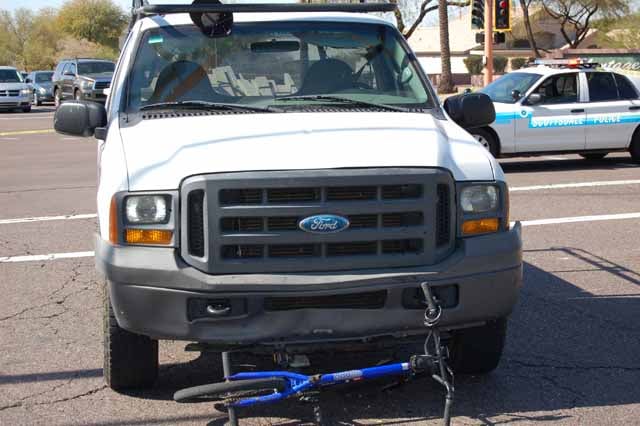
According to Scottsdale muni court records, the driver, was charged with 28-672, a misdemeanor:
Defendant Name: []
Case #: M-751-TR-2012004749
Citation(s): C-08055926
Charge Code: 28-672A
Charge Description:
FAIL TO YLD TURN LFT W/I INTER CAUS ACC SERI INJUR
Criminal Division Arraignment
Court Date: 3/9/2012
Court records indicate the driver plead (was found?) guilty 4/20/2012 to the 672; it’s not clear what happened to the 28-772 violation; online records do not indicate the sentence/fine.
Note that the crash report ADOT case #2614958 (correctly) Faults the driver OTHER; and the bicyclist is NO_IMPROPER.
Interesting reading. Federal Appeals courts have ruled that sidewalks are actually part of highways/streets,(here in MI they are defined the same). Bicycles are allowed in general, local governments have right of prohibition on sidewalk riding such as my home city of Royal Oak, to be ridden on sidewalks. If by definition the sidewalk is part of the street, as maintained by the US 2nd Circuit Court of Appeals, then the law requiring that a bicycle being ridden on a street or highway would seem to apply. The California courts have also ruled that sidewalks are part of the street. Being that the bicycle must be ridden in the direction of traffic flow.
…
Here are links to two cases referred to, above: caselaw.findlaw.com/ca-court-of-appeal/1403039.html; and caselaw.findlaw.com/us-2nd-circuit/1120328.html. Individuals in both cases are maintaining that the police pulled them over without probable cause. The police cited riding against traffic flow on the sidewalk as cause to pull defendants over. These were upheld. The defendants were riding against the flow of traffic, but maintained since they were on the sidewalk, it was in inappropriate act on the part of the police. The courts in both instance ruled that that is not the case, as sidewalks are part of a street or highway by definition. This would seem to be true in MI. A street here is defined to include all the area from the roadway surface to the property lines. Since the sidewalk falls between the curb and the property line, it thus is part of the street. Roadway here is the actual driving surface, and is part of the street/highway.
Most bicycle law firms do not seem to be aware of this definition? At least I have not seen one yet.
…
Here are links to the cases on Google Scholar:
US v. McFadden, 238 F. 3d 198 – Court of Appeals, 2nd Circuit 2001
In re Devon C., 94 Cal. Rptr. 2d 513 – Cal: Court of Appeal, 2nd Appellate Dist., 3rd Div. 2000
Specific to California Law and be sure to see 2013 Update, below:
Cal. Veh. Code § 21200(a) Every person riding a bicycle upon a highway has all the rights and is subject to all the provisions applicable to the driver of a vehicle…
Note well: the term highway (in CA’s current statute) vs. roadway (in AZ’s applicability statute).
There is a CA Attorney General’s opinion directly on point about the legislature’s broadening of the 21200 in 1983, where the terminology changed from roadway to highway. Ops.Cal.Atty.Gen. 214, 9-29-93. Opinion No. 93-418 (if that link is dead, just search it out at AG’s site)
“CONCLUSION Persons riding bicycles on sidewalks are subject to the same Vehicle Code requirements that apply to persons riding bicycles on roadways and may be subject to additional local regulations”
So, then in CA — at least according to the Attorney General — “…to the extent that a vehicle must be driven on the right half of the roadway, a bicyclist riding on an adjacent sidewalk must travel in the same direction as the vehicular traffic.”
Also, as noted in a previous comment; In re Devon C., 94 Cal. Rptr. 2d 513 – Cal: Court of Appeal, 2nd Appellate Dist., 3rd Div. 2000 states unequivocally, using the same reasoning, that helmets are required (for those under 18) when riding on the sidewalk.
VERY comprehensive municipality-by-municipality listing for East Bay / San Fran area cities WHAT A PATCHWORK!!
UPDATE a 2013 CA appeals court ruling says that riding counter-flow is NOT illegal (per state law) according to RabbiLawyer; Spriesterbach v. Holland
I did some research on AZ law. It seems that the laws as they pertain to motor vehicles never define streets or highways, although they reference them in multiple locations. However, on an ADOT website for pedestrians, these terms are defined, through the use of AASHTO definitions. By extension, these definitions that are being used in an official publication by the State of Arizona, could be inferred to represent the position of the state government. It says that the sidewalk is part of the street. If the sidewalk is part of the street, and while riding on a street as traffic, as defined by the AZ state code, then you would be required to ride with the flow of traffic anywhere while riding on that street. This is good sense, as we all seem to agree that riding against the flow of traffic is unsafe (some authoritative studies indicate at least 4X as unsafe as roadway riding).
Hi John,
Let me start by agreeing whole-heartedly that, for safety purposes, those who choose to ride on the sidewalk (for whatever reason) should always ride with the flow of traffic.
That being said, I think you are barking up the wrong tree here (in AZ law); our applicability statute, 28-812, does NOT use the term street or highway. Anywhere. The operative term is ‘roadway’, which has both an accepted and in fact a statutory definition 28-601 which plainly does NOT include the sidewalk.
Further for you to be right, the case mentioned above, Maxwell v. Gossett, would have to be wrong — and I don’t think it is. In that case, the bicyclist was riding counter-flow in a crosswalk.
(links to all mentioned statutes and that case are above in the main body of the article)
–ed
Safe Turning Statutes:
28-751. Required position and method of turning: prohibits swinging wide — that is left turns must be made into the left-most available lane, and right turns must stay as close as practicable to the right.
The LEFT statute 28-772 says “yield .. to a vehicle”. (and enables 28-672).
The generic turning statute, 28-754 requires “reasonable safety” (does not enable 672):
There is also 28-729(1) Driving on Roadways Laned for traffic, drivers must “drive as nearly as practicable within lane and shall not leave lane until movement can be made safely”
Very generally, all drivers “shall control the speed of a vehicle as necessary to avoid colliding with any object, person, vehicle or other conveyance on, entering or adjacent to the highway in compliance with legal requirements and the duty of all persons to exercise reasonable care for the protection of others”, 28-701A. Violation of this statute is often denoted as Failure to Control.
There is also some broad requirments for Drivers to exercise due care 28-794 (and is an enabling statute for 28-672). #1 applies specifically only to pedestrians “1. Exercise due care to avoid colliding with any pedestrian on any roadway”, and #3 applies to children and some others: “3. Exercise proper precaution on observing a child or a confused or incapacitated person on a roadway.”
Though it’s not at all clear how or when it would be expected that a driver could be expected to discern whether a particular person meets those criteria; which would make it all the more shakey if the driver was charged with 28-672 (a criminal offense).
moved info about Cottonwood, and Sedona here.
Story out of Flagstaff from 2004:
http://azdailysun.com/article_622eb371-1da7-5ec3-91db-d72372dd4868.html
And while there’s nothing wrong with trying to address this matter, the story is loaded with confusion and half-truths. for example the statements:
“There is nothing in the city or state code that prohibits it (riding in the crosswalk), but it has been interpreted as illegal by the judges,” said Ken Lane, chair of the Bicycle Advisory Committee. “What we are looking for is clarification.”
We have very specific clarification from the judges of the Arizona Supreme Court, that bicycling is NOT illegal per A.R.S. This clarification came many years ago (see, Maxwell, above). All others, including mistaken judges (hearing officers, magistrates, and so forth), mistaken police, etc. who hold other interpretations in conflict with this are wrong. The Supreme court’s view “wins”.
Local ordinances may be enacted so long as they are not in conflict with state statutes, so I’m sure there is room for clarifying ordinances.
Regarding the Jan 13, 2012 collision which killed
Steven Langager, an (unnamed) PIO officer responded that they filed charges for manslaughter and leaving the scene. (Technically it may be more accurate to say that they submitted the case for review of those charges?). The (county) prosecutors’ office first denied their ability to disclose any and all information, but seemed willing to at least put me in touch with the individual prosecutor who handled it, but that requires more information than I’ve been able to get so far. I’ve requested the PD report, #12-01022.
Phoenix moved their codes to http://www.codepublishing.com/az/phoenix/
36-116 Applicability of vehicle laws.
Every person propelling a pushcart or any device propelled by human power and having one or more wheels sixteen or more inches in diameter, shall be subject to all provisions of this chapter applicable to the driver of any vehicle, except those provisions which by their very nature can have no application.
Is it problematical that this definition varies from the equivalent ARS (28-812)? Why do cities do this (reiterate state statutes?).
Barnes case against city of Tucson involved a minor sidewalk cyclist who sustained injuries when he hit a post in the sidewalk erected by the city. Sidewalk cycling in Tucson is illegal per city code.
Barnes v. City of Tucson, 760 P. 2d 566 – Ariz: Court of Appeals, 2nd Div., Dept. B 1988 on Google Scholar
Scan from ARS Annotate Statutes:
I *guess* that 811 is mostly important for bicycle-specific statues, like 28-817: lighting requirements. For example, this makes it apparent that a headlight is required when riding on a sidepath (this view is further strengthened by Arizona v. Baggett). It’s unclear to me if 811B matters for any of the traffic laws “enabled” by 28-812, which specifies “roadway or shoulder”. Perhaps 811B could be
better phrased:
– Except as otherwise provided (in this article), this (chapter)
ARTICLE applies to a bicycle when it is operated on a highway or on
a path set aside for the exclusive use of bicycles.
INSERTED (deleted)
There are several interesting bits just from the so-called “headnotes” of the Barnes case:
– Duty owed by city to public is to keep its streets and sidewalks reasonably safe;
– … “although it was claimed ordinance [prohibiting operation of bicycle upon pubic sidewalk] was enacted to protect pedestrians … the ordinance is intended not only to protect pedestrians from
bicycle riders, but also to protect bicycle riders from hazards of riding on narrow sidewalks.
– … “riding bicycle was not typical adult activity.”
more on 812 vs. 811 see here:
http://azbikelaw.org/applicability-statutes-why-are-there-two/
Something has GOT to be done to prohibit cyclists from riding on sidewalks. I have walked my dogs along Central up around the Heard Museum as well as the vicinity of N 16th St between Bethany Home and Glendale Blvd. Cyclists do not defer to pedestrians. Rather,they think that THEY own the sidewalk. Case/point, last December,I was walking my 2 small dogs along Central near the Phoenix Theater,north of McDowell.A cyclist came up so fast behind and around us that i couldn’t get out of the way,he clipped my smallest dog who is a special needs dog and she was injured. Not only that,he cussed me out for it! 10 min later,my injured dog had a seizure from the ordeal. There have been so many other rude cyclists that I could scream. But tonight we had another bad experience. I was walking along 16th st at Rose Lane (no of bethany home) A woman came racing across the street and jumped up on the sidewalk behind my deaf husband. she was yelling at him to get out of her f’ing way. But since he did not hear her she slugged him as she sped by. NOT EVEN STOPPING!!! I couldn’t even get her info. I was walking in a lawn about 25 ft behind my husband with my dogs when i witnessed this crime!! SOMETHING has got to be done!! PLEASE SOMEONE DO SOMETHING TO STOP THIS CRAZINESS!!! I HAVE HAD IT!!!
So, as things turn out, Arizona Universities are granted special powers to regulate both vehicles and what are referred to as nonpedestrian devices, specifically to include bicycles.
So there’s a whole ‘nuther parallel universe and layer of bicycle regulations!
I think, but am not entireley sure, that this applies only to ASU, NAU and UofA.
15-1627. Control of vehicles and nonpedestrian devices on university property…
Note that intrepid readers of ARS Title 28 Transportation, would have missed this one entirely because it’s in Title 15.
At NAU visit page Parking Policies. And actual regulations are linked there, e.g. 2014-2015 version It might be interesting to see if they change(?), e.g. here are 2013 version:
> near to the right side of the roadway as practical not “practicable”?
> non-pedestrian devices shall be ridden to the right of the strip
strip => lane line. even when at speed, or too narrow.
> Non-pedestrian devices may not be operated on roadways or bicycle
> paths. […] Non-pedestrian devices must be dismounted
Huh?
> Bicycles may not be ridden on sidewalks.
Who knew?
> Non-pedestrian device riders must ride single file.
Two-abreast never allowed.
Here, there’s reasonably good advice, including “take the lane”. It says “Don’t ride double”, which is unclear, I assumed that meant “two abreast”, but actually means “multiple persons per bike”. http://nau.edu/Parking-Shuttle-Services/Rules-of-the-Road/
I will probably give them a hard time at some point about duplication of laws, inconsistency of laws they perceived to be the same, or otherwise poor/outdated requirements, and grammar issues 🙂
ASU’s is found at PDP 207–01: Tempe Campus Transportation Code. As I glance through it there seems to be nothing of interest(?).
Mionske’s bicyclelaw.com column written by Rick Bernardi delves into sidewalk issues in various places:
http://www.bicyclelaw.com/blog/index.cfm/2011/11/22/Shifting-The-Blame-and-Justice-Denied-Again
I would like to know what folks think of the following proposal (suggested ordinance) for the city of Phoenix? :
When there is no bike lane or bike route, and where the law does not otherwise prohibit it, riding on a sidewalk in the same direction as the street traffic is permitted. Pedestrians shall at all times have the right of way on sidewalks and be given due warning of any approaching bike. The speed of any bike on a sidewalk shall not exceed 10 mph.
Ed. note: Steve, also see http://azbikelaw.org/ruling-cyclists-are-required-to-satisfy-nighttime-lighting-requirements/ for much more about Phoenix… p.s. check out the PhoenixSpokesPeople on facebook
Here’s a good explanation of a jury trial from North Carolina where a bicyclist was struck in a crosswalk:
http://www.bikelaw.com/blog/take-that-contributory-negligence/
By calling them sidewalks and cross walks, isn’t the societal contract that people using them will be walking. They are not called side-ride-your-bike or side-running-at-top-speed. I was pulling out of a driveway at dusk and a gentleman was riding at high speed, on the sidewalk, without a light, against traffic. I was already part way across the sidewalk long before he arrived and he pulled in front of me as I started to go. Luckily I saw him and stopped in time.
Bicyclists need to yield to pedestrians just as drivers need to yield to pedestrians and bicyclists. It doesn’t help our bicycle advocacy when some bicyclists aren’t courteous to pedestrians. But not all drivers and bicyclists are discourteous, the majority of each try to be good, to follow the laws, to be courteous.
Many city codes, eg Phoenix and Tempe, require bicyclists to give an audible warning when passing. Some cities require a bell and even if not required it’s a good idea.
In Phoenix, how do people feel about riding the sidewalks on 7th st or 7th ave, both major streets that need to be accessed sometimes to get to specific places? There’s absolutely no shoulder and cars religiously speed on those roads. There’s no way you’ll find me on those roads. Sidewalks it is.
Accid Anal Prev. 1998 Jan;30(1):29-43. Ottawa-Carleton commuter cyclist on- and off-road incident rates.
“While there were no major injuries reported on sidewalks, the relative rate for these events on paths was greater than the rate for roads… Results suggest a need to discourage sidewalk cycling, and to further investigate the safety of off-road paths/trails”
City of Yuma http://www.amlegal.com/yuma_az
The term “Business Disctrict” isn’t defined (or I can’t see where it is). So I guess that leaves one wondering what that means…
§ 211-41 Crossing in Business Districts.
No pedestrian shall cross the roadway within a business district at any place other than a crosswalk as designated in A.R.S. § 28-602.
213-05 Riding on Sidewalks.
No person shall operate any of the vehicles coming under this chapter upon a sidewalk within a business district, unless in a designated bike lane.
§ 213-06 Traffic Hazard or Impedance.
No person shall operate any of the vehicles coming under this chapter upon a street, alley or public highway in such a manner as to create a traffic hazard or to impede the free flow of traffic.
Here is a news story about the city council discussing the cycling proposal. Annoyingly the article does not provide any way to see the proposals.
Clay Lawson was nice enough to contact me and hook me up with the latest version as was considered by council in 4/1/2015, and varies considerably from the old version referenced below; and all my obvious big objections are gone, the current proposal
– clarifies where sidewalk riding is banned (it, happily, gets rid of the “business district” language, and will require signs be posted).
– sidewalk riding is generally allowed (unless posted), with the flow of traffic. (e.g. like in Tempe)
– sidewalk riding is banned adjacent to a designated bike lane.
– sidewalk riders are granted the right of way over traffic at driveways
– sidewalk riders automatically have no right of way in the crosswalk; I don’t really like this one, e.g. why should a motorist making a right-on-red, or a stop sign have the right of way over a cyclist in a crosswalk?
Oddity: violations are a misdemeanor. I guess this is normal for their city code, but equivalent ARS violations are pure civil. It just seems strange that you can potentially be locked up for riding a bike on the sidewalk 🙂
Another tidbit: there is a “bad” (preexisting) ordinance that can be used against otherwise legally riding roadway cyclists, 213-06. Such a law “looks bad” with regard to “bicycle friendliness”.
For historical purposes, here is an image of the proposed updated ordinances as of Sept 2014.
I feel as though the ordinance probably ought to provide an opt-out for, e.g. children; I’m not seeing a def’n of bicycle so i’m not sure what it includes (or is it just the state def’n?). I can’t find a def’n of “business district”. Banning riding through a (any!) crosswalk seems extreme — and in any event would make Yuma the ONLY place where riding in a crosswalk is banned in Arizona (and possibly anywhere?). Most places elsewhere who address legal behavior in crosswalks make bikes yield to peds; and then give bicyclists the same legal status as a ped (Florida does this).
The sidewalk-banned-where-theres-a-BL provision would also be unusual/novel for Arizona.
Laws ought to actually BE ENFORCED — this is going to cost money; in particular the part about enforcing wrong-way sidewalk riding (which is unusual, but not a bad idea — Tempe has this ordinance); is Yuma prepared to spend the $’s to enforce, and not just in the breech (when a collision occurs)? Yuma should consider setting up a diversion education program for bicyclist infractions.
Here are a couple of possibilies; maybe “business district” is per zoning code (“Commercial zoning districts”) or based on existing land use . . . which “Cool Map” (http://www.ci.yuma.az.us/6274.htm) is it? Or is it more like a City of Mesa definition? http://azbikelaw.org/jaywalking-in-arizona/comment-page-1/#comment-17942
The notion that bicyclists on sidewalks must follow the rules for drivers of vehicles is apparently a fairly prevalent mis-conception amongst LEO’s. In short, Pima county (unlike e.g. Tucson where sidewalk cycling is banned; or Tempe where direction is regulated), AFAIK, has no regulations on sidewalk cycling —
This quote is from the August 2014 Packet of the TPCBAC:
Colin forbes Tucson-area interactive crash website bikecolli.info can be found in archive at https://web.archive.org/web/20160109124539/http://bikecolli.info/
Forbes and several contributors of the TPCBAC enforcement subcommittee read extensive detailed crash reports from Tucson, over 2,000!, and categorized and critiqued each one.
City of Surprise, AZ
uses Municode.
I can find nothing about the operation, or registration, of bicycles in Chapter 54 Traffic and Vehicle; nor anywhere else in the code.
There are a few things about motorized play vehicle that may be problematical for motorized bicyclists.
In any event, in the absence of local regulations on the operation of bicycles, the relevant (if any) state statutes, discussed up at the top of this article, would prevail.
Also, some random stuff about bikes in parks i thought was interesting:
Sec 38-20, “bicycling” is one of 16 “regulated activites” in city parks and as such is allowed only if a sign says it is permitted.
and Sec 38-25: “It shall be unlawful for any person in a park and recreation area to: … (use) bicycles except in those areas specifically designated for such uses”
Tempe Sidewalk laws: in Kolby’s Facebook posting about the new McClintock BLs
From FHWA course on Bicycle and Pedestrian Transportation
Really good article by attorneyKevin Fine with Davis Miles McGuire Gardnen (PI law firm) about running/rules rules vs. bike lanes, also touches on sidewalk cycling. Beyond Bike Path Law—How Should Runners Use Roads and Sidewalks?
Colorado grants bicyclists in crosswalks the same rights as pedestrians. In a well-documented recent case, including court transcripts, dashcam video, lawyer hottmanlawoffice.com lays out the case from Littleton, CO.
The city prosceutor needed to be cajoled into going beyond the first traffic ticket, and then according to the victim’s lawyer, jerked them around repeatedly.
Anyway, the prosecutor erroneously (but why?) claims bicyclists are required to dismount at crosswalks; despite there being no law that says that.
Here is is on google maps, the motorist was eastbound on Bowles turning left onto northbound Federal.
The particular intersection layout is very bad; they have a double left with permissive left turning(!?). The crash was a classic left-hook where the counterflow bicyclists had a walk signal, and the driver had a green (but no arrow) light and made a left without yielding.
This is said to be a “bike path”; but in effect it functions the same as a counterflow on a sidewalk at an intersection.
It’s also a good example of motorists inflicting damages on others and not being financially responsible; the motorist apparently carried only the legally required minimum insurance (apparently 25K in CO, which apparently is similar to AZ which is $15K/$30K). About enough for one brief ER visit.
As an aside, FUTS (Flagstaff Urban Trail System) has many such situations (not the double left, though) where it’s really just a two-way sidewalk at an intersection, begging for left and right hooks.
Yield! – Bicycles in Crosswalks and on Sidewalks are the same as Pedestrians in Arizonaby attorney Jay L. Ciulla; good/brief synopsis of Maxwell v. Gossett.
Crosswalk issues were raised in this collision:
Martinez / Fine 2009-02-16 Ray Rd and 46th Place, ADOT incident 2278194
ph